Abolitionists & Women’s Suffrage Lesson for Kids
This is the 24th lesson in a series of 27 hands-on lessons covering U.S. American History through 1865. This lesson focuses on abolitionists like Sojourner Truth and women’s suffragists like Susan B. Anthony. I used this plan while teaching a 45 minute history class for children in Kindergarten, 1st, & 2nd grades. Each lesson includes a biography report, history notebook page, history song, our favorite children’s books, YouTube video, a history joke, & a variety of hands-on activities to make each lesson engaging & memorable. Use these fun lessons with your classroom, homeschool, after-school program, or co-op!
Student Biography Presentation: Susan B. Anthony
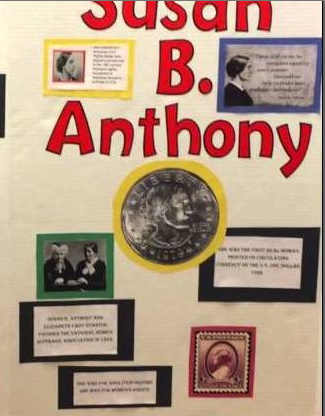
Student biography presentation on Susan B. Anthony
- Student biography presentation on Susan B. Anthony
Review & Presidents Song
- Review: What was the Oregon Trail? (The trail many pioneers took to travel out West.) What was the Battle of the Alamo? (A battle fought between the Mexicans & Texans for Texas independence that inspired Texans to fight harder for their independence.) In 1848 what was discovered in California? (gold) What did Eli Whitney invent? (cotton gin & interchangeable parts) What did the Erie Canal connect? (the Great Lakes to the Atlantic Ocean) What’s something you remember about Harriet Tubman? (former slave, helped many other slaves escape, etc.) What do we call the route slaves would take while escaping? (Underground Railroad) What star would they follow? (North Star/Polaris)
- Now let’s go through all the Presidents. Sing through the entire song 2 times while either showing the video or flipping through pictures of the Presidents. (Be sure to add in “Donald Trump” at the end.)
You will need:
- Screen to show the below video or a book showing Presidents or point to their pictures on a President place mat
U.S. Presidents Song
The County Election – Who’s Missing?
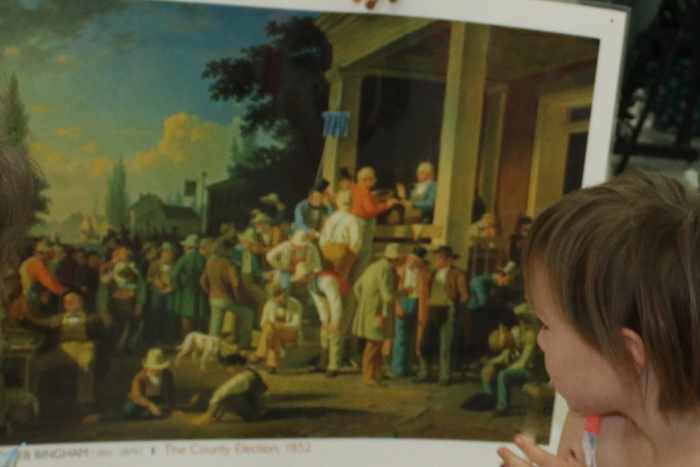
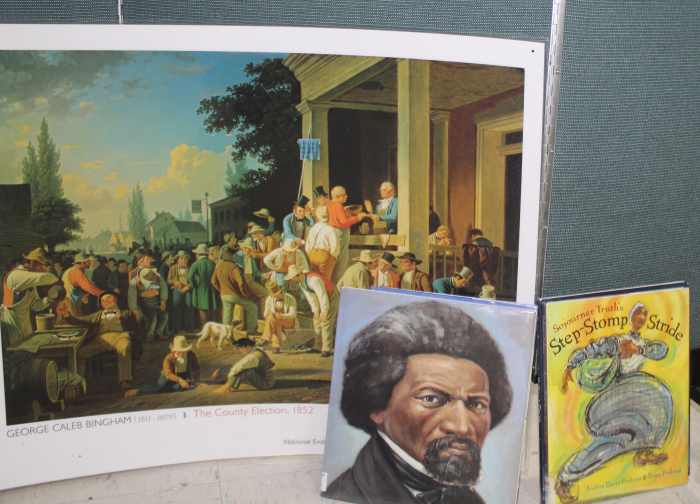
Studying The County Election, 1852 by George Caleb Bingham
- Study The County Election, 1852 by George Caleb Bingham. Ask children questions such as the ones below, some of which come from Picturing America by the National Endowment for the Humanities
- Find a white dog, a man pouring drinks, a man with a bandaged head, and a horse and rider.
- Find a seated man with a top hat who appears to be sketching or writing. (That’s actually the artist.)
- What do you think is happening in this painting? Look for clues. [They’re voting.]
- Who has gone with your parents when they voted? How does look different? [It looks noisy and disorganized. They didn’t track who had voted. It wasn’t a secret ballot.]
- Can you see a man who looks poor who is voting? Can you see a man who looks rich who is voting?
- What groups of people are not in line to vote? [Women & people with dark skin were not there because in 1852 they did not have the right to vote.]
You will need:
- a copy of The County Election, 1852 by George Caleb Bingham
Boys Vote on Books
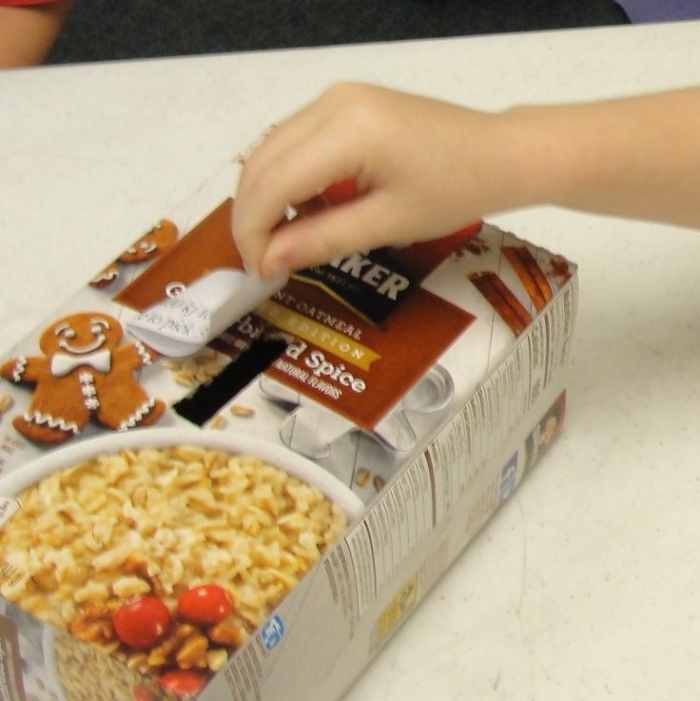
Only boys get to vote
- Women have only be allowed to vote for the past 100 years in this county. It wasn’t until 1920 that all women in America were allowed to vote. During the time period we’re studying, women were not allowed to vote, so today the boys will get to decide what we’re going to do. They will vote on each book we read.
- Introduce the terms abolitionists (people who wanted to end slavery) and women suffragists (people who wanted women to be able to vote). [These are big words. Repeat these words numerous times and repeatedly ask what they mean.]
- First we need to decide which book to read. Show 2 books on Frederick Douglass such as Frederick’s Journey by Doreen Rappaport and Words Set Me Free by Lesa Cline-Ransome.
- Either have the boys select a book simply by pointing to their choice or by having them fill out secret ballots and then placing the votes in a box.
- Read or summarize the book they voted for us to read.
- Go through the same process for letting the boys vote on which book to read about Sojourner Truth: My Name Is Truth: The Life of Sojourner Truth by Ann Turner or Sojourner Truth’s Step-Stomp Stride by Andrea Davis Pinkney.
You will need:
- Two books on Frederick Douglass such as Frederick’s Journey by Doreen Rappaport and Words Set Me Free by Lesa Cline-Ransome.
- Two books on Sojourner Truth such as My Name Is Truth by Ann Turner and Sojourner Truth’s Step-Stomp Stride by Andrea Davis Pinkney
- For each boy student, a small paper ballot that has small pictures of the two books [optional]
- a ballot box (any box with a slit cut on one side) [optional]
- Sojourner Truth had been a slave. After she was free, she fought for other slaves to also be free. She was an abolitionist, who tried to abolish slavery. Abolish means “to end or get rid of.”
- Who did we learn about last week who was also an abolitionist? (Harriet Tubman) Had she been a slave? (Yes)
- There were a number of abolitionists who had been slaves who had either escaped or been freed by their owners. Another famous one was Fredrick Douglass. [Show his picture.]
- [Show a picture of an Underground Railroad Station.] Some abolitionists had white skin. Many of them belonged to a religion called Quakers (just like the name of an oatmeal brand). Many of the abolitionists never became famous. They were just normal people like you & me & your moms & dads who helped slaves while they were escaping in the Underground Railroad. They might have given them food or let them sleep in their barns or in hidden bedrooms during the day. Why would it be during the day? (Many escaping slaves traveled at night.)
- [Show a picture of Harriet Beecher Stowe.] Some abolitionists wrote newspaper articles or even books to let others know about how horrible slavery was. Harriet Beecher Stowe wrote a book called Uncle Tom’s Cabin. Some of the story is about a slave named Uncle Tom who has a nice master & then a really mean master. Many Americans who hadn’t thought about slavery before read this book and realized that slavery is wrong.
You will need:
- pictures of Fredrick Douglass, and Underground Railroad Station, & Harriet Beecher Stowe
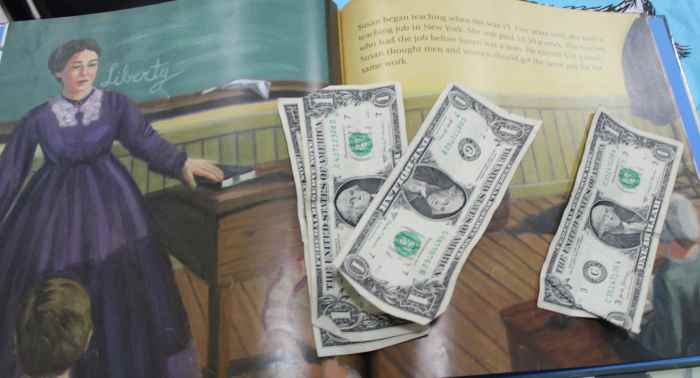
Women like Susan B. Anthony got paid 1/4 of what men got paid for doing the same job.
Women’s suffragists (the right to vote)
- As the children are coloring, ask them if they like that the boys have been the only ones to decide on what we’re doing today. What are their thoughts on that?
- During this time while some people were abolitionists, trying to free slaves & get rid of slavery, some of the women were realizing that they also were not free because they couldn’t vote.
- They were called women’s suffragists. Suffrage means “the right to vote.”
- Many people including Frederick Douglass and Sojourner Truth both abolitionists & women’s suffragists.
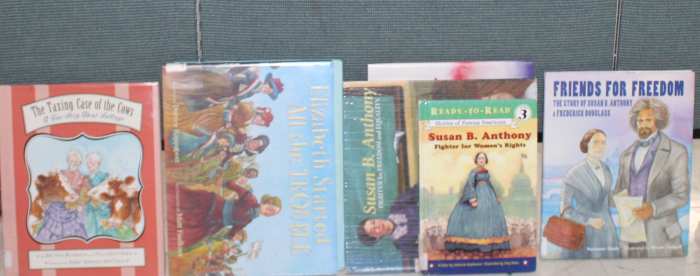
- What difference did it make if women could vote or not? Read or summarize The Taxing Case of the Cows by Iris Van Rynbach.
- Summarize the stories of Elizabeth Cady Stanton, Susan B. Anthony, and Esther Morris by flipping through books on their lives.
- If desired, pass out ten $1 bills to a boy and then pass out $2.50 to a girl because Susan B. Anthony took over a position as a school teacher. The man who had the position before her was paid $10 per week, but she was only paid $2.50 per week because she was a girl even though she was doing the same job. She didn’t think this was fair. [Collect the money back after doing this.]
You will need:
- The Taxing Case of the Cows by Iris Van Rynbach
- books on Elizabeth Cady Stanton, Susan B. Anthony, and Esther Morris such as Elizabeth Leads the Way by Tanya Lee Stone, Susan B. Anthony by Suzanne Slade, Heart on Fire: Susan B. Anthony Votes for President by Ann Malaspina, Friends for Freedom by Suzanne Slade, and I Could Do That: Esther Morris Gets the Vote by Linda Arms White
- Optional: ten $1 bills and $2.50 in real or play money
Money & Review
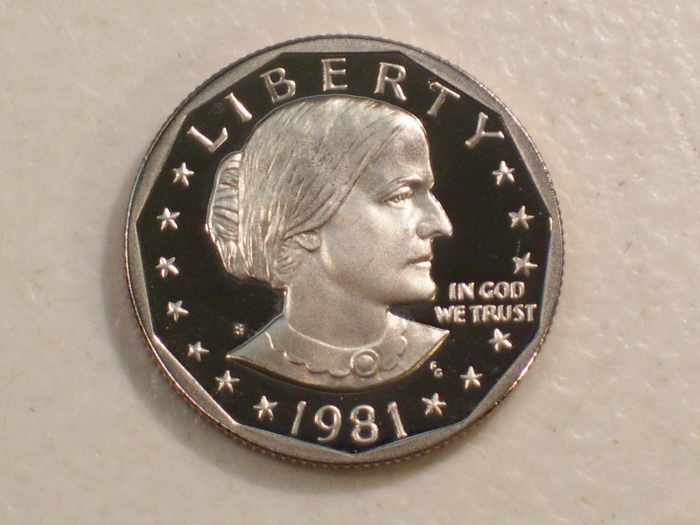
Susan B. Anthony Dollar
- Women have been allowed to vote in America for only the past 100 years! This was made possible through the work of many women’s suffragists including Susan B. Anthony, who died before the U.S. government made it legal for women to vote in all states.
- Because of all her hard work, Susan B. Anthony’s face was put on a dollar coin. [Pass around the dollar coin.]
- Many women and some men fought for the right for women to vote, so when you turn 18, make sure to vote every chance you get.
You will need:
- Susan B. Anthony dollar coin
- What was an abolitionist? (Someone who wanted to abolish or end slavery.) Name a famous abolitionist. (Sojourner Truth, Fredrick Douglass, Harriet Beecher Stowe, Harriet Tubman, & others) Many abolitionists were of what religion? (Quaker) What was a woman’s suffragist? (Someone who thought women should have the right to vote.) Name a famous women’s suffragist. (Susan B. Anthony, Elizabeth Cady Stanton, Sojourner Truth, & others)
- Assign next week’s student biography report on Abraham Lincoln.
A Book to Read Each Day
Plus 1 audio CD
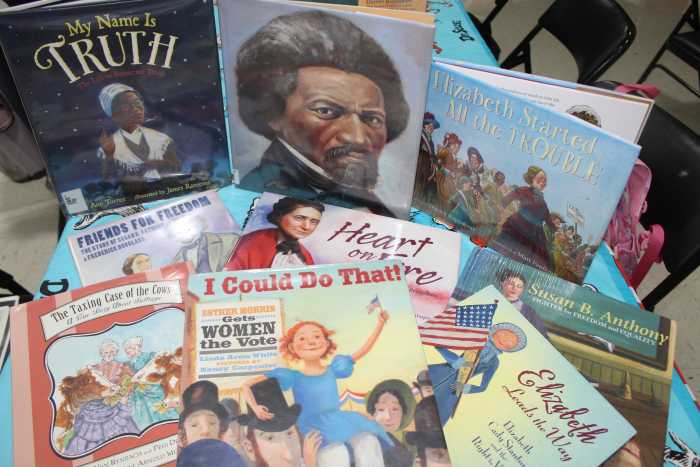
Our favorite books on abolitionists and women suffragists
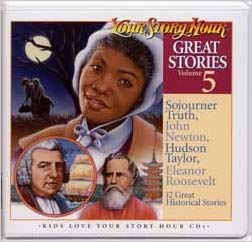
Great Stories Volume 5 CD Album (Great Stories, Volume 5) – Sojourner Truth
We read many books on abolitionists & women’s suffragists. In addition to the two used in this lesson, these were our 7 favorites:
- Elizabeth Leads the Way: Elizabeth Cady Stanton and the Right to Vote by Tanya Lee Stone
- Frederick’s Journey: The Life of Frederick Douglass by Doreen Rappaport
- Only Passing Through: The Story of Sojourner Truth by Anne Rockwell
- I Could Do That! Esther Morris Gets Women the Vote by Linda Arms White
- Heart on Fire: Susan B. Anthony Votes for President by Ann Malaspina
- The Taxing Case of the Cows by Iris Van Rynbach
- Susan B. Anthony: Fighter for Women’s Rights (Ready-to-read SOFA) by Deborah Hopkinson
- Great Stories Volume 5 CD Album (Great Stories, Volume 5) – Sojourner Truth
Schoolhouse Rock – Women’s Suffrage Movement
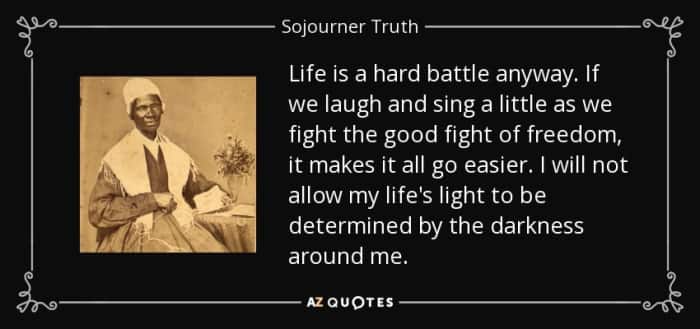
Image credit: https://www.azquotes .com/quote/1166842
Looking for all of my American History Lessons?
(Links to my middle school level
American History lessons can be found at https://hubpages.com/education/ColonialismWeeks3-8 .)
AMERICAN HISTORY FOR EARLY ELEMENTARY:
Native Americans & Columbus Lesson
Jamestown Lesson
Pilgrims Lesson
Thirteen Colonies Lesson
French and Indian War Lesson
Colonial Period & Revolution Rumblings Lesson
Boston Massacre & Boston Tea Party Lesson
First Shots & Declaration of Independence Lesson
American War for Independence Battles Lesson
Valley Forge & Battle of Yorktown Lesson
American Literature Lesson & American War for Independence Review
Colonial Christmas Party
Constitution Lesson
Three Branches of Government Lesson
President George Washington Lesson
Louisiana Purchase Lesson
War of 1812 Lesson
Monroe Doctrine Lesson
Trail of Tears Lesson
Oregon Trail & Battle of Alamo Lesson
California Gold Rush & Pony Express Lesson
American Industrial Revolution Lesson
Underground Railroad Lesson
Abolitionists & Women Suffragists Lesson
Civil War: The Confederate States & Abraham Lincoln Lesson
Civil War Battles Lesson
Civil War Party & End of Year Review Game
BONUS LESSONS (if you have room for a few extra classes):
Reconstruction Lesson
Wild West Lesson
Immigrants Lesson
Tycoons & Theodore Roosevelt Lesson
World War I Lesson
Roaring Twenties Lesson
Great Depression and the 1930s Lesson
World War II Lesson
ALL MY LESSONS:
Fun, Free Hands-on Unit Studies (My Lessons in All Subjects)
© 2018 Shannon
Comments
Shannon (author) from Florida on August 13, 2018:
That is wonderful! I am very grateful for those who fought for women suffrage.
Liz Westwood from UK on August 12, 2018:
This is especially interesting as we have been marking the role of the suffragettes this year in the UK.
Leave a Reply