
War of 1812 Lesson for Kids
This is the 17th lesson in a series of 28 hands-on lessons covering U.S. American History through 1865. This lesson focuses on the War of 1812 & the Star-Spangled Banner. I used this plan while teaching a 45 minute history class for children in Kindergarten, 1st, & 2nd grades. Each lesson includes a biography report, history notebook page, history song, our favorite children’s books, YouTube video, a history joke, & a variety of hands-on activities to make each lesson engaging & memorable. Use these fun lessons with your classroom, homeschool, after-school program, or co-op!
Joke: How do you play War of 1812?
You burn down a white house.
Student Biography Presentation: Dolley Madison
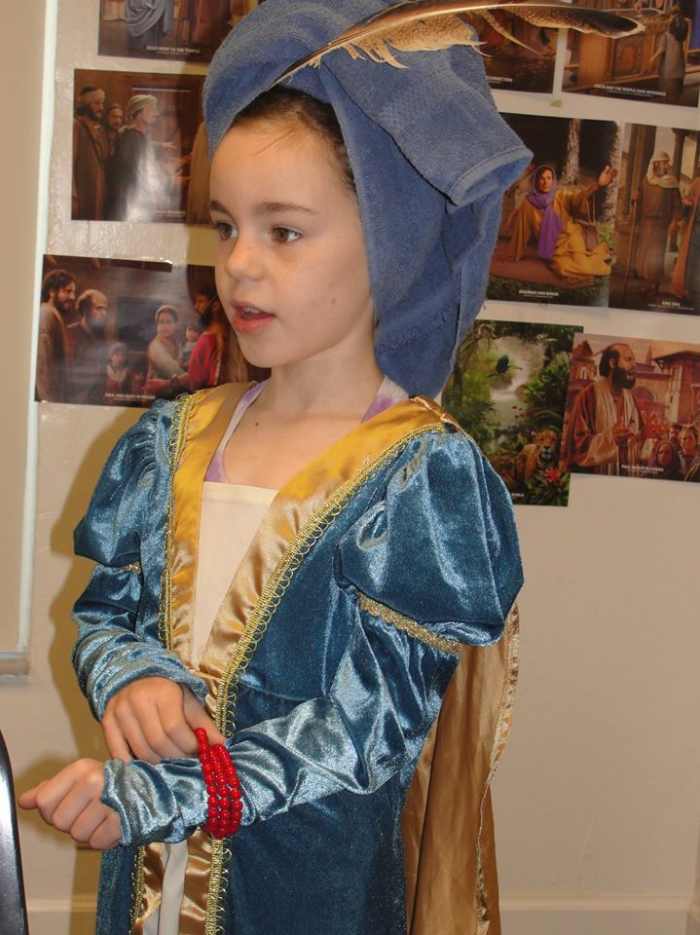
Student biography presentation on Dolley Madison
- Student biography presentation on Dolley Madison
Review & Presidents Song
- Review: What does the Constitution tell us? (rules for how America’s government will run) How many branches are there in our government? (3) Can you name 1? (legislative, executive, judicial) Who can tell me something about our first president, George Washington? Who was the President at the time who purchased the Louisiana Territory? (Thomas Jefferson) What year did they buy it? (1803) Who was the Native American woman guide and translator who went with them? (Sacajawea)
- Now let’s go through all the Presidents. Sing through the entire song 2 times while either showing the video or flipping through pictures of the Presidents.
You will need:
- Screen to show the below video or a book showing Presidents or point to their pictures on a President place mat
(*Note: My children and I memorized the Presidents using the below song. If you’d like a song that has a better video, use this one: https://www.youtube.com/watch?v=xkE47TY8D10 .)
Presidents Song
Causes of the War of 1812 Demonstration
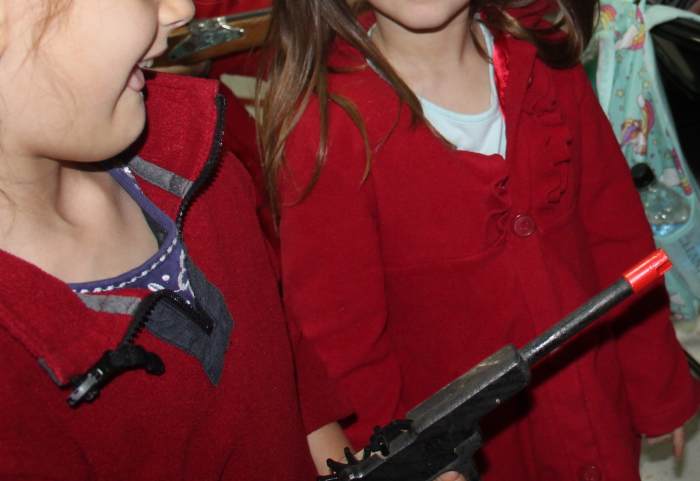
British soldiers impressing American sailors and giving Native Americans weapons
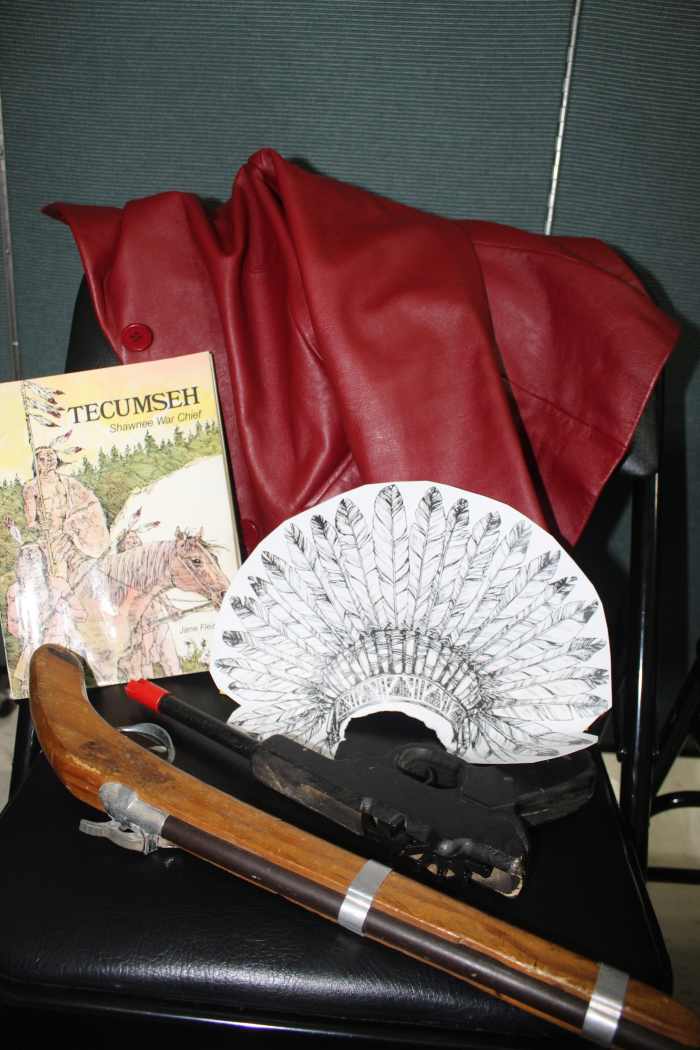
British giving weapons to Native Americans including Tecumseh and the Shawnee

British soldiers giving weapons to the Native Americans
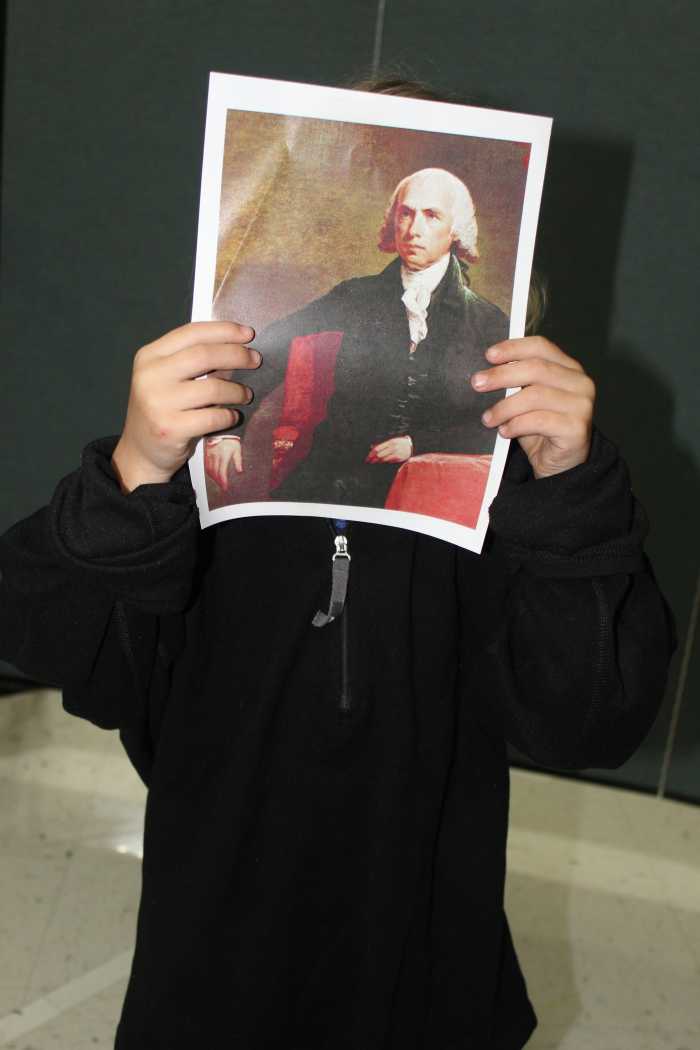
President Madison declaring war on England
- Quickly review some of the main causes of the War of 1812.
- Cause 1: England was stealing American sailors from their ships, stealing their cargo, & forcing the sailors to either die or join the British Navy (impressment).
- Cause 1 Demo: Ask for 3 volunteers. Hand 2 red coats or tops to 2 of the children. They are the British soldiers. Have the 3rd volunteer pretend to be sailing his boat. The British soldiers stop him & tell him to give them the boat & join their navy…or die. He agrees. Give him a red coat or top.
- Cause 2: Also, the British were giving weapons to some of the Native Americans in American & encouraging them to attack Americans.
- Cause 2 Demo: Ask for 1 more volunteer & add a headband. He’s a Native American. Hand the 3 British soldiers some toy guns & swords. They are the British soldiers. They should give the weapons to the Native American & say, “Use these to attack the Americans.” He can pretend to sneak up on one of the children in the class & gently hit him with a toy sword (though you can skip that if desired).
- Pick another volunteer to be President Madison. Hand him a black jacket (optional – Madison always wore black) and a picture of Madison to hold in front of his face. President Madison should say, “Enough, England! We declare war on you!”
- Emphasize: America declared war on England.
You will need:
- 3 red jackets or tops
- toy weapons (guns & swords) or sticks to pretend to be weapons
- headband or other generic Native American prop item
- black jacket (optional) and picture of President Madison
Overview of the War of 1812
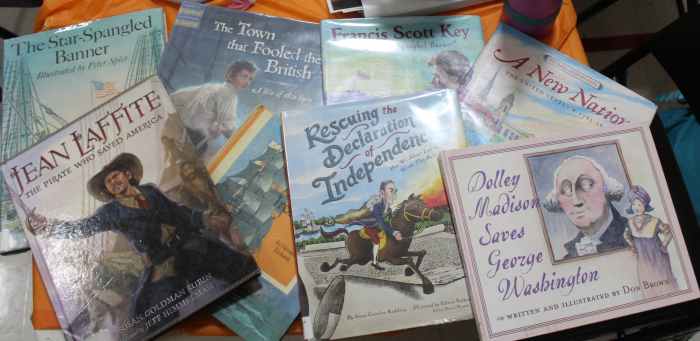
Some of the books I summarized while describing the main events of the War of 1812
- Flip through the pictures in A New Nation: The United States: 1783-1815 by Betsy Maestro as you summarize the main events of the War of 1812. I also held up a few other books and quickly summarized each of the stories. A few things I noted:
- King George III was still the King of England, but he was in poor health. His son, Prince George (eventually King George IV) – helped rule at that point.
- England was busy fighting France/Napoleon (point to both on a map) and needed more soldiers, which is why they kept kidnapping American sailors and forcing them to join the British navy.
- America declared war on England. They did this by attacking Canada (point out on a map), which was still ruled as a British Colony just like America had been about 35 years before.
- America’s fighting in Canada went badly. They lost lost of people and battles.
- The battles on the Great Lakes went a bit better for America. Oliver Hazard Perry became famous after winning against the British on Lake Erie.
- Eventually England defeated Napoleon and the French and could spend more time and money fighting in America. They set up a naval blockade along the Atlantic Coast.
- One town outsmarted them by taking advantage of a foggy night. They hung lanterns in the trees. The British blasted their cannons at the lights and then sailed away. They thought they’d destroyed the town but had only hit the trees.
- They burned down Washington, DC. A secretary saved the Declaration of Independence and Dolley Madison saved the portrait of George Washington. Before they burned the President’s House, the soldiers at the dinner for 40 that Dolley had set out. [You can burn down the White House.]
- Next they headed for Fort McHenry. [Summarize the story of Francis Scott Key. Look at a picture of the Star Spangled Banner flag. Sing the Star Spangled Banner.]
- Eventually both sides agreed to stop fighting. They met in Europe to discuss a peace treaty. They didn’t have phones, texting, emails, etc. A real person had to sail back from Europe and then travel from place to place with the news.
- Andrew Jackson (who would eventually be a President) hadn’t heard the war was over yet. He employed pirates to help him beat the British. (Quickly summarize who Jean Lafitte was.) The beat the British in the Battle of New Orleans…two months after the War of 1812 had ended.
- No one won the War of 1812. Everything basically went back to the way it had been before…except about 25,000 people (15,000 Americans) had died in battle or as a result of it.
- America did prove it could survive and could be a world leader. Andrew Jackson became a war hero which helped him later become a President. Canada became a little bit more united.
You will need:
- A New Nation: The United States: 1783-1815 by Betsy Maestro or other book on the War of 1812
- Optional other books to share about other events during the War of 1812 (links are at the bottom of this lesson in the book section)
Burning down the White House
![Using "torches" [matches] to burn down the "White House"](/wp-content/uploads/archived/997f9debf65da09adcbcd2ed854af442.jpg)
Using “torches” [matches] to burn down the “White House”
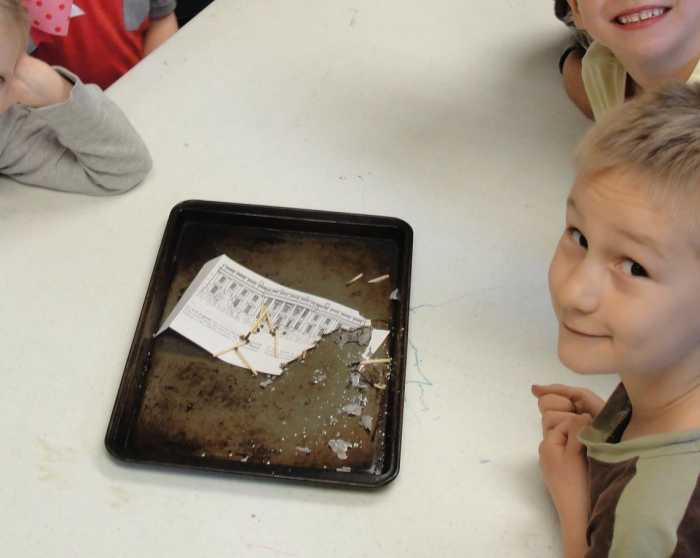
Burning down the White House
- During the War of 1812, the British soldiers set Washington, D.C. on fire & burned down the White House (along with the Capitol and a few other buildings).
- Each of the children will get to be a British soldier. They used torches. We’ll use mini-torches (matches). Hand each child a match.
- One a a time, allow them to light their match using a lit candle. Then have them drop it onto a picture of the White House that is on a baking sheet. (This won’t burst into flames. It just slowly burns black holes or edges.)
- *Be sure to have ventilation so that the fire alarm doesn’t go off. Also notify your principal or other adults so that they don’t get concerned when they smell fire.
You will need:
- a picture of the White House (printed from online)
- matches
- a candle
- a baking sheet (or other item that won’t burn)
Star-Spangled Banner
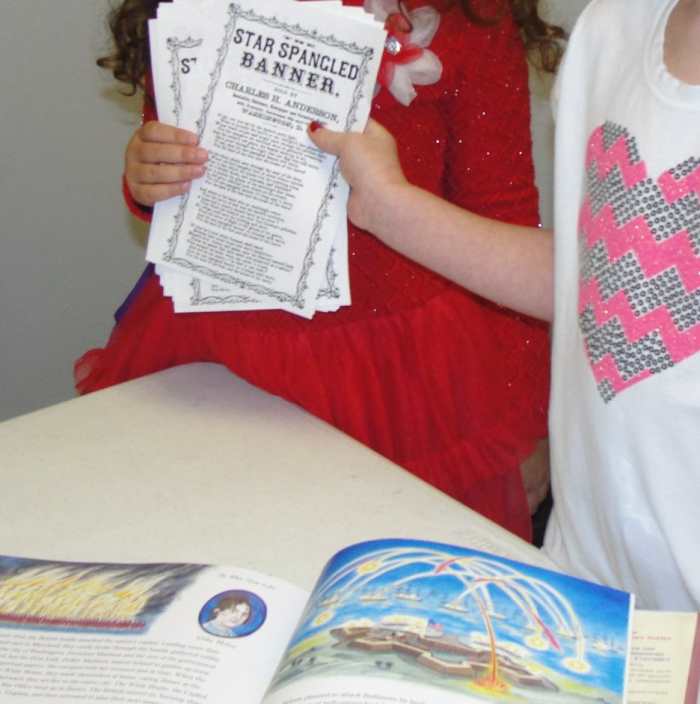
Singing the Star-Spangled Banner
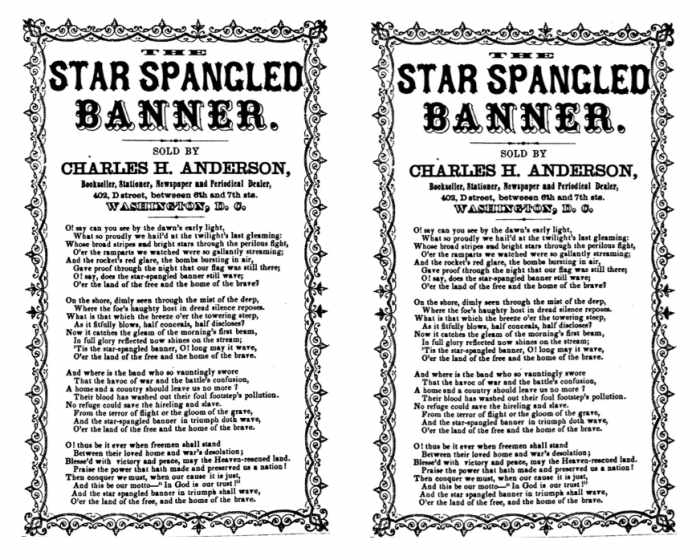
Star-Spangled Banner words
- While a lawyer named Francis Scott Key was aboard a British ship off the coast of Ft. McHenry, he wasn’t sure if the American fort would survive the bombings from the British ships. He was so excited when the next morning when the sun rose. At the fort he didn’t see a white flag of surrender. He saw the American flag was still waving. That meant the American army hadn’t surrendered. He wrote a poem that is now our national anthem or song called Star-Spangled Banner.
- Let’s sing the first verse. (I flipped through the pages of the book The Star Spangled Banner by Peter Spier as we sang.)
- They can add the page to their history binders.
You will need:
- words to the Star-Spangled Banner punched with a 3 hole punch – per child
- The Star Spangled Banner by Peter Spier (optional)
Coloring the Flags & Review

Coloring the flags & Francis Scott Key
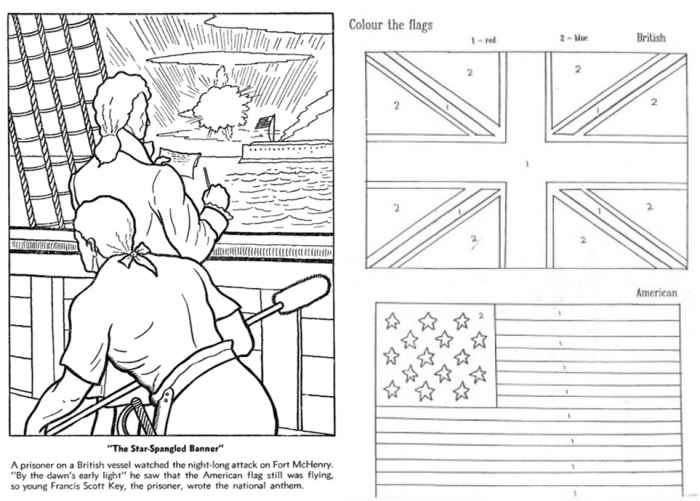
Star-Spangled Banner Coloring Sheet
- Allow children to color pictures of the 2 flags of the War of 1812 (the British flag & the Star-Spangled American Flag) and Francis Scott Key. Have children put these in their history notebooks.
You will need per child:
- a coloring page with the flags of the War of 1812 & Francis Scott Key
- student supplies: crayons
- Review: What war did we learn about today? (War of 1812). Which 2 countries fought during the War of 1812? (England & America) Who was the President during this time? (James Madison) Why did American declare war on England? (impressment of sailors, British giving weapons to Native Americans) What happened to the White House during the war? (The British burned it down.) What famous song was written during this war? (Star-Spangled Banner) Who wrote it? (Francis Scott Key)
- Assign next week’s biography report on James Monroe.
A Book to Read Each Day
Plus 1 Audiobook CD
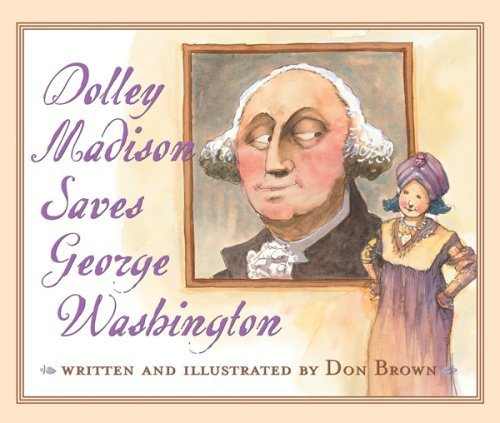
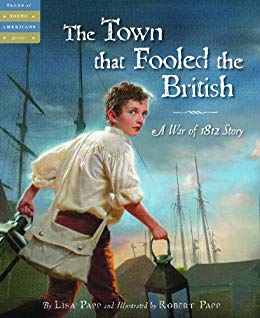


Dolley Madison Saves George Washington by Don Brown – Book images are from amazon .com.
1 / 8
We read through a large stack of books. In addition to the book used in this lesson, these were our top 7 favorites:
- Dolley Madison Saves George Washington by Don Brown
- The Town that Fooled the British: A War of 1812 Story (Tales of Young Americans) by Lisa Papp
- James Madison: Fourth President 1809-1817 (Getting to Know the US Presidents) by Mike Venezia
- Jean Laffite: The Pirate Who Saved America by Susan Goldman Rubin
- Francis Scott Key’s Star-Spangled Banner (Step into Reading) by Monica Kulling
- Women Who Broke the Rules: Dolley Madison by Kathleen Krull
- Long May She Wave: The True Story of Caroline Pickersgill and Her Star-Spangled Creation by Kristen Fulton
- Rush Revere and the Star-Spangled Banner Audio CD by Rush Limbaugh (Audiobook CD)
James Madison: 60-Second Presidents: PBS
Looking for all of my American History Lessons?
(Links to my middle school level
American History lessons can be found at https://hubpages.com/education/ColonialismWeeks3-8 .)
AMERICAN HISTORY FOR EARLY ELEMENTARY:
Native Americans & Columbus Lesson
Jamestown Lesson
Pilgrims Lesson
Thirteen Colonies Lesson
French and Indian War Lesson
Colonial Period & Revolution Rumblings Lesson
Boston Massacre & Boston Tea Party Lesson
First Shots & Declaration of Independence Lesson
American War for Independence Battles Lesson
Valley Forge & Battle of Yorktown Lesson
American Literature Lesson & American War for Independence Review
Colonial Christmas Party
Constitution Lesson
Three Branches of Government Lesson
President George Washington Lesson
Louisiana Purchase Lesson
War of 1812 Lesson
Monroe Doctrine Lesson
Trail of Tears Lesson
Oregon Trail & Battle of Alamo Lesson
California Gold Rush & Pony Express Lesson
American Industrial Revolution Lesson
Underground Railroad Lesson
Abolitionists & Women Suffragists Lesson
Civil War: The Confederate States & Abraham Lincoln Lesson
Civil War Battles Lesson
Civil War Party & End of Year Review Game
BONUS LESSONS (if you have room for a few extra classes):
Reconstruction Lesson
Wild West Lesson
Immigrants Lesson
Tycoons & Theodore Roosevelt Lesson
World War I Lesson
Roaring Twenties Lesson
Great Depression and the 1930s Lesson
World War II Lesson
ALL MY LESSONS:
Fun, Free Hands-on Unit Studies (My Lessons in All Subjects)
© 2018 Shannon
Comments
Shannon (author) from Florida on August 04, 2018:
Yes, that is definitely true.
Liz Westwood from UK on August 04, 2018:
Yes, over the years much has been made of the ‘special relationship’ our two countries share.
Shannon (author) from Florida on August 03, 2018:
It’s interesting looking at the past and seeing how times have changed. It’s a blessing that the UK & America do get along so well together now.
Liz Westwood from UK on August 03, 2018:
As a Brit I find this lesson embarrassing reading. Thankfully our two nations get on better now.
Leave a Reply