
Hands-on American History Lesson on Tycoons, the Gilded Age, and Theodore Roosevelt
This is the 31st lesson in a series of 35 hands-on lessons covering U.S. American History. This lesson focuses on Tycoons and Theodore Roosevelt. I used this plan while teaching a 45 minute history class for children in Kindergarten, 1st, & 2nd grades. Each lesson includes a biography report, history notebook page, history song, our favorite children’s books, YouTube video, a history joke, & a variety of hands-on activities to make each lesson engaging & memorable. Use these fun lessons with your classroom, homeschool, after-school program, or co-op!
Student Biography Presentation: Teddy Roosevelt
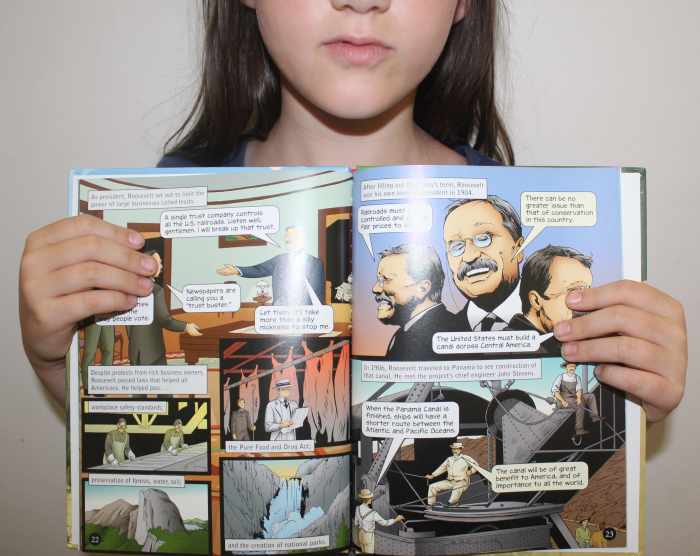
Student Biography Presentation on Teddy Roosevelt
- Student biography presentation on Teddy Roosevelt
Review & Presidents Song
- Review questions: Reconstruction is the time period when Americans had to build back the nation after which war? ([American] Civil War) Which ex-slave tried to convince poor Southern farmers to stop growing cotton and to start growing peanuts and sweet potatoes? (George Washington Carver) Which institute did Booker T. Washington start? It was started as college for ex-slaves and children of ex-slaves and had George Washington Carver as one of the professors. (Tuskegee Institute) In the “Wild West”, what were cowboys moving North to get to cities or train stations? (Cattle) Who started a famous Wild West Show to introduce the Wild West to the rest of America and the world? (Buffalo Bill Cody) Who was the famous young lady who starred in his show by her accurate shooting? (Annie Oakley) What do we call people who move from one country to live in a different country? (Immigrants) After 1886, what statue greeted immigrants when they arrived in New York (Statue of Liberty) What is the name of the island in New York at which many immigrants arrived? (Ellis Island)
- Sing through the entire President’s Song 2 times while either showing the video or flipping through pictures of the Presidents. (We add in “Trump, Biden, Trump” at the end of the song.)
You will need:
- Screen to show the below video or a book showing Presidents or point to their pictures on a President place mat
Portrait of a Boy, 1890
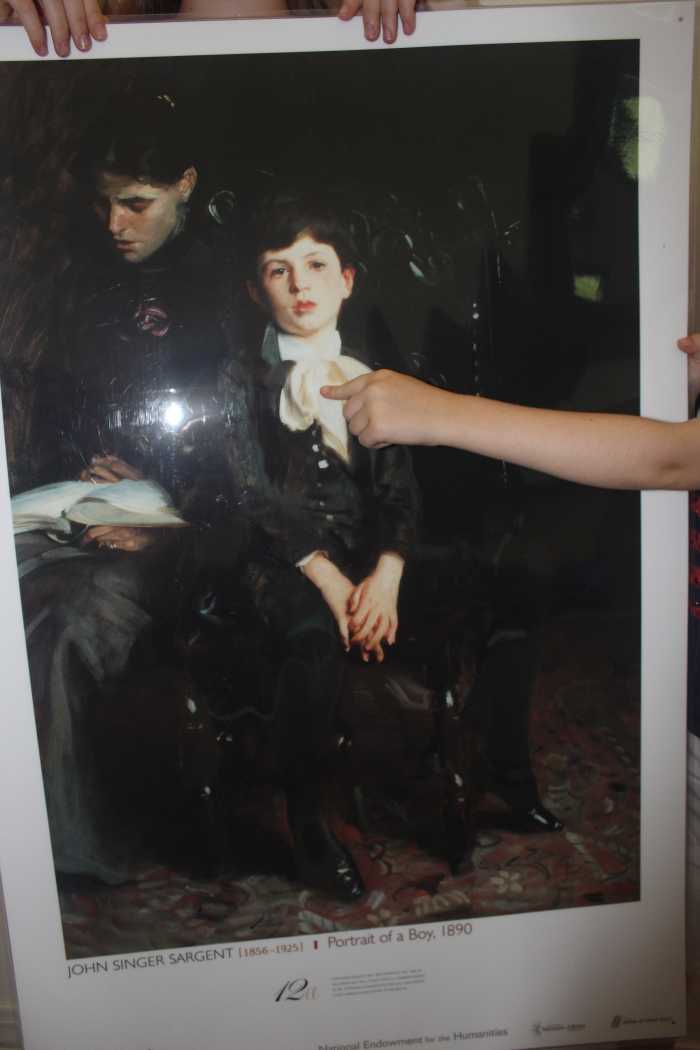
Portrait of a Boy, 1890 by John Singer Sargent
- Show John Singer Sargent’s painting Portrait of a Boy, 1890. Ask questions such as the ones below based on the Picturing America lesson:
- What do you first notice in the painting?
- Posing for a portrait painted in oils can be a long process. Try to pose like the boy in the portrait (slumped, sideways, foot dangling, etc.) How does it make you feel? (Maybe wanting to squirm around)
- How is the boy dressed?
- Who do you think is sitting behind the boy? (His mother – Interestingly, the woman is Augusta, the wife of Augustus Saint-Gaudens and the the boy is Homer Saint-Gaudens, the son of Augustus Saint-Gaudens, who is the sculptor who created the Robert Shaw Memorial we looked at while studying the Civil War.)
- What’s Homer’s mother doing? (Reading to him – She’s actually trying to keep him interested in a book about a naval battle during the War of 1812! Who can tell me something about the War of 1812?)
- Does he seem interested in the story? (No) How can you tell? (Homer’s sitting awkwardly in the chair; bored expression on his face; back at an angle to his mother; fingers spread)
- What else do you see in the room? (large chair, carpet with swirling pattern, etc.)
- Mention: This painting was done in a time called “the Gilded Age” when some Americans were getting very rich because they built great businesses but usually didn’t pay their workers very much money.
You will need:
- a copy of John Singer Sargent’s painting Portrait of a Boy, 1890
Gilded Age
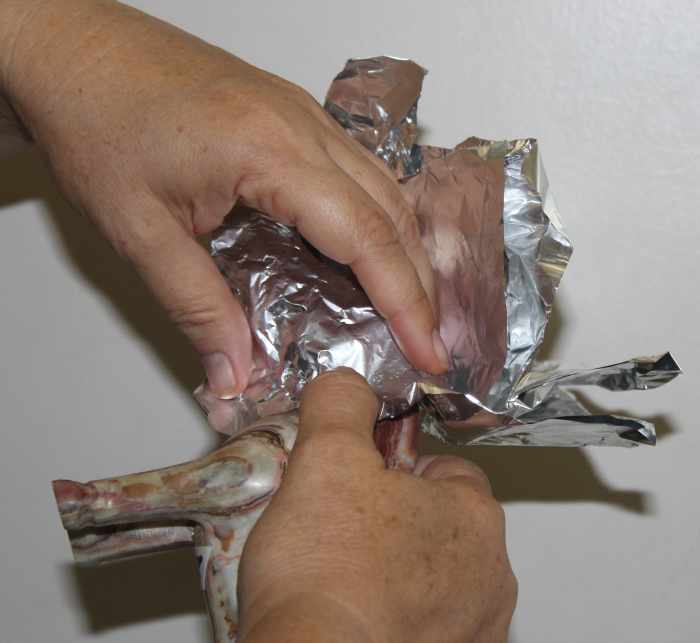
“Gilding” a figurine with aluminum foil
- While many places in the South were in a period of “Reconstruction” or building back after the Civil War, some places in the North were living in “the Gilded Age.”
- To gild something is to cover it in gold that’s been hammered out so think it’s like aluminum foil or gold powder was mixed in with other materials kind of like what you get when you get a “gold” trophy.
- Use aluminum foil to cover over a figurine to show what it’s like to gild something.
- Some people tried to make themselves look really rich by making lots of the things in their homes look like they’re solid gold, but they were only gold covered.
You will need:
- a small piece of aluminum foil and a small item such as a figurine
Tycoons
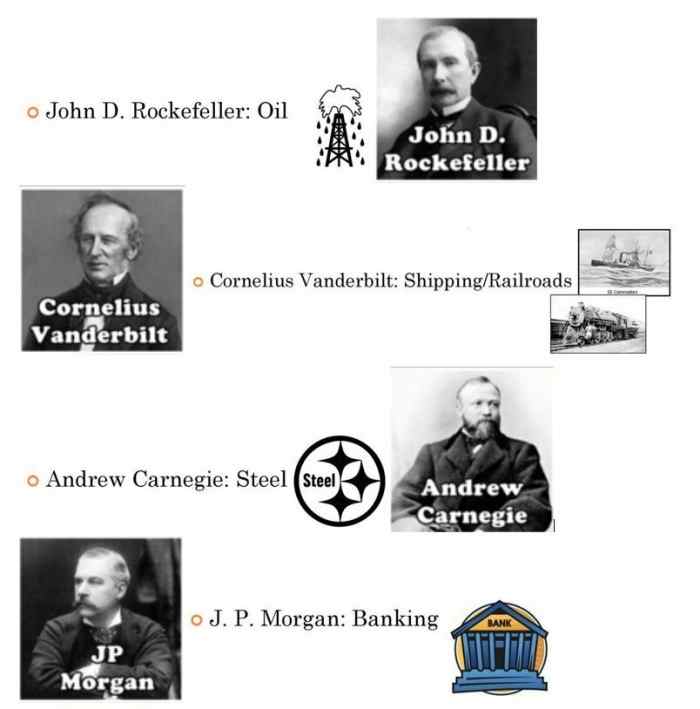
Notebook Paper on Tycoons (front page) – The back page is below and has a picture of Theodore Roosevelt.
The Peacock Room – An Example from the Gilded Age
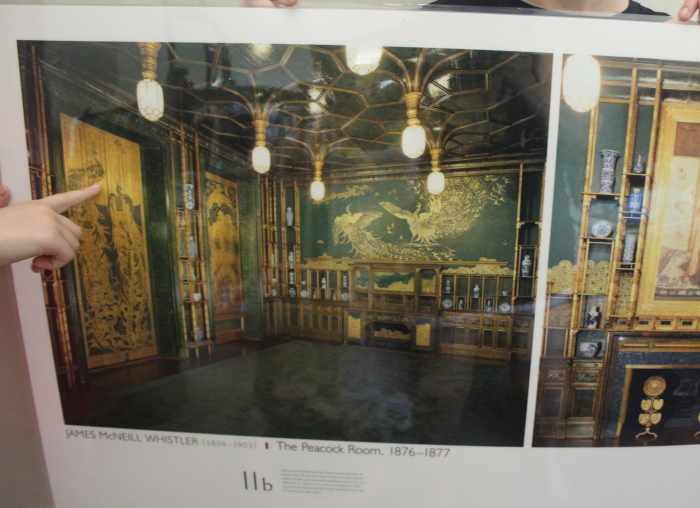
The Peacock Room, 1876-1877 by James McNeill Whistler
- Show The Peacock Room, 1876-1877 by James McNeill Whistler.
- Name or point to what you see that you think might be gilded.
- How would you feel if you stepped into a room that looked like this?
- How would you feel if you were really rich and walked into The Peacock Room? What might you do in this room?
- How would you feel if you were really poor and walked into The Peacock Room? What might you do in this room?
You will need:
- a copy of The Peacock Room, 1876-1877 by James McNeill Whistler.
- During “the Gilded Age” some of the Americans that because very rich because from their great businesses were called Tycoons.
- Pass out the above notebook page for their notebooks. If desired, have children color on the page.
- Some of the rich Tycoons included Andrew Carnegie (who we learned about last week), John D. Rockefeller, Cornelius Vanderbilt, and J.P. Morgan.
- [Show a toy train.] Cornelius Vanderbilt helped goods move across American using the steamboats and railroads that he owned. [Draw railroad tracks next to the photo.]
- [Show play money.] J.P. Morgan controlled electricity with General Electric and controlled lots of banks. [Draw a $ sign.]
- [Show oil.] John D. Rockefeller controlled most of oil in America. The oil we’re talking about is the kind of oil used to help your cars and other machines move well. [Draw black oil.]
- [Show a nail.] Andrew Carnegie developed America’s steel industry, using it to build the frames/insides of really tall buildings called skyscrapers, railroad spikes, and many other industrial items. [Draw a railroad spike.]
- Both John D. Rockefeller and Andrew Carnegie gave lots of their money away to help people. They were philanthropists. (“Say that big word with me.”) Philanthropists are people who give lots of money to help other people. Like we learned about last week, Andrew Carnegie used lots of his money to build libraries. John D. Rockefeller used lots of his money to help fight diseases.
You will need:
- optional visuals: toy train (like Thomas the Train), toy money, oil (WD40 or car oil bottle), and a nail (or something else made from steel)
- crayons
- per student: above notebook page, punched with a 3-hole punch
John D. Rockefeller

John D. Rockefeller by Nicole Damon (Image is from amazon.com)
- Summarize while flipping through (or read) John D. Rockefeller by Nicole Damon.
You will need:
- John D. Rockefeller by Nicole Damon or other book on Rockefeller or one of the tycoons
Theodore Roosevelt
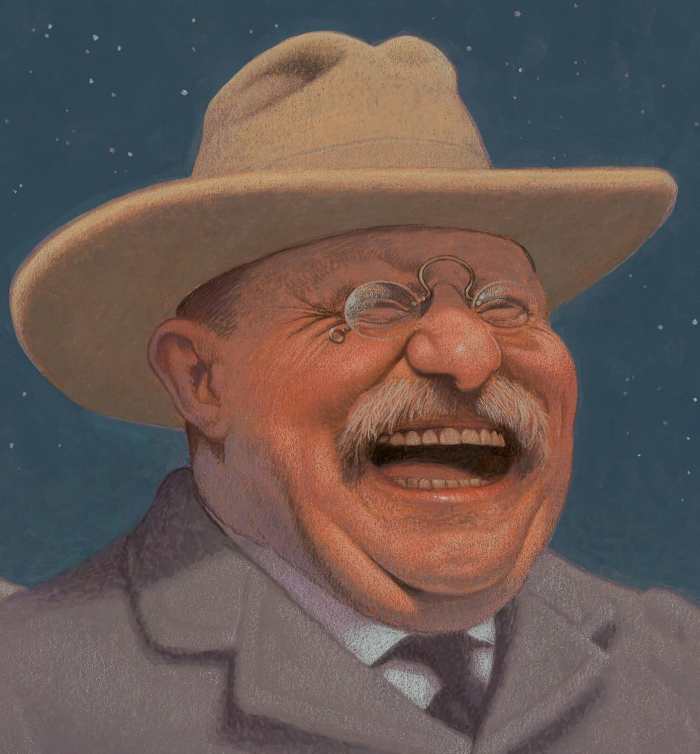
To Dare Mighty Things: The Life of Theodore Roosevelt by Doreen Rappaport (Image is from amazon.com.)
- Summarize while flipping through (or read) To Dare Mighty Things: The Life of Theodore Roosevelt by Doreen Rappaport in order to summarize Theodore Roosevelt’s life. Mention:
- When he was President, Roosevelt encouraged Congress to reform businesses under the Sherman Antitrust Act, which weakened the businesses of the tycoons.
- Theodore Roosevelt loved the outdoors and wanted to keep some parts of the United States wild so future generations of Americans including YOU can enjoy the same outdoors the way he did over 100 years ago.
You will need:
- To Dare Mighty Things: The Life of Theodore Roosevelt by Doreen Rappaport or other book on Theodore Roosevelt
Roosevelt and the Outdoors
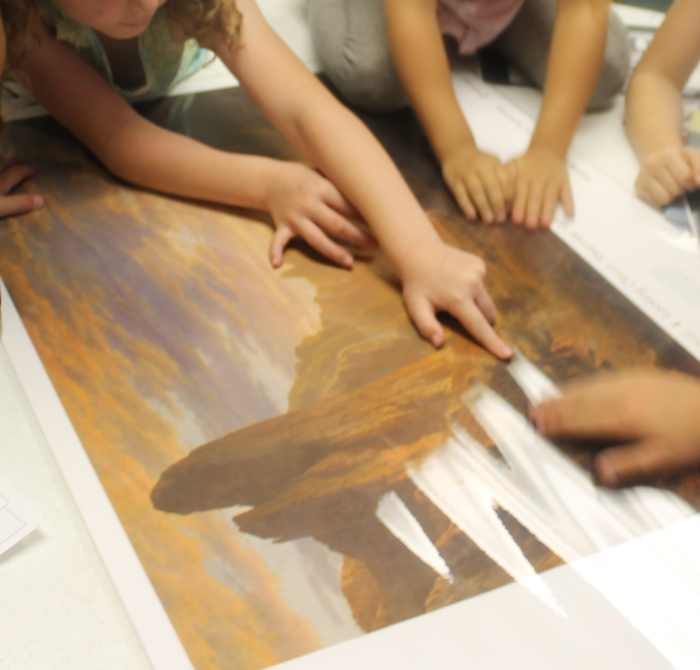
Looking Down Yosemite Valley, California, 1865 by Albert Bierstadt
Theodore Roosevelt Camps with John Muir

The Camping Trip that Changed America: Theodore Roosevelt, John Muir, and Our National Parks by Barb Rosenstock (Image is from amazon.com)
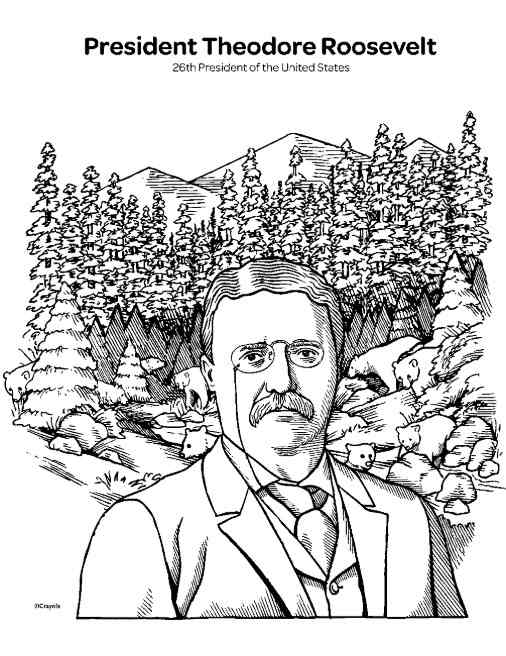
Notebook page (back)
- Show Looking Down Yosemite Valley, California, 1865 by Albert Bierstadt. Ask questions such as the ones below based on the Picturing America lesson:
- What do you notice first?
- Where do you see trees reflected in water? (in the center)
- Describe the texture of the rocks. (rough, weathered)
- If you standing in the middle of the scene, how large would you feel? How might you describe it?
Mention:
- This painting is 5 feet by 8 feet. (Show the approximate size on the wall.) He wanted you to really enjoy the view and let you see how majestic Yosemite is.
- Yosemite is in California. Find California on your map.
- Albert Bierstadt was an immigrant to America His family emigrated from Prussia to Massachusetts when Albert was one.
- When Bierstadt headed West to paint this, the Miwok lived here, but most Americans hadn’t been out West. Something happened in 1848 that brought lots of people to California. What was it? (Gold Rush)
- In 1864 the President of the United States made it Yosemite territory a California State Park. If the Civil War was fought from 1861 – 1865, who was the President who did this? (Abraham Lincoln)
You will need:
- a copy of Looking Down Yosemite Valley, California, 1865 by Albert Bierstadt
- a copy of a map of the United States
- Just like Albert Bierstadt, John Muir and the Sierra Club wanted to preserve this natural beauty of Yosemite Valley and many other gorgeous locations in the West, so Muir took President Theodore Roosevelt on a camping trip in Yosemite in 1903. Muir convinced President Roosevelt to protect Yosemite Valley by making it Yosemite National Park in 1906.
- Summarize while flipping through (or read) The Camping Trip that Changed America: Theodore Roosevelt, John Muir, and Our National Parks by Barb Rosenstock.
You will need:
- The Camping Trip that Changed America: Theodore Roosevelt, John Muir, and Our National Parks by Barb Rosenstock or other book on Roosevelt and Muir camping in Yosemite
- Point out the back page of the notebook page with Theodore Roosevelt and the wilderness he helped to protect. (The front has the tycoons on it.) If desired, allow the students to color some of the page.
You will need:
- the above notebook coloring page printed on the back of the Tycoons page
Review
- Review: During the Reconstruction time period in the South, what was the time period in the North during which some people became very rich by operating very successful businesses? (Gilded Age) What does it mean to gild something? (Cover it in gold or add gold powder to something to make it look like it’s made of gold) What is a term for the men who because very rich during this time? (Tycoons) Name one of the tycoons. (Andrew Carnegie, John D. Rockefeller, Cornelius Vanderbilt, J.P. Morgan, etc.) Name one resource/business that made lots of money for the tycoons. (railroads, oil, steel, banks) John D. Rockefeller and Andrew Carnegie were philanthropists; what is a philanthropist? (Someone who gives lots of their money away to help other people.) Which President encouraged Congress to reform businesses and weaken the businesses of tycoons under the Sherman Antitrust Act? (Theodore Roosevelt) What place in California did Albert Bierstadt, John Muir, the Sierra Club, and Theodore Roosevelt want to preserve so you can enjoy it today? (Yosemite Valley)
- Assign next week’s biography report on Woodrow Wilson.
A Book to Read Each Day
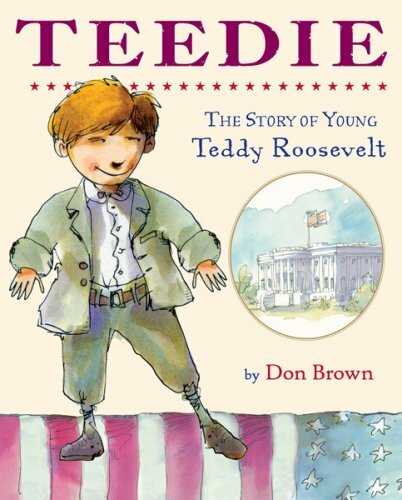
Teedie: The Story of Young Teddy Roosevelt by Don Brown (Image is from amazon.com)
We read through a large stack of books. In addition to the book used in this lesson, these were our top 7 favorites:
- The Man Who Loved Libraries: The Story of Andrew Carnegie by Andrew Larsen
- Teedie: The Story of Young Teddy Roosevelt by Don Brown
- What To Do About Alice?: How Alice Roosevelt Broke the Rules, Charmed the World, and Drove Her Father Teddy Crazy! by Barbara Kerley
- Mother Jones and Her Army of Mill Children by Jonah Winter
- Theodore Roosevelt (Getting to Know the US Presidents) by Mike Venezia
- Teddy: The Remarkable Tale of a President, a Cartoonist, a Toymaker and a Bear by James Sage
- Pass Go and Collect $200: The Real Story of How Monopoly Was Invented by Tanya Lee Stone
Song to Memorize About Tycoons
Looking for all my lessons?
AMERICAN HISTORY FOR EARLY ELEMENTARY:
Native Americans & Columbus Lesson
Jamestown Lesson
Pilgrims Lesson
Thirteen Colonies Lesson
French and Indian War Lesson
Colonial Period & Revolution Rumblings Lesson
Boston Massacre & Boston Tea Party Lesson
First Shots & Declaration of Independence Lesson
American War for Independence Battles Lesson
Valley Forge & Battle of Yorktown Lesson
American Literature Lesson & American War for Independence Review
Colonial Christmas Party
Constitution Lesson
Three Branches of Government Lesson
President George Washington Lesson
Louisiana Purchase Lesson
War of 1812 Lesson
Monroe Doctrine Lesson
Trail of Tears Lesson
Oregon Trail & Battle of Alamo Lesson
California Gold Rush & Pony Express Lesson
American Industrial Revolution Lesson
Underground Railroad Lesson
Abolitionists & Women Suffragists Lesson
Civil War: The Confederate States & Abraham Lincoln Lesson
Civil War Battles Lesson
Civil War Party & End of Year Review Game
BONUS LESSONS (if you have room for a few extra classes):
Reconstruction Lesson
Wild West Lesson
Immigrants Lesson
Tycoons & Theodore Roosevelt Lesson
World War I Lesson
Roaring Twenties Lesson
Great Depression and the 1930s Lesson
World War II Lesson
ALL MY LESSONS:
Fun, Free Hands-on Unit Studies (My Lessons in All Subjects)
© 2025 Shannon
Leave a Reply