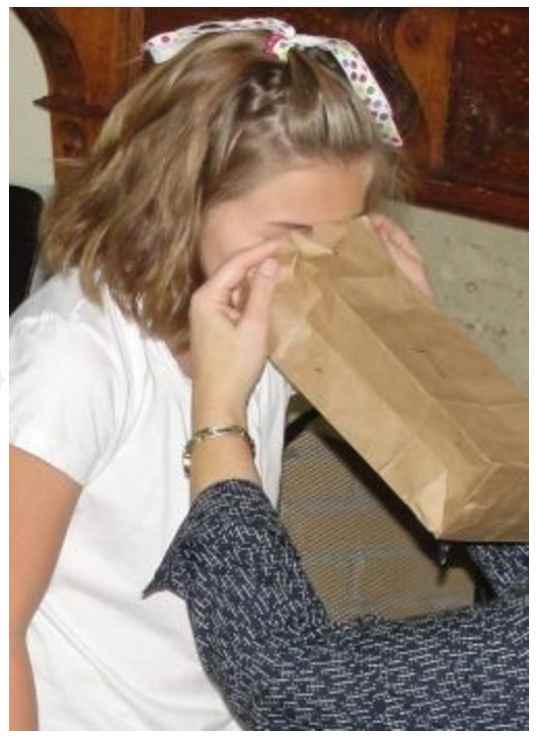
Expose Your Nose (Olfaction) Activity: Guess what is in the bag simply by smelling it
This is part 4 of a 4 part hands-on unit on the five senses. Feel, smell, and taste mystery items, make a touch and feel book, and more! My lessons are geared toward 3rd-4th grade level children and their siblings. These are lessons created to do with a weekly homeschool co-op. We meet each week for 2 1/2 hours and have 14 children between the ages of 0-13. Use these fun lessons with your classroom, family, after school program, camp, or co-op!
Introduction and Sense of Touch
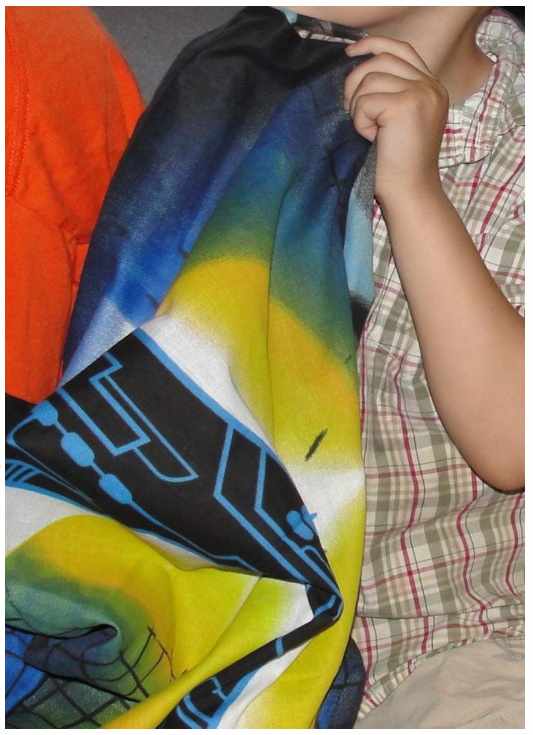
Use your sense of touch to guess what is in the pillow case
- Read and discuss John 20:24-29.
- Briefly review the 5 senses.
- Read “Soft And Smooth, Rough And Bumpy: A Book About Touch” by Dana Meachen Rau, which is the best picture book we read about the sense of touch. It has great factual information told in a picture book format. The illustrations are large enough to use this for group reading and they are enjoyable for both toddlers and older children alike.
YOU WILL NEED:
- Soft And Smooth, Rough And Bumpy: A Book About Touch by Dana Meachen Rau or other book on the sense of touch
- Sense of Touch Game: Ahead of time, fill pillowcases or tube socks with an assortment of items (feathers, cotton balls, pine cones, feathers, soap, aluminum foil, block letters, etc. ) Try to have items that vary in texture. At class/co-op, hand each child a filled pillowcase or tube sock. First have children feel the outside and try to guess what is inside. Without peeking, have them put their hands into their pillow cases/socks and try to count how many items are inside. Have them try to guess what the items are, which letter is on the letter block, which type of coin is in the pillowcase, etc. Finally let them pull out the items and see how much their sense of touch could tell them. Have them take out items one at a time, and then group them together (to make clean-up easier).
YOU WILL NEED:
- 1 pillow case or tube sock per child, each filled the same items (see above for suggestions)
Touch and Feel Books

Touch and feel book
- Make a touch and feel book. Let children decorate the cover of their books using markers. Pass out various items for the children to paste into their books. The more variety in surface textures, the better.
YOU WILL NEED PER STUDENT:
- Sandpaper, terry cloth, sponge, satin, rough wood, rubber, smooth plastic, etc.; paper to make the book; glue; markers
Sense of Smell
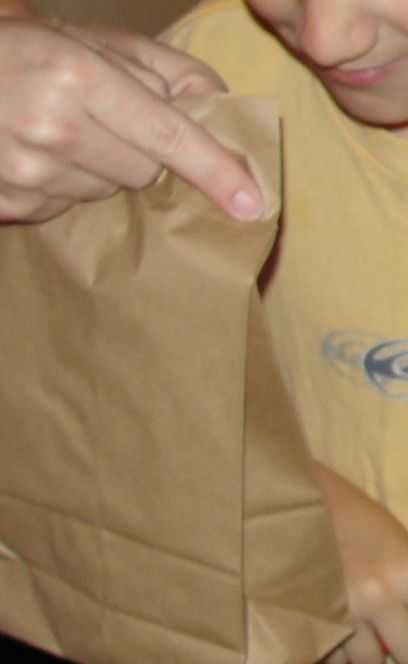
Smell what’s in the bag
- Read “Sniff, Sniff: A Book About Smell” by Dana Meachen Rau.
YOU WILL NEED:
- Sniff, Sniff: A Book About Smell by Dana Meachen Rau or other book on the sense of smell
- Expose Your Nose (Olfaction): Ahead of time place items that have distinctive smells in 10-15 separate bags that have been numbered ahead of time. Some ideas include: perfume soaked cotton, rotten fruit, nail-polish remover, banana, rose petals, sawdust, ginger, peppermint, pine needles, chocolate, coffee, dirt, vanilla, day-old chicken fat, garlic, onion, mint, vinegar, moth balls, pencil shavings, and potato chips. Have children walk around as partners and sniff inside each bag without peeking. They will then mark on a numbered sheet of paper if the bag has a wonderful, good, medium, bad, or horrible smell. After everyone has visited each station, collect the bags. Go through them one by one and ask them to share their “smell rating” for the first bag (by raising their hands). Select one volunteer to smell what’s inside the bag and try to guess what it is. Pull it out and show them. Discuss how our sense of smell can protect us – especially with the old chicken fat, moth balls, and nail-polish remover.
YOU WILL NEED:
- 10-15 paper bags each with a smelly item inside (see above for ideas), sheets numbered 1-15, and a writing utensil for each child
- Have children hold their noses and close their eyes and try to tell the flavor of a Skittle. Have them unplug their nose and see if they were right. Talk about how smell and taste are related.
YOU WILL NEED:
- at least 1 Skittle per child
Sense of Taste, Helen Keller, and Review
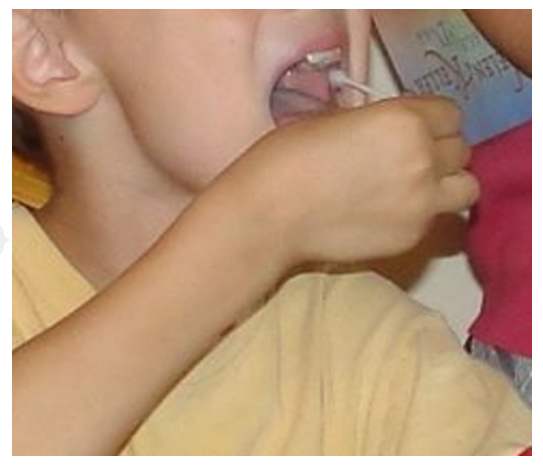
Taste Test
Sense of Taste, Helen Keller, and Review
- Read “Yum!: A Book about Taste” by Dana Meachen Rau.
YOU WILL NEED:
- Yum!: A Book about Taste by Dana Meachen Rau or other book on the sense of taste
- Taste Tests: Briefly discuss the 5 basic tastes: sweet, salty, sour, bitter, and umami (savory)*. Ahead of time pour 5 “mystery liquids” into 5 small cups. Give each child 5 Q-tips. Give each teacher/mom a cup and have them allow each child to taste the “mystery liquid” by using a new Q-tip each time to dip into each cup. Ask them if the liquid is salty, sweet, sour, bitter, or savory.
(*Umami is not always included in children’s books since is has been classified as a basic taste more recently than the others. You can read more about it at http://en.wikipedia.org/wiki/Umami. Metallic is also considered to be a sixth basic taste as is ammonium chloride (prominent in Nordic foods like salt licorice candy).)
YOU WILL NEED:
- Salty water, sugary water, lemon juice (for sour), tonic water (for bitter), soy sauce (for umami), 5 small cups, and 5 q-tips per child
- Read “Courage in the Dark” by Johanna Hurwitz and then quickly discuss how Helen Keller had to rely on her senses of touch, taste, and smell to live the full life that she did.
YOU WILL NEED:
- Courage in the Dark by Johanna Hurwitz or other book on Helen Keller
- 5 Minute Review of what we’ve learned.
Ready for the other lessons?
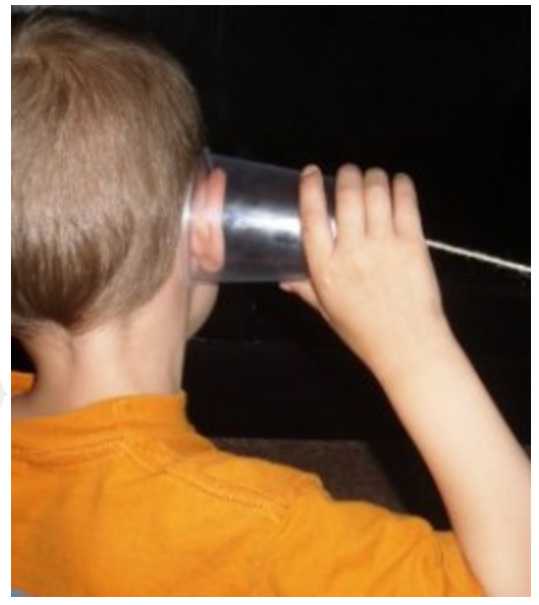
Cup phone activity to learn about sound waves from the lesson on hearing and sound waves
Build a crawl-through ear as you study hearing, play scales on water glasses as you study music and sound, dissect a cow eyeball as you study sight, try to identify mystery objects simply by their smell, present on various aspects of the five senses, and more during this 4 lesson hands-on unit study of the five senses!
- Hearing and Sound Waves Lesson – This is part 1 of a 4 part hands-on thematic unit on the five senses. Build and crawl through a model of an ear, watch sound waves at work, make paper cup phones, use a stethoscope and otoscope, and more!
- Music and Instruments Lesson – This is part 2 of a 4 part hands-on unit study on the five senses. See the inside of a piano and how it works, study pitch while playing water glasses, test out different instruments, and more!
- Eyes and Seeing Lesson – This is part 3 of a 4 part hands-on unit on the five senses. Make an edible model of an eye, dissect a cow eyeball, visit an eye doctor, and more!
- Touch, Smell, & Taste Lesson in Five Senses Unit – This is part 4 of a 4 part hands-on unit on the five senses. Feel, smell, and taste mystery items, make a touch and feel book, and more!
- Five Senses Culminating Project and Field Trip Ideas – This is the culminating project for the 4 part hands-on unit on the five senses. The students created presentations on people and ideas related to the 5 senses and shared 5 Senses-themed snacks and desserts. (Recipes are included.) Also included is where we went for field trips during this unit.
- My KONOS Volume I Lessons – Are you using Konos or curious about what hands-on unit studies look like in real life? Here are my pictures & lessons that describe our adventures as we roll up our sleeves and have F-U-N while learning! I have divided my Konos co-op lessons in the order presented in Konos Volume I. You can follow along even if you’re doing these lessons with only your family.
- All My Unit Studies and Lessons – Over the years I have posted over 30 science and social-studies based unit studies, compromised of more than 140 lessons. The unit studies include the Human Body, Simple Machines, Earth Science, Medieval Period, American Revolution, Pioneer Life, Countries of the World, and many more! For each lesson I have included activities (with photos), our favorite books and YouTube video clips, lapbook links, and other resources.
Sense of Taste: Science of Spice
Sense of Smell: How Do We Smell?
Sense of Touch: How Your Brain Registers Pain
Sense of Touch: School House Rock: Nervous System
KONOS Curriculum
Konos Volume I
Would you like to teach this way every day?
I use KONOS Curriculum as a springboard from which to plan my lessons. It’s a wonderful curriculum and was created by moms with active boys!
© 2011 Shannon
Which Sense Would Be Hardest to Lose And Why? – Or just let me know you dropped by! I love getting feedback from you!
Shannon (author) from Florida on July 08, 2012:
@l-may: Thank you so much!
l-may on July 07, 2012:
Looks like a well thought out lesson plan… A fun one to do! The sense of smell is the most surprising sense of them all I think. I submitted your lens in the Polka SquidSearch quest.. hope it brings you some traffic! 🙂 As for the hardest sense to lose… I guess I’d have to say vision because I need it for my independence in this world, but sound would be almost as hard for me. I love music!
SnoopyGirl1 on February 20, 2012:
Your Konos lenses are amazing so helpful! Thank you!
dellgirl on November 20, 2011:
This is a very nice lens with so much interesting and helpful information. Have a terrific week!
Leave a Reply