
Navajo Sand Painting Craft Activity
This is part 4 of a 4 part hands-on unit on Native Americans. Make Navajo Fry Bread, draw Pueblo chalk drawings, create Navajo sand paintings and concho-style belts, weave Apache baskets, and more! My lessons are geared toward 3rd-4th grade level children and their siblings. These are lessons I created to do with a weekly homeschool co-op. We meet each week for 2 1/2 hours and have 17 children between the ages of 1-13. Use these fun lessons with your class, family, or homeschool co-op group!
Southwest Tribes Overview
- Pray. Discuss Romans 1:20-23.
- Point out tribes on map. Sing the “Tribes of America” Song (Tune: “10 Little Indians”)
Eastern Woodlands/
Northeast, Southeast:
Iroquois, Algonquian,
Seminole/Creek & Cherokee
All lived in the East
Blackfoot, Lakota, Sioux, and Comanche
Cheyenne, Crow, and Pawnee
All hunted buffalo on the plains.
They are the Plains tribes!
On the Plateau-Basin is the Nez Perce
And Sacajawea’s Shoshoni.
Head to the Northwest to find the Haida
And the Inuit.
Pueblo (Hopi and the Zuni),
Apache and Navajo,
Housed in adobe in the desert
Wow, those Southwest tribes!
One little, two little, one-hundred little native tribes,
Covering the expanse of our land,
All created in God’s image
They are Native Americans.
- Read a section on Southwest tribes from “Famous Indian Tribes” by William Moyers. Quickly discuss traits of Woodlands/Northeast & Southeast, Plains, Northwest, and Southwest tribes.
YOU WILL NEED:
- “Famous Indian Tribes” by William Moyers or other book describing the Southwest Tribes
Navajo Fry Bread

Mixing together Navajo Fry Bread dough
- Begin making Navajo Fry Bread. We will divide children into 3 groups. Each group will make the below recipe.
- 4 cups flour
- 1 tablespoon baking powder
- 1 teaspoon salt
- 1 cup warm water (or more)
- 1-2 cup shortening or 1-2 cup cooking oil
Mix the flour, baking powder and salt in a large bowl. Gradually stir in the water and work it in, adding more water a little at a time, if needed. Knead by hand until soft but not sticky. Form the dough into a round ball, cover and let stand for about 30 minutes. Set the dough aside while children work on other activities.
While children knead the dough, tell them about how Native Americans were sent to reservations so American settlers could take their land. The government was supposed to provide them with food. Frequently it was flour and lard. They had to figure out how to use this new kind of food. One way was to make fry bread. They wouldn’t have had baking powder, salt, or cinnamon sugar like what we used and will be using.
YOU WILL NEED:
- flour, baking power, salt, cinnamon sugar, shortening or oil, measuring cups & spoons, mixing bowls, mixing spoons, skillets, & pancake turners
Pueblos
- Look at pictures of Pueblo tribes from books.
YOU WILL NEED:
- pictures of Pueblo tribes
- Remind the children of our Bible verses and how everyone in the entire world knows about God, though they might try to worship someone other than Him. Missionaries will sometimes use legends from a particular people group and will then use those stories to explain who God truly is and what He came to do. Read “Arrow to the Sun” by Gerald McDermott. Have the children discuss how they could use that legend to explain to the Pueblos who Jesus is and what He came to do.
YOU WILL NEED:
Pueblo Chalk Drawings
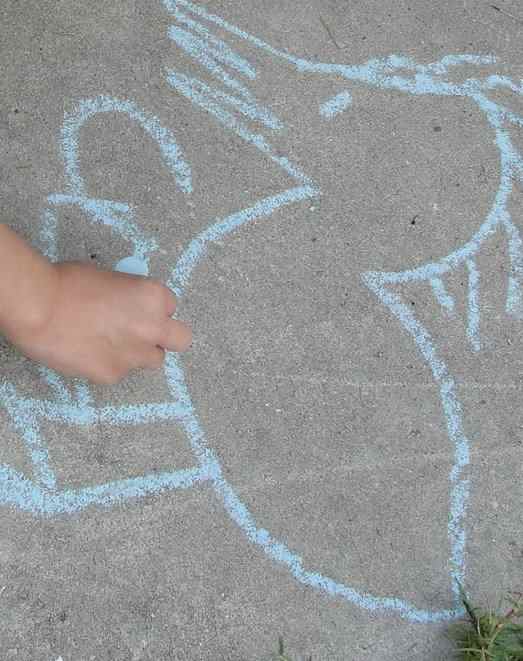
Pueblo-style chalk drawing using sidewalk chalk
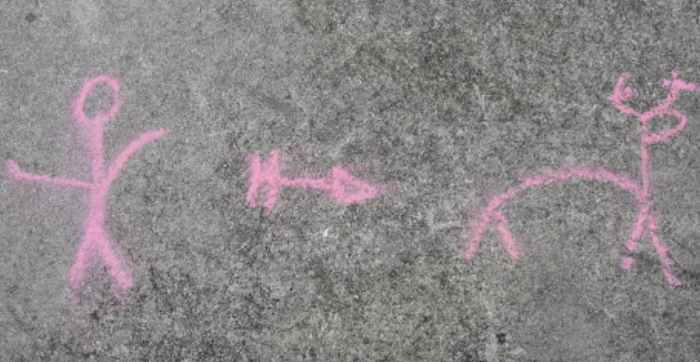
- Look at pictures of Pueblo chalk drawings from “When Clay Sings” by Baylor (which takes the drawings that have been found on Pueblo pottery and has they come alive in various stories. Both my 4 and 7 year old enjoyed this book.) or “Stories on Stone” by Dewey (in which the author tells of the images she saw growing up when her parents would take her to the Pueblo caves. My sons begged to head out West to see these drawings and caves after reading this book.)
YOU WILL NEED:
- “When Clay Sings” by Baylor, “Stories on Stone” by Dewey, or other book with Pueblo chalk drawings
- Draw Pueblo-style pictures using sidewalk chalk on our driveway. Draw pictures of a modern event or image.
YOU WILL NEED:
- sidewalk chalk
Hopi & Zuni
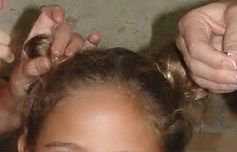
Hopi squash blossom hair-do
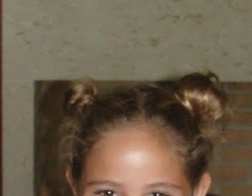
- Look at pictures of Hopi & Zuni tribes.
YOU WILL NEED:
- pictures of Hopi & Zuni tribes
- Demonstrate a squash blossom hair-do. Hopi girls would fashion their hair in this manner as a sign that they were ready to get married. Using a girl with long hair, make high pig-tails. Twist the hair like a bun leaving 2 inches untwisted. Wrap that around the pony-tail holders and secure with hairpins. It should look like the young princess Lela. You can see photographs at this link.
YOU WILL NEED:
- 2 ponytail holders and lots of hair pins
- (If you are not limited by time) Look at Hopi pottery and make a pinch pot.
YOU WILL NEED:
- 10 lb. terra cotta colored self-hardening clay, 16 squares of wax paper
Navajo Sand Paintings
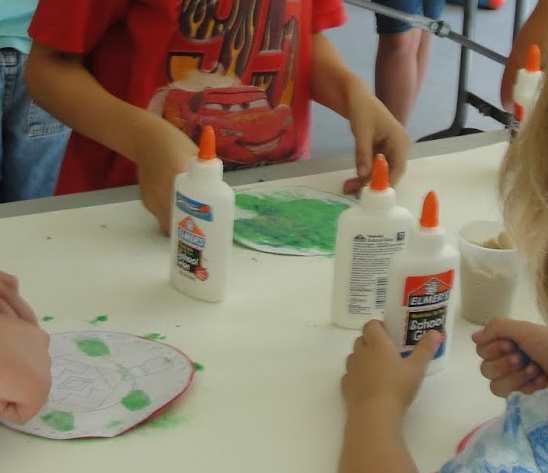
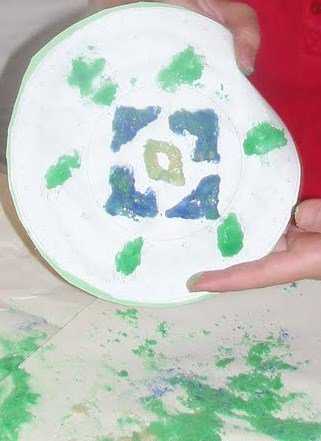
Navajo Sand Painting Art Activity
- Look at pictures of Navajo using books.
YOU WILL NEED:
- pictures of Navajo
- Look at sand paintings. Have children make a sand painting.
- Glue the turtle pattern to construction paper to make it sturdier.
- Then place glue on various parts of the turtle picture and sprinkle a particular color of sand over the glue.
- Pour off the excess sand.
- Place glue over another part of the picture, sprinkle another color of sand over the glue, and then pour off the excess sand.
- Repeat this until you’ve finished your picture.
We did this on tables outside, and we covered the tables with newspaper.
YOU WILL NEED: (per child)
- 1 copy of turtle pattern printed from this webpage. (please cut out ahead of time), 1 piece of construction paper cut out the same size as the turtle circle, & colored sand (at least 2-3 colors) (We purchased a few bags of colored sand from the outdoor department at Wal-Mart. It’s used for sandboxes. Each bag cost a few dollars.)
Finish Navajo Fry Bread
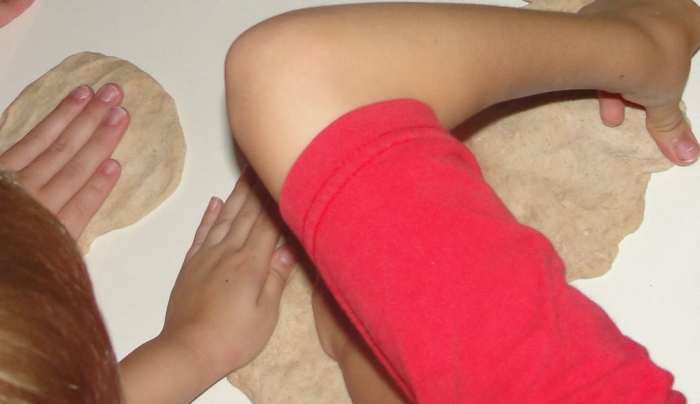
Flattening Navajo Fry Bread
- Finish making Navajo fry bread. Have the children use their hands to roll the dough into a ball and flatten it. It won’t get as flat as it should be, but it will still taste fine.
- While the children do the next activities, two teachers or parents will fry the dough until it’s golden and then sprinkle them with cinnamon sugar. Let cool.
Navajo Cocho-style Belts
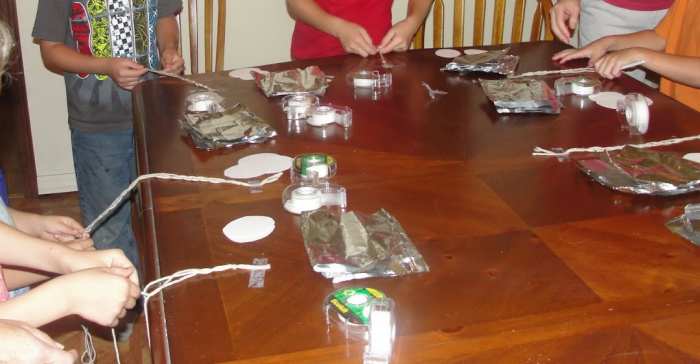
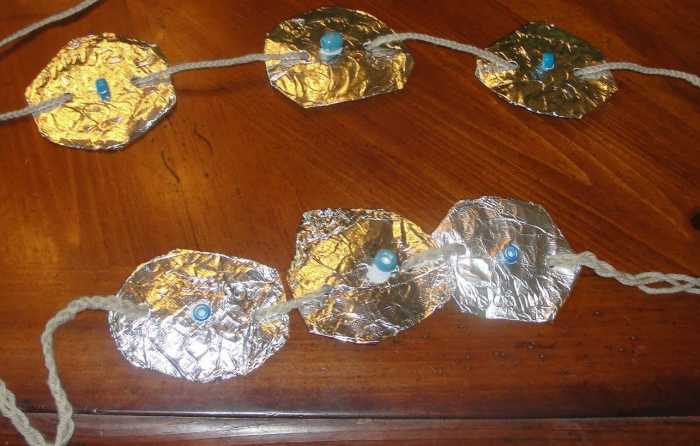
Navajo Cocho-style Belts made using yarn, aluminum foil, and pony craft beads
- Show pictures of Navajo jewelry. Let children pass around turquoise & silver jewelry.
YOU WILL NEED:
- turquoise & silver jewelry
- Make Concho-style belts (Show a photo of one.)
- Each child gets 3 ovals. Glue or tape aluminum foil to ovals and double the foil. Use a toothpick to gently indent and decorate the Conchos.
- Glue a turquoise bead on each Concho.
- Give each child 3 pieces of yarn. Knot the end and tape it to the table. Show them how to braid the yarn.
- Push through the previously-punched out holes.
- Attach Conchos by putting the braid into one hole and out through the other, making sure the yarn is in the back of the Concho.
- Tie a knot to secure the braid.
- *Note: To make this activity much shorter time wise and/or to use this for younger children, pre-braid the yarn. Teachers/parents spent the entire time braiding the yarn for those who couldn’t braid.*
(This activity idea is from “A Kids’ Guide to Native American History” by Yvonne Dennis.)
YOU WILL NEED: (per child)
- 4 ovals (3.5″x2″) cut out of cardstock with a hole punched on each side 1/2 inch from edge, aluminum foil, tape, 4 pieces of yarn that are 42 inches each, 4 turquoise colored craft beads, glue, & 1 toothpick
Apache Woven Baskets
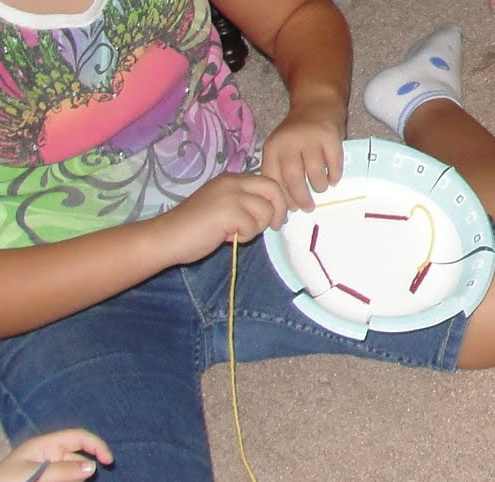
Apache-inspired Woven Baskets
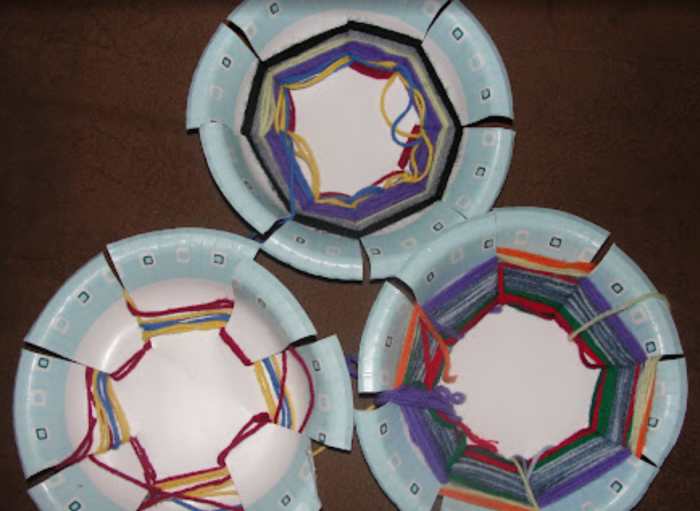
Apache-inspired Woven Baskets
- (If time allows) Look at pictures of Apache and make a simplified Southwest woven basket by following the directions at this link.
- Tie a piece of yarn around one of the pre-cut pieces of the bowl. Then weave the yarn over and under. Tie another piece of yarn on the pre-cut piece of bowl next to the one you started with. Go in the opposite directions, going over and under. The fatter the yarn, the shorter amount of time this activity will take.
- We were able to start this activity but no one had time to finish their basket. Do you see the yarn in this picture? It is too thin! This is what our baskets looked like after we worked on them for 45 minutes (after class/co-op was over).
YOU WILL NEED: (per child)
- 1 paper bowls (precut in 6 places) and 4 pieces of THICK yarn each cut 3′ long OR 2 pieces of 6′ long THICK yarn that has various colors
Eat Navajo Fry Bread & Review
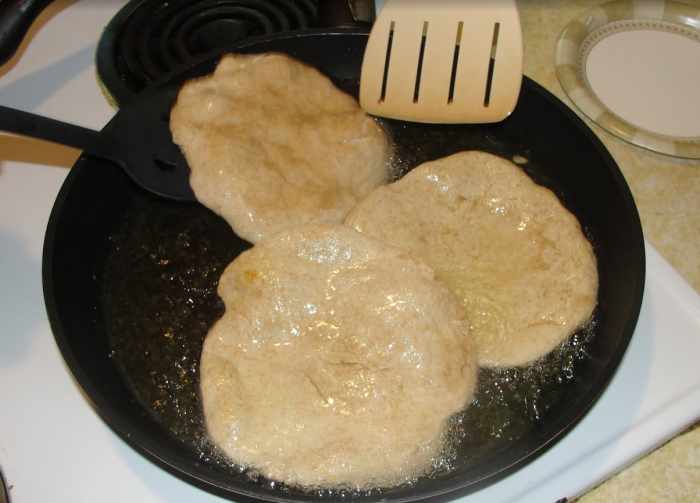
- Eat fry bread & talk about Navajo code talkers. (By the way, many children voted that making and eating the Navajo Fry Bread was their favorite part of the unit study on Native Americans.)
YOU WILL NEED:
- napkins & cups for water
- Five minute drill/discussion on what we learned. Review song for tomorrow night’s powwow.
Homework: Tribe & Missionary Reports
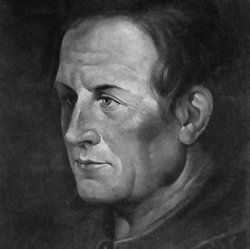
Eusebio Francisco Kino
For each of the main tribes we studied, my sons and I completed an “Indian Tribe Report” page from this link.
We also completed a missionary report page using the form from this link. We did a missionary report on
Eusebio Francisco Kino, an Italian Roman Catholic priest who established many Spanish missions in modern day Arizonia during the late 1600’s. If you would prefer someone else, you could do a missions report on Navajo Missions, a modern mission serving the Navajo people.
Our Favorite Children’s Books on the Southwest Tribes
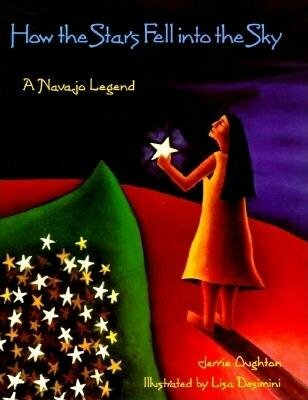
How the Stars Fell into the Sky: A Navajo Legend (Book image is from amazon.com)
Zuni
- Coyote: A Trickster Tale from the American Southwest tells of the Zuni Coyote trickster. My 4 year old thought the illustrations were hilarious.
- Sunflower’s Promise: A Zuni Legend (Native American Legends) – In addition to the retelling of this Zuni legend, this also provides information about the historical and present day Zuni people.
- The Turkey Girl: A Zuni Cinderella Story by Penny Pollock is a Zuni version of a Cinderella story that focuses on a girl who keeps wild turkeys but does not keep true to her word.
- Houses of Adobe (Native Dwellings) by Bonnie Shemie is a picture book that provides information about the dwellings of various Southwest tribes.
Hopi
- The Mouse Couple: A Hopi Folktale – A Hopi legend about a mouse couple that searches the world for a husband for their daughter.
- Night Dancer by Marcia Vaughan – Kokopelli leads the animals in an evening dance across the desert.
- The Warrior Maiden by Ellen Schecter is about a young Hopi girl who saves her town from Apache raiders.
- “The Hopis” (First Americans Books) by Virginia Driving Hawk Sneve is filled with facts on the life of the Hopi.
- “If You Lived With The Hopi Indians” by Anne Kamma helped us find out about specific aspects of Hopi life, but it is too long to read through as a story book.
Navajo
- Turquoise Boy (Native American Legends) – This Navajo legend in picture book format tells of a Navajo boy who wants to make Navajo life easier, so he sets out on a quest.
- Dzani Yazhi Naazbaa’ / Little Woman Warrior Who Came Home: A Story of the Navajo Long Walk (English and Navaho Edition) by Evangeline Parsons-Yazzie follows a young Navajo girl and speaks of the tragedy of the Navajo being forced off their land.
- Coyote Steals the Blanket: A Ute Tale (Ute Tales) – I know this claims to be an Ute legend, but it contains the same tricksters characters, Coyote and Hummingbird, that are so popular amongst the Southwest tribes. Both my boys laughed out loud at this book and wanted me to read it over and over again.
- How the Stars Fell into the Sky: A Navajo Legend (Sandpiper Houghton Mifflin Books)- This Navajo legend in picture book form tells of the first man and woman. We compared it to the Biblical account of Adam, Eve, and the serpent.
- The Navajo Year Walk Through Many Seasons by Nancy Bo Flood – Coyote leads you through the Navajo year. The name of each month is given in English and in Navajo, but it unfortunately doesn’t include how to pronounce the Navajo words.
- “The Unbreakable Code” by Sara Hoagland Hunter has a grandfather telling his grandson about the WWII code talkers.
Apache and the Southwest
- Antelope Woman: An Apache Folktale was one of the few Apache legends we could find in story book format.
- “The Apaches” by Virginia Driving Hawk Sneve is a fact-filled book on the Apache and has illustrations rather than photographs.
- Geronimo (Childhood of Famous Americas) is a children’s chapter book on Geronimo.
- “This Place Is Dry: Arizona’s Sonoran Desert” (Imagine Living Here) by Vicki Cobb is a very comprehensive picture book on the Sonoran Desert
Looking for the other lessons?
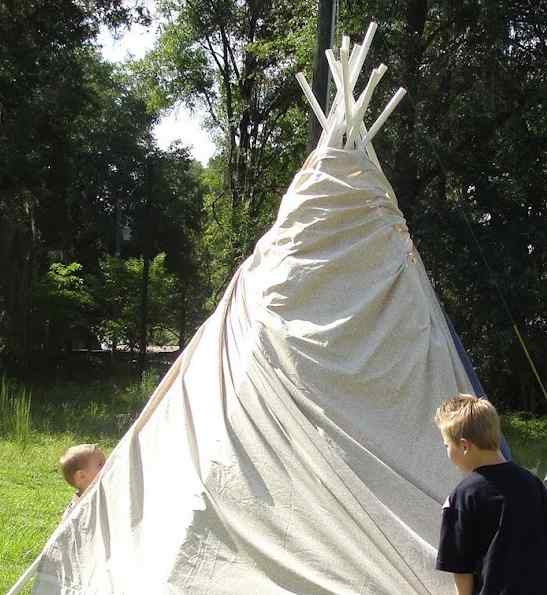
Setting up a tepee during Lesson 2: Plains Native American Tribes Lesson
Hunt for arrowheads, build teepees, paint totem poles, draw Pueblo chalk drawings, present on specific Native American tribes, and more during this fun four week hands on study of Native Americans.
- Northeast and Southeast Native Americans Lesson – This is part 1 of a 4 part hands-on unit on Native Americans. Make arrows, cook Three Sisters Stew, go on an “archeological dig” for arrowheads, create Iroquois Bowl games, bead Seminole necklaces, and more!
- Plains Native American Tribes Lesson – This is part 2 of a 4 part hands-on unit on Native Americans. Create headdresses and war shields, build a teepee, eat dried “buffalo” and more!
- Northwest and Plateau Native American Tribes Lesson – This is part 3 of a 4 part hands-on unit on Native Americans. Decorate parfleches, fry salmon cakes, create totem poles, dramatize a dramatize potlatch ceremony, and more!
- Southwest Native American Tribes Lesson – This is part 4 of a 4 part hands-on unit on Native Americans. Make Navajo Fry Bread, draw Pueblo chalk drawings, create Navajo sand paintings and concho-style belts, weave Apache baskets, and more!
- Native American Powwow and Field Trip Ideas – After our 4 part unit study on Native Americans, our culminating activity was a powwow. Each child presented on a different tribe and brought food from that tribe for us to share. I am also including where we went for field trips during this unit.
- Fun, FREE Hands-on Unit Studies – Looking for all of my lessons and unit studies? Over the years I have posted over 30 science and social-studies based unit studies, compromised of more than 140 lessons. For each lesson I have included activities (with photos), our favorite books and YouTube video clips, lapbook links, and other resources. I posted links to all of my unit studies and lessons at the above link.
KONOS Curriculum
KONOS Volume I
Would you like to teach this way every day?
I use KONOS Curriculum as a springboard from which to plan my lessons. It’s a wonderful curriculum and was created by moms with active boys!
© 2011 Shannon
Leave me a note – Let me know you dropped by! Was this lens helpful? Do you have any questions, comments, or additional ideas? Please post here!
mattcut on June 17, 2012:
Loved this Lens thanks !
anonymous on May 20, 2012:
Great ideas! I love the book suggestions and pictures!
Leave a Reply