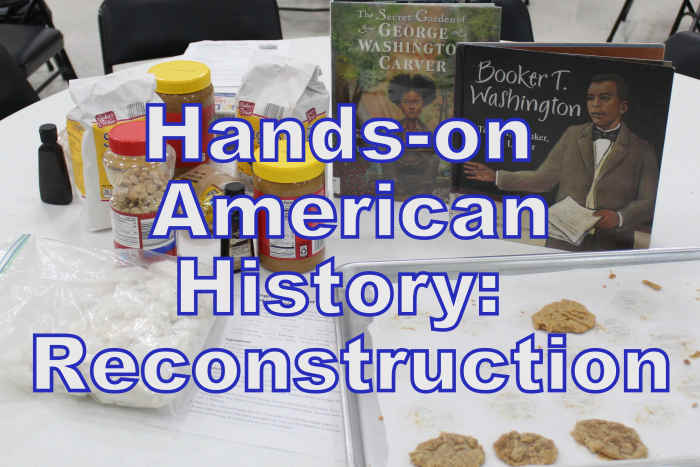
Reconstruction Lesson Plan for Kids
This is the 29th lesson in a series of 35 hands-on lessons covering U.S. American History. This lesson focuses on Reconstruction, focusing on George Washington Carver and Booker T. Washington. I used this plan while teaching a 45 minute history class for children in Kindergarten, 1st, & 2nd grades. Each lesson includes a biography report, history notebook page, history song, our favorite children’s books, YouTube video, a history joke, & a variety of hands-on activities to make each lesson engaging & memorable. Use these fun lessons with your classroom, homeschool, after-school program, or co-op!
Joke: What did George Washington Carver say when he invented a new peanut product?
“I’m nuts about this idea!”
George Washington Carver’s Peanut Butter Cookies
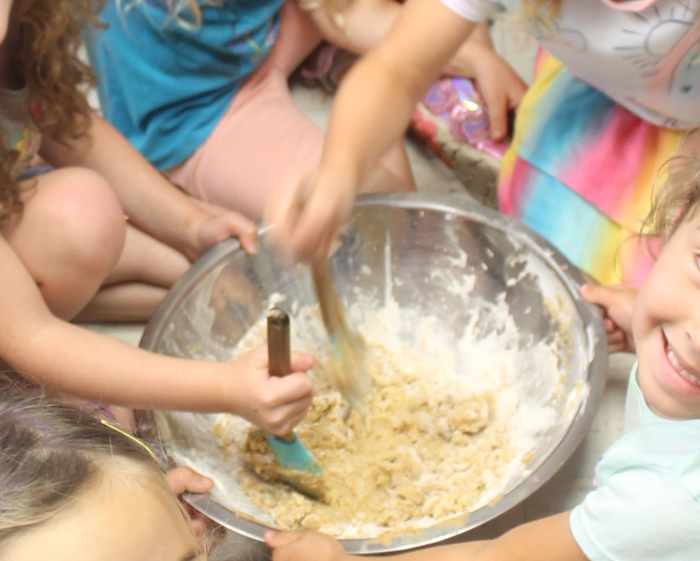
Mixing together the ingredients to make peanut butter cookies
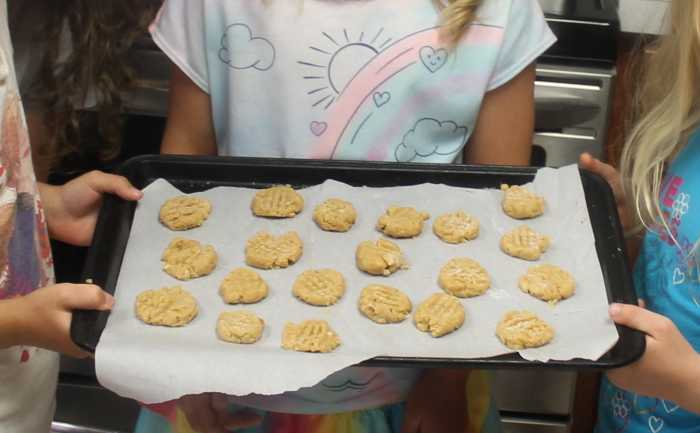
Peanut butter cookies before they’re baked
***IMPORTANT: Check for peanut allergies before doing this lesson!***
- George Washington Carver did NOT invent peanut butter, but he did invent 287 uses for peanuts. He was a great cook and baker and would pass out the recipes he created for peanuts, including a recipe for peanut butter cookies, which used chopped peanuts. (You can find his Peanut Butter Cookie recipe at https://www.nps.gov/museum/exhibits/tuskegee/gwcrecipe.htm .)
- Mix together a recipe that is close to the recipe George Washington Carver created for Peanut Butter Cookies.
Peanut Butter Cookies
*Allow the children to measure out the ingredients and dump them in. Let them take turns stirring. Let them all drop cookies on the baking sheet and then crisscross them with a fork (which they LOVED doing). Make sure everyone gets a turn. If you have a larger group, divide into groups of 6-8.*
½ cup shortening or butter
1 ¼ cups packed light brown sugar
1 cup peanut butter
1 egg
3 tablespoons milk
1 tsp vanilla extract
1 ¾ cups all-purpose flour
¾ teaspoon baking soda
¾ teaspoon salt
- Preheat the oven to 350F.
- Cream together shortening/butter, brown sugar, and peanut butter. Stir in the egg, milk, and vanilla. Add in the flour, baking soda, and salt and stir until well blended.
- Drop by rounded spoonfuls onto ungreased cookie sheets. Crisscross each cookie with a fork. (If desired, sprinkle with more sugar on top.
- Bake for 8 to 10 minutes in the preheated oven.
(The above recipe comes from https://www.allrecipes.com/recipe/24429/delicious-peanut-butter-cookies/ .)
You will need:
- Ingredients for the cookies: shortening or butter, light brown sugar, peanut butter, egg, milk, vanilla extract, flour, baking soda, & salt
- Tool for mixing & baking: measuring spoons & cups, baking sheets, parchment paper or non-stick cooking spray, large mixing bowl, mixing spoon, and spoons and forks
Student Biography Presentation: George Washington Carver
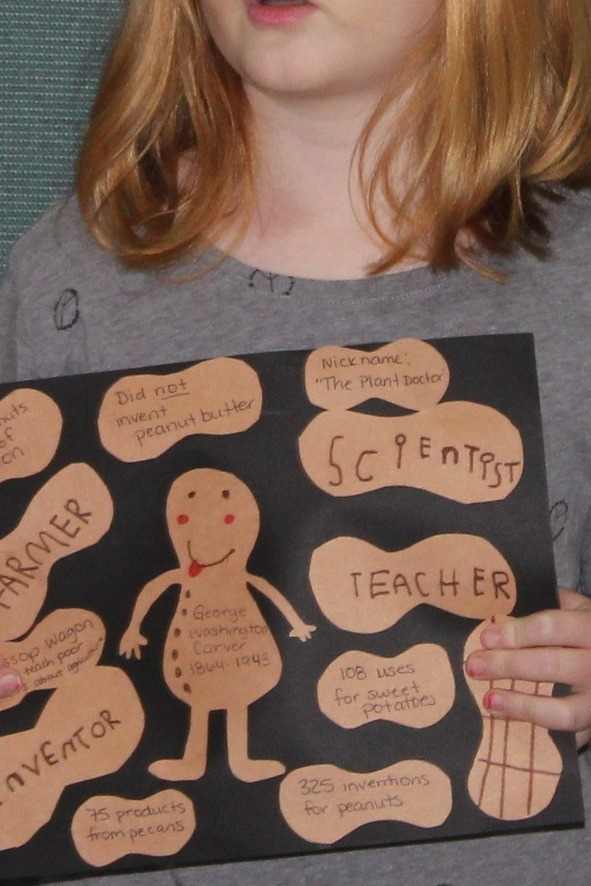
Student biography presentation on George Washington Carver
- Student biography presentation on George Washington Carver
Review & Presidents Song
- Review questions: What was a woman’s suffragist? (Someone who thought women should have the right to vote.) Name a famous women’s suffragist. (Susan B. Anthony, Elizabeth Cady Stanton, Sojourner Truth, & others) The Southern states seceded & became their own country after which man was elected President? (Abraham Lincoln) Was the Confederate States of America the Northern states or the Southern states? (Southern) The first skirmish that started off the war was held at which fort? (Fort Sumter) Name the two ironclads. (Monitor vs. Virginia) What did Abraham Lincoln’s Emancipation Proclamation do? (freed slaves in the Confederate states) When Grant & his Union army beat Vicksburg, what river did they win control of? (Mississippi) Who won at the Battle of Gettysburg? (North/Union) Who gave the Gettysburg Address? (Abraham Lincoln) Where did Robert E. Lee surrender to Ulysses S. Grant? (Appomattox Courthouse)
- Sing through the entire President’s Song 2 times while either showing the video or flipping through pictures of the Presidents. (Add in “Trump, Biden, Trump” at the end.)
You will need:
- Screen to show the below video or a book showing Presidents or point to their pictures on a President place mat
George Washington Carver
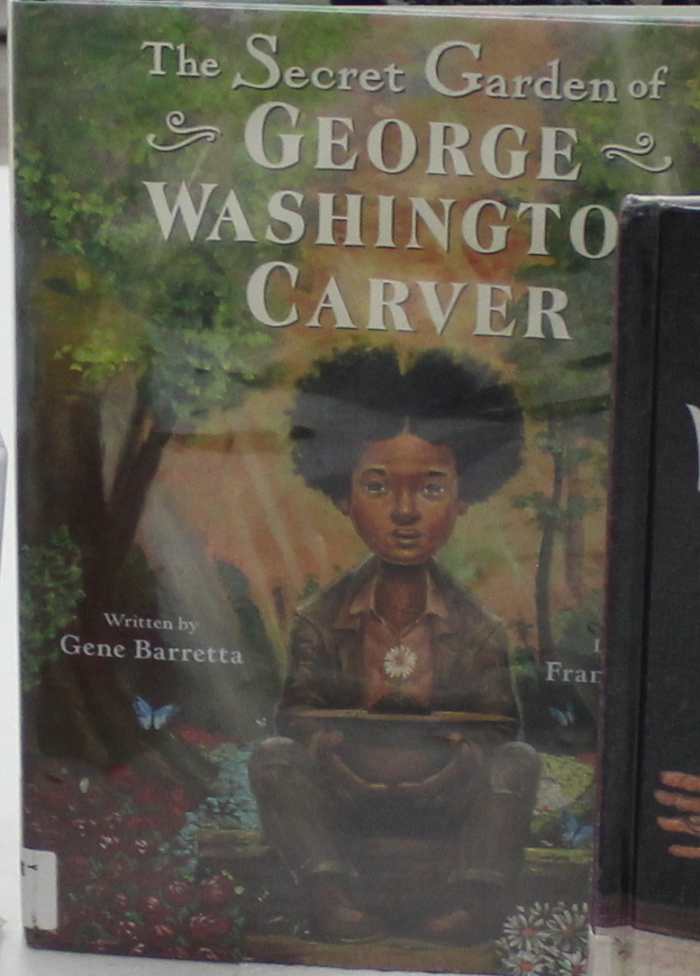
The Secret Garden of George Washington Carver by Gene Barretta
- Flip through The Secret Garden of George Washington Carver by Gene Barretta to introduce the life and accomplishments of George Washington Carver.
You will need:
- The Secret Garden of George Washington Carver by Gene Barretta or other book on George Washington Carver
Reconstruction & Cotton
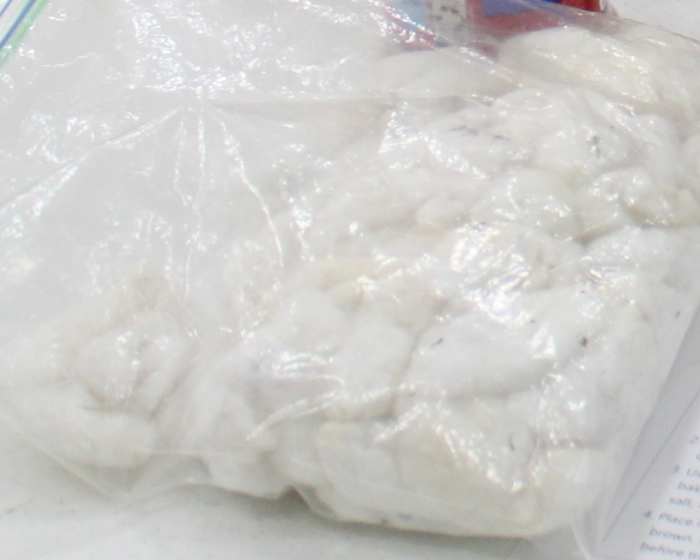
Many ex-slaves grew cotton
- Reconstruction:
- The time period after the Civil War is called “Reconstruction.” (Have students repeat “Reconstruction.”) They had to build back America. Many people died during the Civil War. Many homes, businesses, and churches had been destroyed. People who were fighting as enemies during the Civil War now had to get along as fellow countrymen.
- Show cotton.
- Another huge change was that slaves were set free, but most former slaves still had a very difficult life. In many places they were still treated unfairly. Many of them continued with what they knew: growing cotton. Growing the same crop every year isn’t good for the soil. The couldn’t make much money doing this and it didn’t leave them anything their family could eat
You will need:
- Cotton
Peanuts
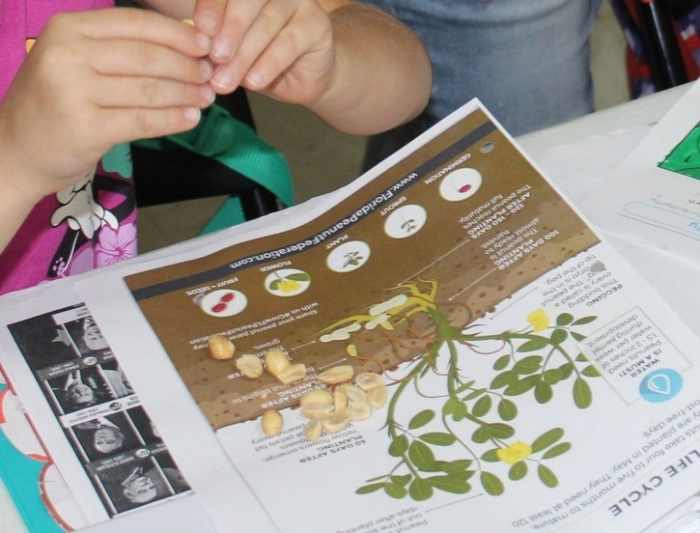
Studying peanuts

Life Cycle of a Peanut from the Florida Peanut Federation (Notebook page front)

George Washington Carver from https://www.pinterest.com/pin/1128011037901680986/ (Notebook page back)
- Pass out a page on the life cycle of a peanut and a small handful of peanuts to each child and have them study them.
- What do they notice?
- Share some information about peanuts such as they are dicot seeds because they split apart into 2 halves. Because they grow underground, they are classified as legumes, not nuts. They can improve the health of soil by drawing nitrogen into the soil. Find the testa/seed coat (skin), cotyledon (peanut kernels you eat), & plumule (germ/heart between the two halves that can form a new plant).
- Allow the children to eat the peanuts.
You will need:
- Napkins, peanuts (preferably ones in their shells), and notebook pages showing the lifecycle of a peanut
- George Washington Carver encouraged Southern farmers to grow crops they can eat and that are good for soil.
- He discovered you can get all the nutrients you need by eating sweet potatoes and peanuts, so he encouraged farmers to grow both.
- No one wanted to grow peanuts, though, because peanuts were mainly only grown to feed animals. He prayed to God and came up with 287 uses for peanuts.
- [Point of the George Washington Carve page on the back of the notebook sheet.] Some of the products he created from peanuts included food (including peanut butter cookies, peanut flour, and a meat substitute), beverages (like peanut milk), laundry soap, margarine, ink, paints, and dyes, livestock feed, cosmetics, and medicine. He even made things from the shells such as paper, fire wood, paving bricks, and insulation.
Booker T. Washington
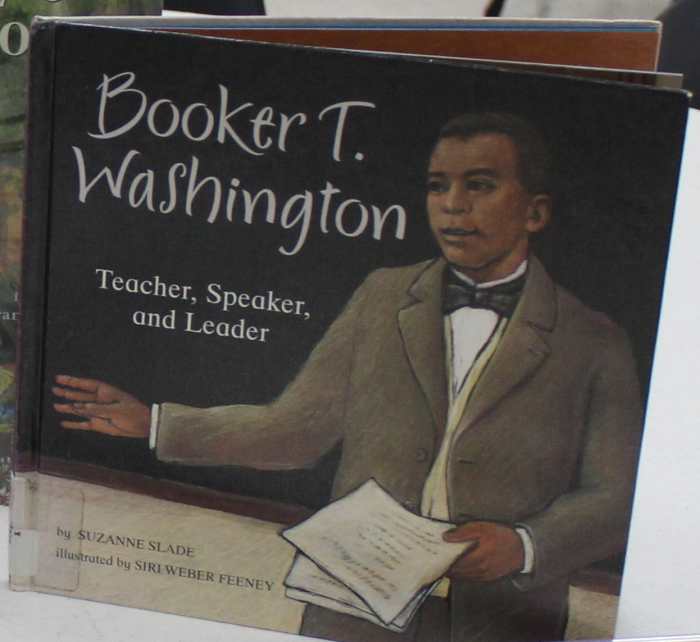
Booker T. Washington : Teacher, Speaker, and Leader by Suzanne Slade
- Flip through and summarize (or read) Booker T. Washington : Teacher, Speaker, and Leader by Suzanne Slade to introduce Booker T. Washington.
- Be sure to mention that he hired George Washington Carver to teach agriculture (and many other subjects) at Tuskegee Institute.
- Also mention that he met with Andrew Carnegie (who we’ll talk about in our next lesson), and Andrew Carnegie donated lots of money to support Tuskegee Institute.
You will need:
- Booker T. Washington : Teacher, Speaker, and Leader by Suzanne Slade or other book on Booker T. Washington
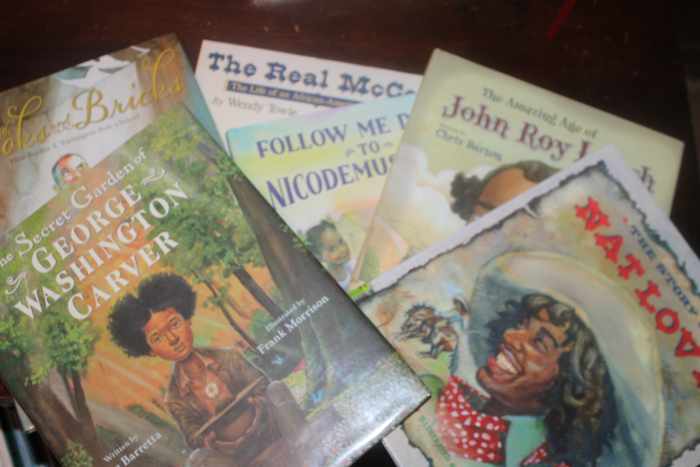
Some of the books the Reconstruction books that can be used
- (Optional) If time allows and if you have access to the books, hold up other children’s biographies on ex-slaves or children of slaves who were successful during the Reconstruction period. With each book quickly summarize the person’s name and what they are known for accomplishing. Encourage them to find these books at the library and read about them.
You will need:
- children’s biographies on ex-slaves or children of slaves who were successful during the Reconstruction period such as:
- Step Right Up : How Doc and Jim Key Taught the World About Kindness by Donna Bowman
- The Slave Who Went to Congress by Frye Gaillard
- The Amazing Age of John Roy Lynch by Chris Barton
- The Story of Nat Love by Robert H. Miller
- The Real Mccoy by Wendy Towle
- Hammering for Freedom: The William Lewis Story by Rita Lorraine Hubbard
- Fearless Mary: Mary Fields, American Stagecoach Driver by Tami Charles
- No Small Potatoes: Junius G. Groves and His Kingdom in Kansas by Tonya Bolden
- Stitch by Stitch: Elizabeth Hobbs Keckly Sews Her Way to Freedom by Connie Schofield-Morrison
- Follow Me Down to Nicodemus Town : Based on the History of the African American Pioneer Settlement by A. LaFaye
Eat the cookies
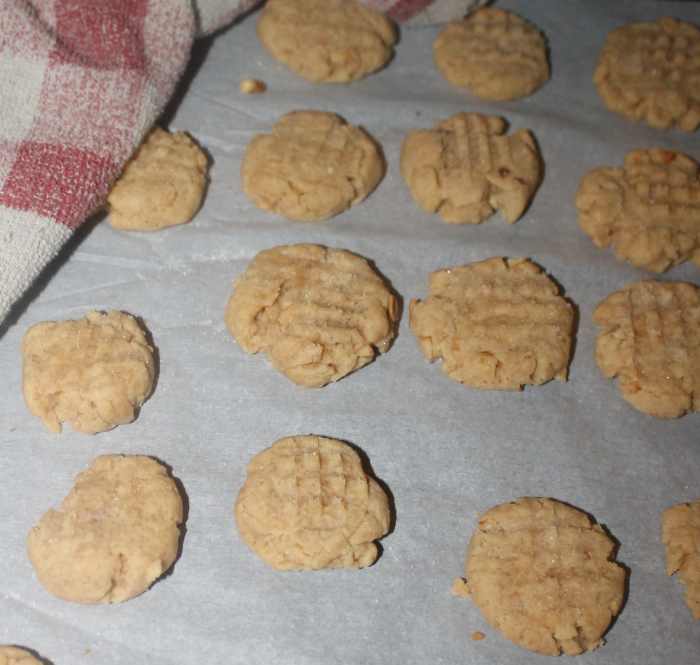

- Allow students to each try a peanut butter cookie if they’d like. If desired, provide sandwich baggies and allow for the children to take home some to share with their families.
You will need:
- napkins and sandwich baggies (optional)
- Review: What is the time period we studied today that happened after the American Civil War? (Reconstruction) What product did most ex-slaves try to grow but weren’t able to make much money from it? (cotton) What plant is George Washington Carver most well known for encouraging farmers to grow? (Peanuts) Who can tell me something else about George Washington Carver? (Answers will vary) What is the name if the ex-slave who started the Tuskegee Institute at which ex-slaves and children of slaves could get a college education? (Booker T. Washington) Who can tell me about one more person we learned about today and what they did? (Answers will vary.)
- Assign next week’s biography report on Annie Oakley.
A Book to Read Each Day
(and an audio book to listen to)
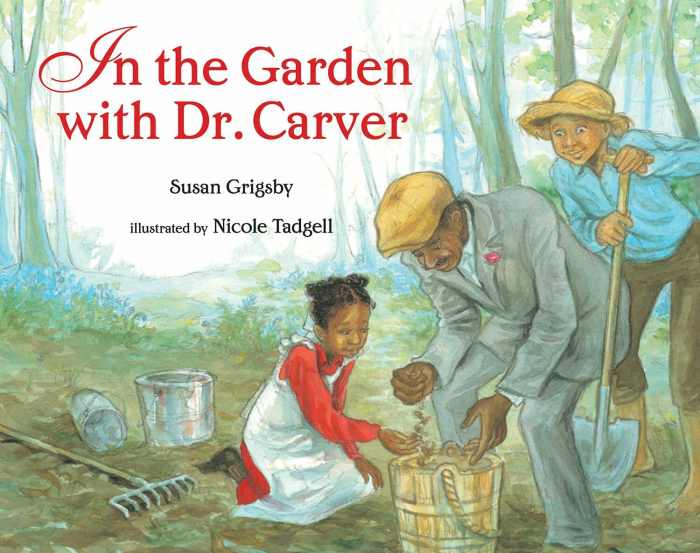
In the Garden with Dr. Carver by Susan Grigsby (Book image is from amazon.com)
We read through a large stack of books. In addition to the book used in this lesson, these were our top 7 favorites:
- In the Garden with Dr. Carver by Susan Grigsby
- With Books and Bricks : How Booker T. Washington Built a School by Suzanne Slade
- The Slave Who Went to Congress by Frye Gaillard
- The Amazing Age of John Roy Lynch by Chris Barton
- The Story of Nat Love by Robert H. Miller
- The Real Mccoy by Wendy Towle
- No Small Potatoes: Junius G. Groves and His Kingdom in Kansas by Tonya Bolden
We also loved learning more about George Washington Carver. We listened to the audio version of George Washington Carver: From Slave to Scientist (Heroes of History) by Janet and Geoff Benge.
Optional History Sentence Song to Memorize: The Fourteenth Amendment
Looking for all my lessons?
AMERICAN HISTORY FOR EARLY ELEMENTARY:
Native Americans & Columbus Lesson
Jamestown Lesson
Pilgrims Lesson
Thirteen Colonies Lesson
French and Indian War Lesson
Colonial Period & Revolution Rumblings Lesson
Boston Massacre & Boston Tea Party Lesson
First Shots & Declaration of Independence Lesson
American War for Independence Battles Lesson
Valley Forge & Battle of Yorktown Lesson
American Literature Lesson & American War for Independence Review
Colonial Christmas Party
Constitution Lesson
Three Branches of Government Lesson
President George Washington Lesson
Louisiana Purchase Lesson
War of 1812 Lesson
Monroe Doctrine Lesson
Trail of Tears Lesson
Oregon Trail & Battle of Alamo Lesson
California Gold Rush & Pony Express Lesson
American Industrial Revolution Lesson
Underground Railroad Lesson
Abolitionists & Women Suffragists Lesson
Civil War: The Confederate States & Abraham Lincoln Lesson
Civil War Battles Lesson
Civil War Party & End of Year Review Game
BONUS LESSONS (if you have room for a few extra classes):
Reconstruction Lesson
Wild West Lesson
Immigrants Lesson
Tycoons & Theodore Roosevelt Lesson
World War I Lesson
Roaring Twenties Lesson
Great Depression and the 1930s Lesson
World War II Lesson
ALL MY LESSONS:
Fun, Free Hands-on Unit Studies (My Lessons in All Subjects)
© 2025 Shannon
Leave a Reply