Protozoa Lesson for Middle School Biology
This is the 29th lesson in a series of 32 hands-on lessons covering middle school biology from a Christian perspective. This lesson focuses on protozoa. Study pond water, play the Pond Scum game, observe bacteria, and more! I used this plan while teaching a 55 minute middle school biology class. Each lesson plan includes homework assignments and a variety of hands-on activities to make each lesson engaging & memorable. Use these fun lessons with your classroom, homeschool, after-school program, or co-op!
These lessons are written for a class that meets once a week. If your class meets 5 days a week, simply do this lesson one day a week and use the homework assignments (at the bottom of the page) for the work for the other days of the week.
Homework Review
- Pass out tickets to students who did their homework and who did the extra credit. Go over the homework questions from the book. (I give out tickets for students who volunteer to answer the questions.)
(Note: We will be going over the homework questions on trees, but we will save the class activities on trees for next week’s class.)
One-Celled Wonders Mini-Presentations
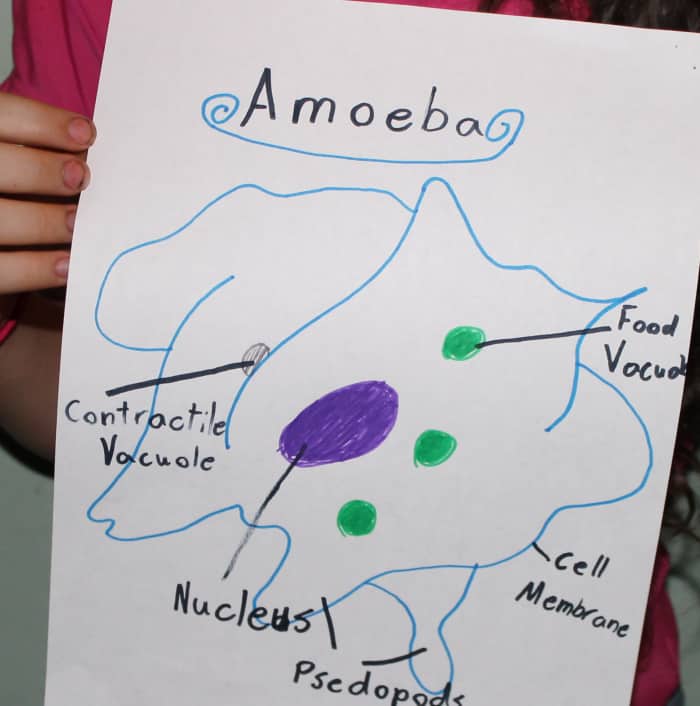
Visual for mini-presentation on amoebas
- Have students do mini-presentations on one-celled organisms.
- Divide students into pairs.
- Pass out a topic paper to each pair: Anton van Leeuwenhoek, Euglena, Trypanosome, Amoeba, Paramecia, Sporozoa, Bacteria, & Blue-green algae.
- Students will have 5 minutes to research their topic using the textbook and create a drawn visual to accompany the presentation. The presentation should include at least 3 important ideas and 1 interesting fact.
- Tip: One student might want to work on the information while the other student works on the visual.
- Have each pair present on their topic. I filled in any especially important information if it wasn’t included.
Observe Pond Water

Trying to identify protozoa in pond water under a microscope
- Allow students to view pond water under a microscope. (They should be able to see some protozoa even with a 40x magnification.) Can they identify any of the protozoa they saw?
You will need:
- at least 1 microscope
- at least 1 microscope slide and slip cover
- pond water
Pond Scum Game
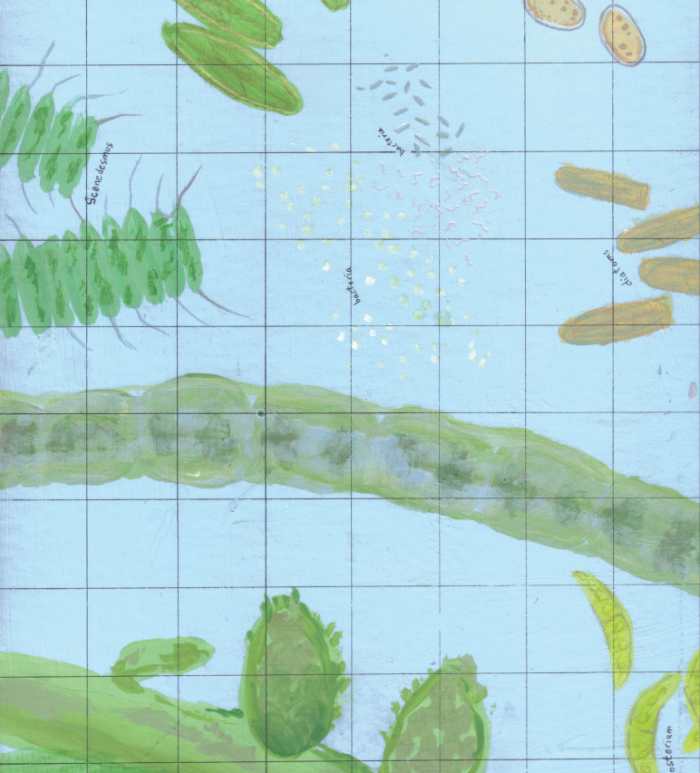
Part of the Pond Scum game
- Assemble and play the Pond Scum game.
- Have pair of students assemble the Pond Scum game, which is played similar to a chess game, with the various types of protozoa consuming one another.
- While students assemble their boards, explain the rules.
- Have students play the Pond Scum game. It will take about 30 minutes.
You will need:
- a set of this Pond Scum game for each pair of students (It is free to print.)
- scissors and tape or glue sticks (which students should have)
Homework
A Beka’s Science: Order & Design science textbook
(Page numbers refer to the pages in A Beka’s Science: Order & Design textbook.)
- Friday: Read pp. 432-436. Answer 4 questions of your choice from p. 436.
- Monday: Read pp. 437-445, skipping Science Investigation on pp. 441-442. Answer 4 questions of your choice from p. 446.
- Tuesday: Read pp. 446-448. Answer 3 questions of your choice from p. 449.
- Wednesday: Read pp. 449-455, skipping Science Investigation on pp. 451-452. Answer 3 questions of your choice from p. 455.
- Extra Credit #1: Read pp. 456-461. Select 2 of the trees featured. Draw a picture of the leaf or needle of the tree and its seed. Research online or in a book to find out a little bit more about the tree. Write 3 more pieces of interesting information about the tree that is not included in the textbook.
- Extra Credit #2: Sketch and identify 4 different trees that you find outside. Include the general tree shape, the leaf shape (possibly doing a leaf rubbing), and the bark type (possibly doing a bark rubbing) You can get another extra ticket for doing this for 4 more trees. (8 in total = 2 tickets)
Looking for all my lessons?
- First Day of Class & Plant Identifications
- Parts of a Flower
- Amazing Plants (Horticulturist Guest Speaker)
- Seeds and Flower Families
- Photosynthesis and Plant Parts
- Cardiovascular, Respiratory, & Digestive Systems
- Skeletal, Muscular, & Integumentary Systems
- Endocrine & Nervous Systems and Healthy Living
- Human Baby Fetal Development (Pregnancy Care Center Guest Speaker)
- Creation and Science
- Creation, Evolution, & the Eyes of Faith
- Classifying Plants & Animals
- Amazing Mammals
- Mammal Dissection
- Semester Review & Winter Party
- Bird Anatomy
- Bird Features
- Bird Watching (Birding Guide Guest Speaker)
- Fish Anatomy and Dissection
- Invertebrates Anatomy and Dissections
- Frog Dissection
- Reptiles Show and Tell
- Insect Anatomy
- Singing & Social Insects
- Beneficial Insects (Entomology Guest Speaker)
- Arthropods (Crayfish & Grasshopper) Anatomy and Dissections
- Crustaceans & Arachnids
- Cells, Algae, and Fungi
- Protozoa and Bacteria
- Trees
- Ecology
- Semester Review & End of Year Party
- My Middle School American History Lessons
- All of My Hands-on Lessons & Unit Studies
© 2019 Shannon
Leave a Reply