Middle School Biology Lesson on Photosynthesis & Plant Parts (Botany)
This is the 5th lesson in a series of 32 hands-on lessons covering middle school biology. This lesson covers plant parts and photosynthesis. I used this plan while teaching a 55 minute middle school biology class. Each lesson plan includes homework assignments and a variety of hands-on activities to make each lesson engaging & memorable. Use these fun lessons with your classroom, homeschool, after-school program, or co-op!
These lessons are written for a class that meets once a week. If your class meets 5 days a week, simply do this lesson one day a week and use the homework assignments (at the bottom of the page) for the work for the other days of the week.
Transpiration
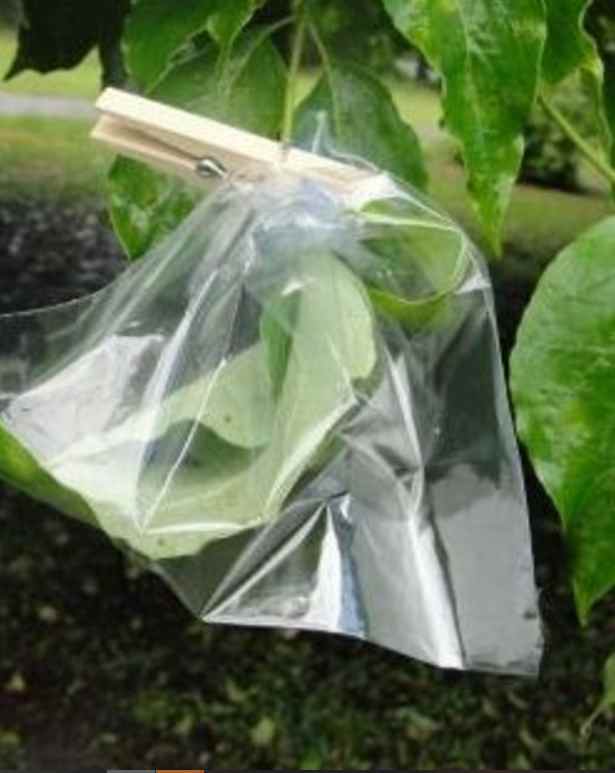
Transpiration Activity: Placing a bag over leaves in the sun
- Briefly talk about transpiration. Head outside and cover a leaf or leaves on a tree or other plant with a clear plastic sandwich bag and tightly close the bag using a clothespin, rubber band, or tape. Try to find leaves that are in the sun. If desired, place bags over leaves on 2 or 3 different trees or plants so that you can compare. If the tree or plant is indoors, move it to a sunny spot. Continue on with the lesson.
YOU WILL NEED:
- at least 1 tree or other plant (outdoors or indoors)
- 1-3 clears plastic bags, such as sandwich bags
- 1-3 clothespins, rubber bands, or tape
Pair ‘n Share Bizarre Plant Mini-Reports & Homework Review
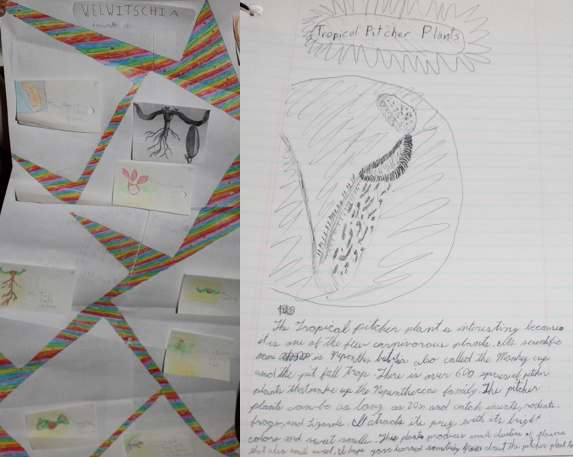
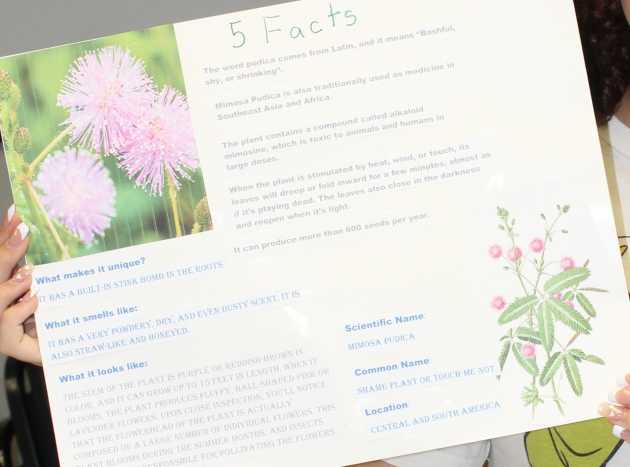
Bizarre Plant Mini-Reports
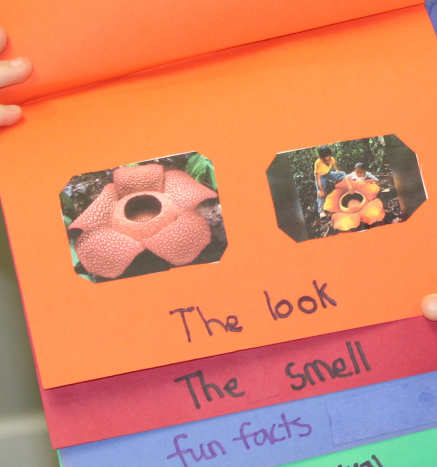
- Have students quickly show the picture of their bizarre plant, name it, and share 1-2 interesting facts about it. (I gave an extra prize ticket to students who went above & beyond on their mini-reports.)
- Go over the homework questions from the book. (I give out tickets for students who volunteer to answer the questions.)
 1 / 3
1 / 3
Lily/Liliaceae Family
Monocot Families Notes
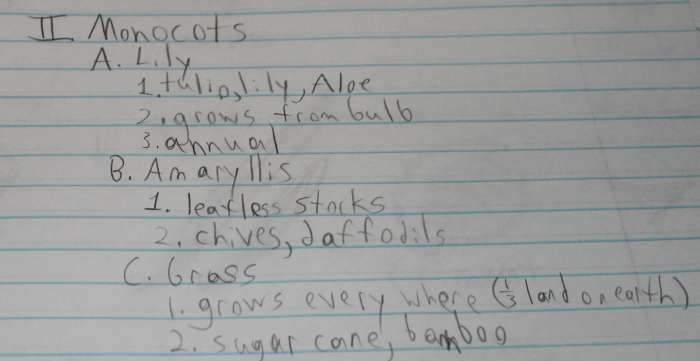
- Picking up from what we didn’t finish last week, have the student/pair share what they found about the lily family. Write whatever they say and then verbally add to the information.
- Traits: grows from a bulb (layers of thick, fleshy leaves surrounding a very short stem), annual (sprouts every year), bulbs store food during growing season so plant can live after the stem dies, & usually have large flowers with 6 petaloid tepals (undifferentiated petals and sepals), 6 stamens, & a superior ovary
- Examples: tiger lily, lily of the valley, tulip, hyacinth, trillium, day lily
Amaryllis/Amaryllidaceae Family
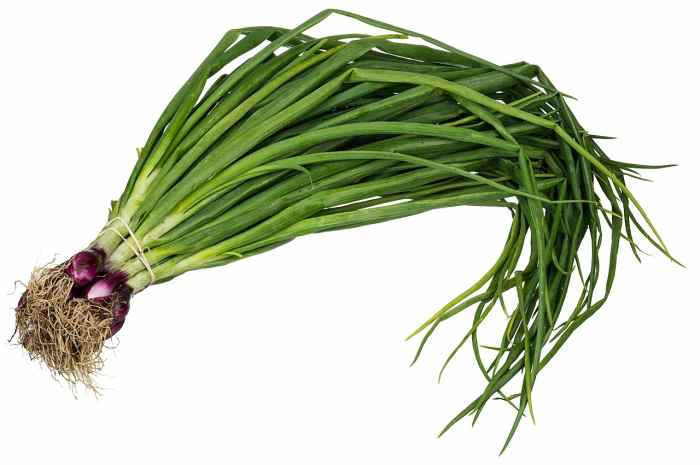
Scallions/Green Onions are part of the Amaryllis family.
- Have the student/pair share what they found about the amaryllis family. Write whatever they say and then verbally add to the information.
- Traits: leafless stalks, most grow from bulbs but some grow from corms or rhizomes (horizontal stem growing underground), & different from lilies because ovary is inferior (below flowering parts) rather than superior (above flowering parts)
- Examples: daffodil, amaryllis, narcissus, wild onion, garlic, chive (high in Vitamin C) — the last ones having strong odors
- Optional: Cut open a green onion bulb and allow children to quickly inspect the layers. They can also taste it if they desire.
You will need:
- Optional: green onions with bulbs, a knife, & magnifying glasses
Grass/Poaceae Family
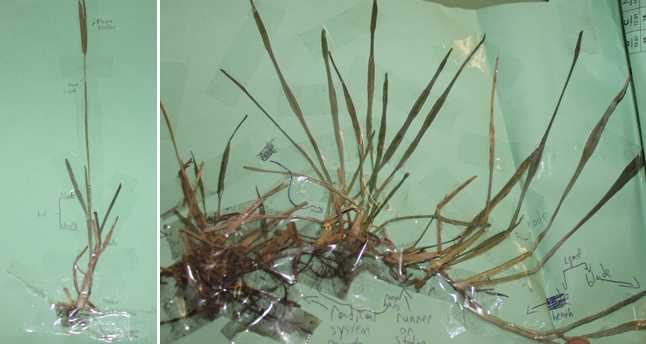
Labeling parts of grass (former homework assignment)
- Have the student/pair share what they found about the grass family. Write whatever they say and then verbally add to the information.
- traits: flowers are spikelets, small, inconspicuous clusters growing along main stem in spikes or caremens
- examples: variety of grasses, sugar cane, & bamboo (which can grow to be 125 feet tall)
- Fertilized grass flowers are the grains we eat
- Remind students about their homework when they mounted and labeled grass.
- Covers 1/3 of the earth’s land
- Feed the world: animals eat leaves & stems and we eat the grains
Leaf Shapes & Margins

Sketching 16 main leaf shapes plus margins
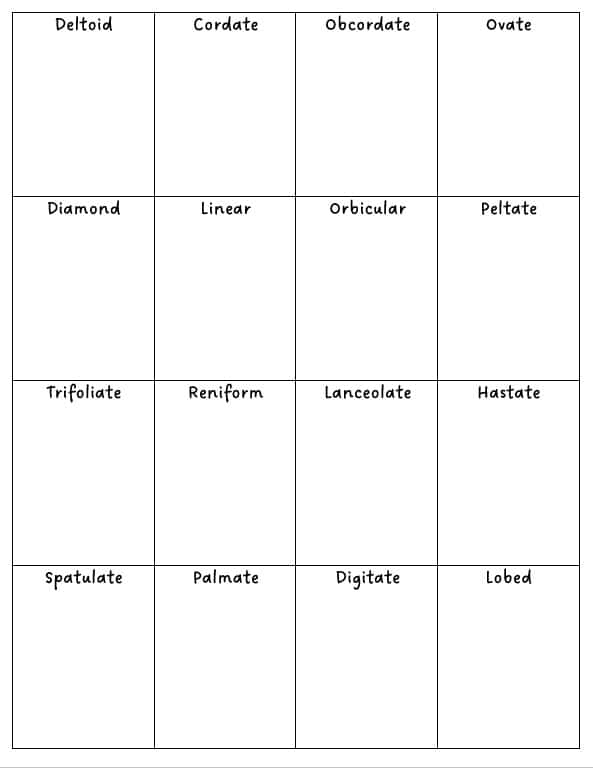
If desired, use this worksheet for them to draw their leaves.
- Lead the students in sketching 16 basic leaf shapes and leaf margins. I drew on the board while the students drew on their paper. I followed the below video.
You will need per student:
sheet of blank paper folded into 16 squares (or above worksheet) & punched with 3 hole punch and OPTIONAL: examples of some of the leaves
How to draw 16 basic leaf shapes – You can still watch it but you must be on YouTube.
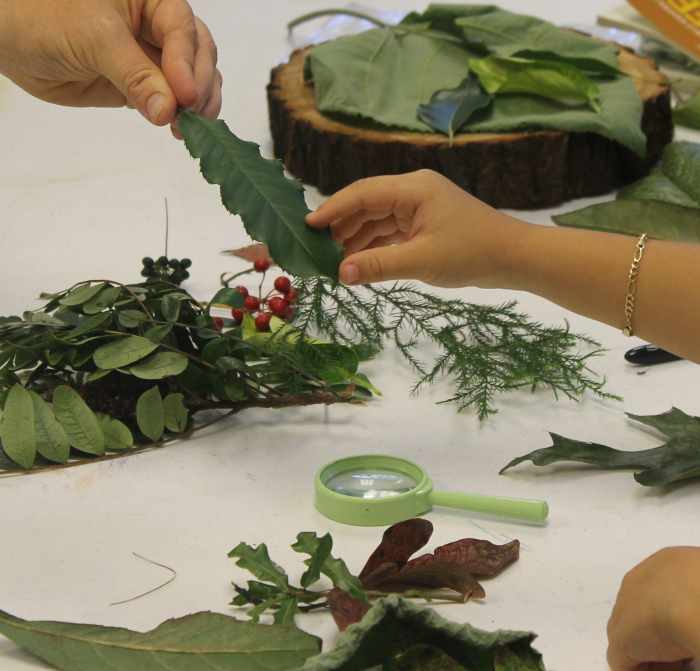
If desired, bring leaves of each of the shapes.
Photosynthesis
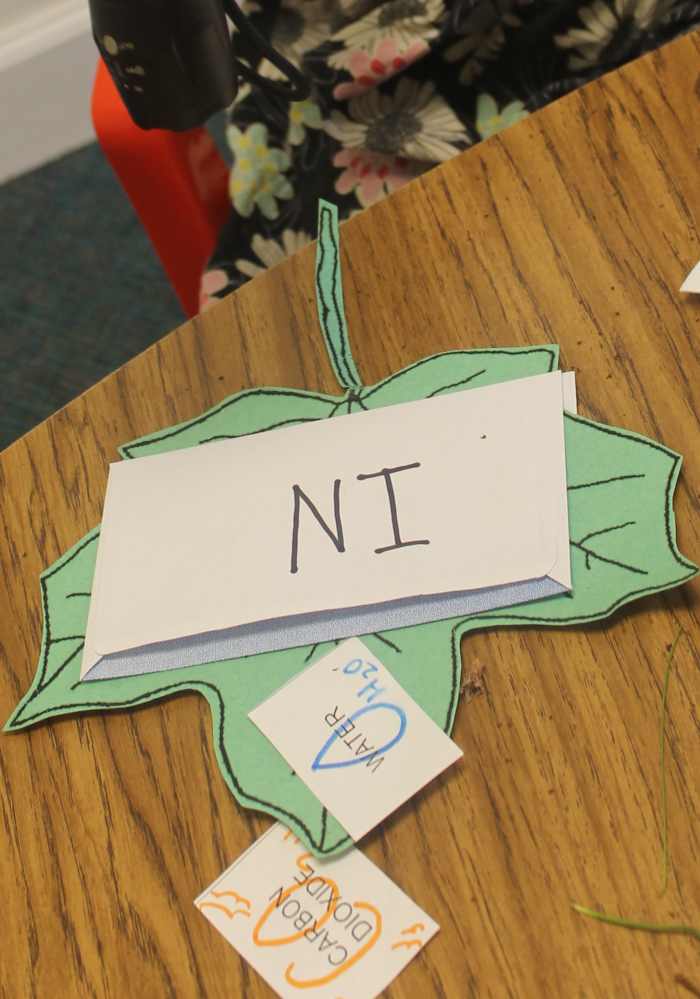
Photosynthesis Relay Race
- Briefly discuss photosynthesis.
- If you’re not limited by time, play the Photosynthesis Relay Race found at www.ellenjmchenry.com to review the formula for photosynthesis. Teams will race each other to complete the process of photosynthesis. They will place cards with water and carbon dioxide into the “in” envelope on a leaf and shine a flashlight on it and then will remove cards for oxygen, glucose, and water from the “out” envelope on the leaf.
- If you are limited by time (which we are), have 1 student volunteer to show the full process while standing in front of the class as you talk through what she/he should do.
You will need:
- at least 1 piece of green construction paper each cut into the shape of a leaf with 2 small envelopes glued to it
- at least 1 flashlight
- free pattern pieces found at www.ellenjmchenry.com
Photosynthesis & Glucose
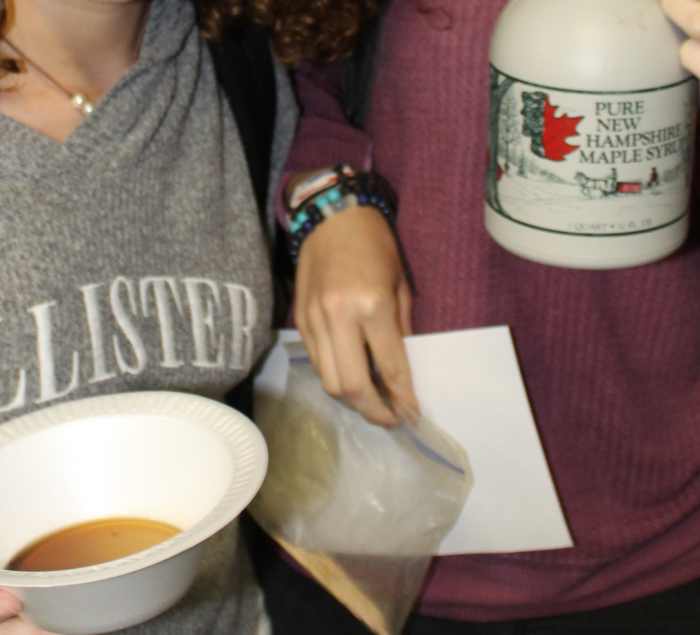
Tasting a product of photosynthesis: glucose (maple syrup)
- Write on the board the formula for photosynthesis: 6CO2 + 6H20 –> C6H1206 + 6O2 (The raw materials/reactants carbon dioxide + water combine to create the product of glucose and oxygen.)
- Allow students to dip a toothpick in maple syrup in order to sample the glucose created during photosynthesis.
- The glucose is created in the leaves and then flows through phloem to the rest of the plant.
- As they sample the “glucose”, they can also enjoy the other product of photosynthesis: oxygen.
You will need:
- maple syrup
- a bowl
- a toothpick per student
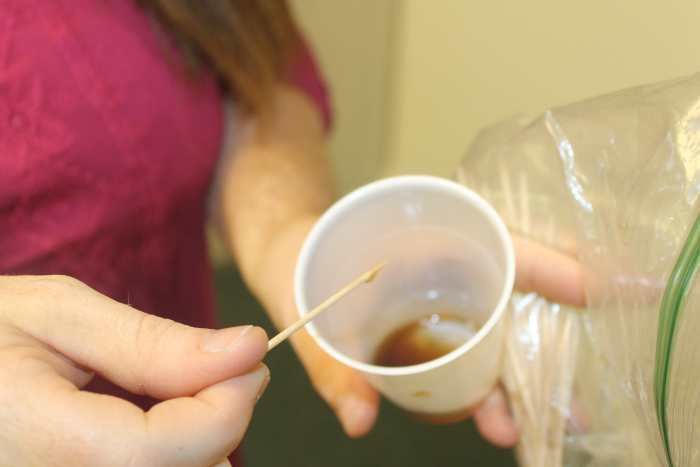
Tasting maple syrup
Vascular System
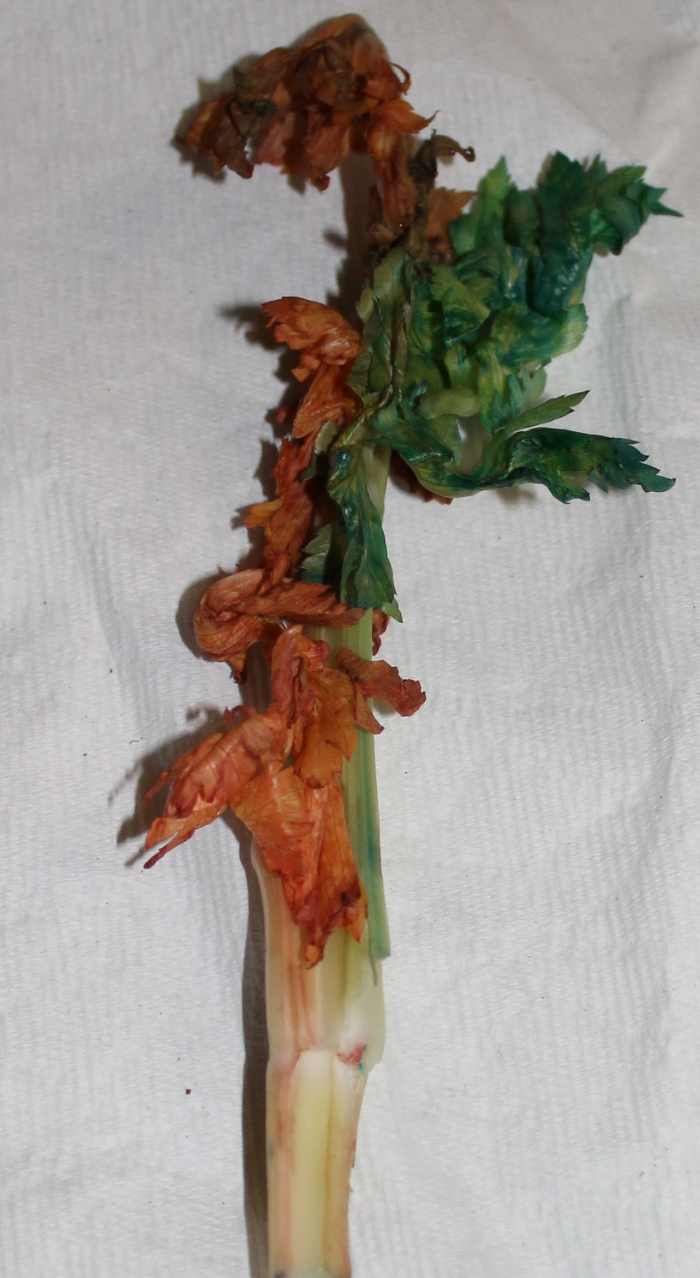
Celery that was dyed to show how its vascular system works
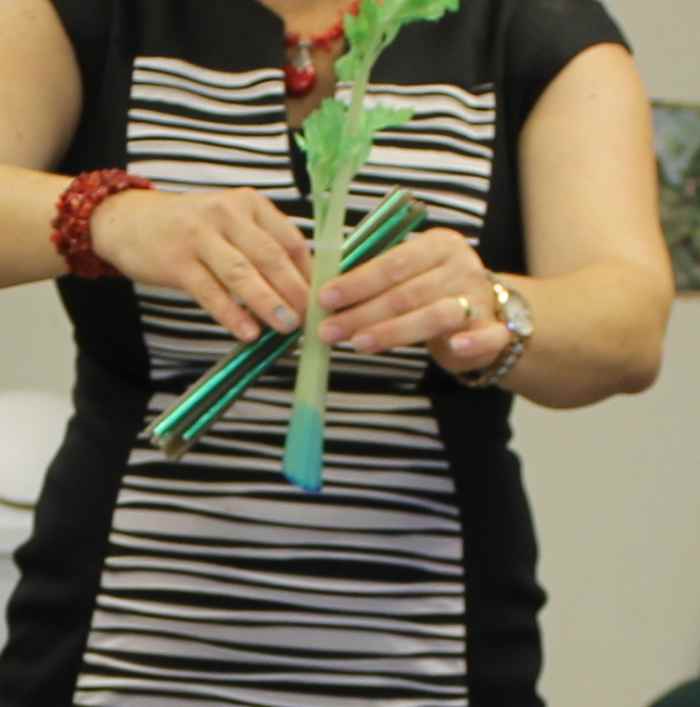
Showing a “vascular bundle” of straws
- Pass around pieces of celery that were placed in water dyed with food coloring. Allow students to look at their & break the stems to see the dye in the veins as well.
- Show a “vascular bundle” of straws (two different colors of straws, a few of each, taped together). There are 2 types of straws just like there are two types of transportation systems: phloem & xylem.
- Which part carries sugar from leaves to stem & roots to be stored? (Phloem)
- Which part carries water & nutrients from root hairs to leaves where water is used in photosynthesis or released through stomata? (Xylem)
- (Optional) Allows students to eat celery sticks.
You will need:
- a few stalks of celery with leaves that have been dyed using food coloring – Blue worked the best for us. I did mine overnight. If you’d like to start the celery at the beginning of the class, you’ll be able to see it some if you use the smaller, inner stalks of celery
- celery for students to eat
- a few straws each of 2 different colors, taped together in a bundle
Acting out Xylem and Phloem
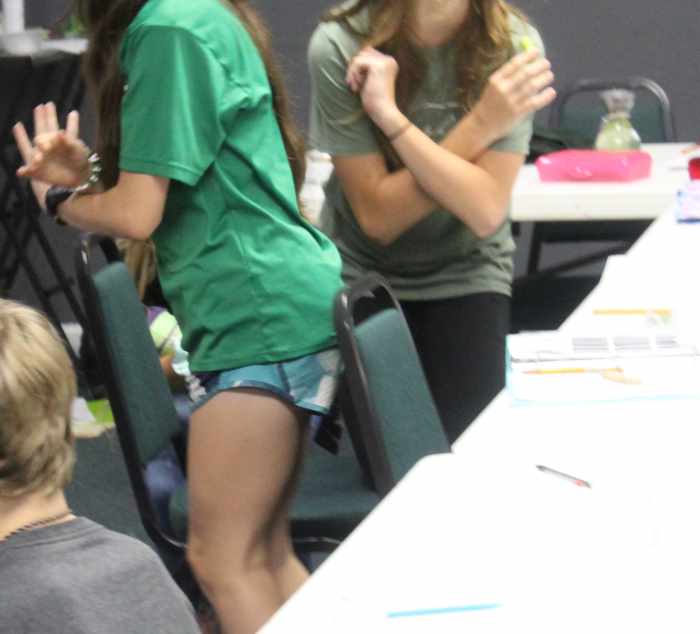
Acting out Xylem and Phloem
- Act out Xylem and Phloem to help remember what they do: “Water zips up the xlyem; sugar flows from the phloem.”
- Cross arms in front of you like an X to remind you of xylem. Even though it starts with an X, it makes a Z sound as does zip.
- Stomp your feet, which will be our roots. Squat down near your feet/roots. As you stand up, uncross your arms, spreading them out to your “leaves” and say, “Water zips up the xylem.”
- Do a wave with your arms as you say, “Sugar flows from the phloem.” Sugar, food for the plant, flows out of the leaves to the rest of the plant through the phloem. (Phloem starts with an F sound as does flow.)
- Repeat one more time as you chant, “Water zips up the xylem; sugar flows from the phloem.”
Roots
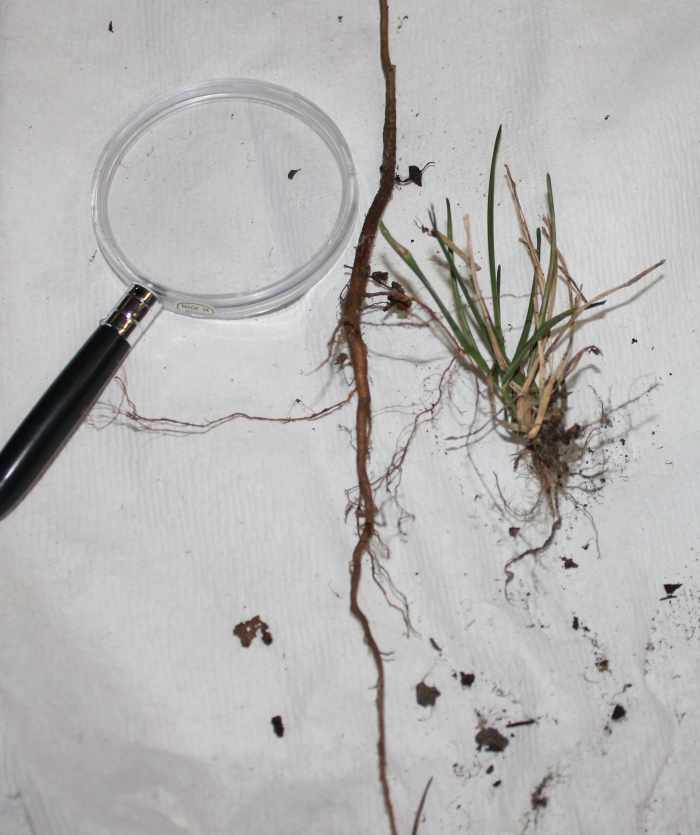
Comparing tap & fibrous roots
- Allow groups of students to observe tap roots & fibrous roots using magnifying glasses. As they observe the root systems, briefly mention:
- Most dicots have taproots & monocots have fibrous roots.
- Why are roots important? (Allow students to answer) Root system anchors the plant in the soil, absorbs water & minerals for plant growth, & stores food
- Some plants like strawberries reproduce not by flowers but by vegetative reproduction. Their roots spread out to form new plants.
- Root cap (dead cells) protects new cells as they push through soil to lengthen root
- Roots can lift houses. They upset sidewalks. If you’ve been on an uneven sidewalk with cracks, roots are probably to blame.
- Roots can grow long to get to water. The roots of a fig tree in South Africa grew 393 feet in order to get water!
- Some roots grow above the ground like the ones for a banyan tree.
- The root hairs absorb nutrients & water through osmosis = continual movement of water from solution of higher water content through semipermeable membrane into solution of lower water content.
- *Demonstrate osmosis by placing a piece of paper towel next to a small puddle of water.
You will need:
- examples of tap roots & fibrous roots
- magnifying glasses
- small amount of water
- a few small pieces of paper towel
Transpiration
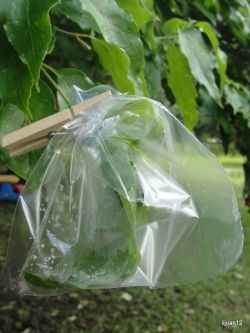
Water in the sandwich bag came from transpiration
- Check on the bags that are over the leaves that you started at the beginning of class. Hopefully you’ll be able to see some water in them. Where did it come from? The leaves! What part of the leave did the water come from? (stomata)
- How does transpiration work? How do plants suck up the water?
- Quickly demonstrate transpiration by having a few volunteers hold hands. They each represent a water molecule.
- As a water molecule flies up into the sky out of the stomata, another water molecule must replace it. It pulls another one from down in the root system. This continues on.
Importance of Plants
- How are plants important to us? (Allow students to share)
- We eat them for food or eat animals that eat them for food.
- They’re an important source of Vitamins A, B-complex, C, E, & K
- Most of the water in our clouds is pulled from the ground through a plant & then evaporated into the sky.
- They recycle our carbon dioxide & provide oxygen for us & for animals.
A Beka’s Science: Order & Design
Homework
Page numbers refer to the pages in A Beka’s Science: Order & Design.
- Friday: Body Systems: Read pp. 78-79 on body systems & answer 3 questions of your choice on p. 80.
- Monday:Cardiovascular System:
- Read pp. 80-82 on the cardiovascular system.
- Complete Tackle This on p. 82 by listing the names for #1-9. Use the diagram on p. 81 to help!
- Color The Heart Worksheet blue & red. (It’s posted below)
- Tuesday:Respiratory System:
- Read pp. 82-83 on the respiratory system.
- Complete Tackle This on p. 83.
- Read questions #3-5 on p. 91 & answer 2 questions of your choice.
- Wednesday:Digestive & Urinary System:
- Read pp. 85-87 (skipping Check it Out) on the digestive and urinary systems. [Don’t read about the Lymphatic System.]
- Read questions #6-10 on p. 91 & answer 3 questions of your choice.
- Do the Thought Provoker on p. 91.
- Extra credit: Get an extra ticket for EACH worksheet you color. (1 colored page = 1 ticket). Click on the picture to have it come up in a printable format: https://iheartguts.com/blogs/free-downloads/heart-circulatory-system-coloring-page , https://iheartguts.com/blogs/free-downloads/115615493-respiratory-system-coloring-page , & https://iheartguts.com/blogs/free-downloads/54625989-digestive-system-coloring-page .
Heart Worksheet
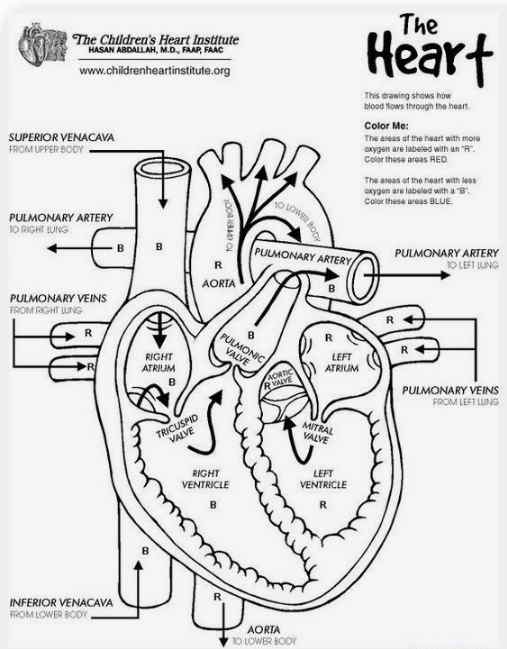
Heart worksheet
Homework: Colored Worksheets
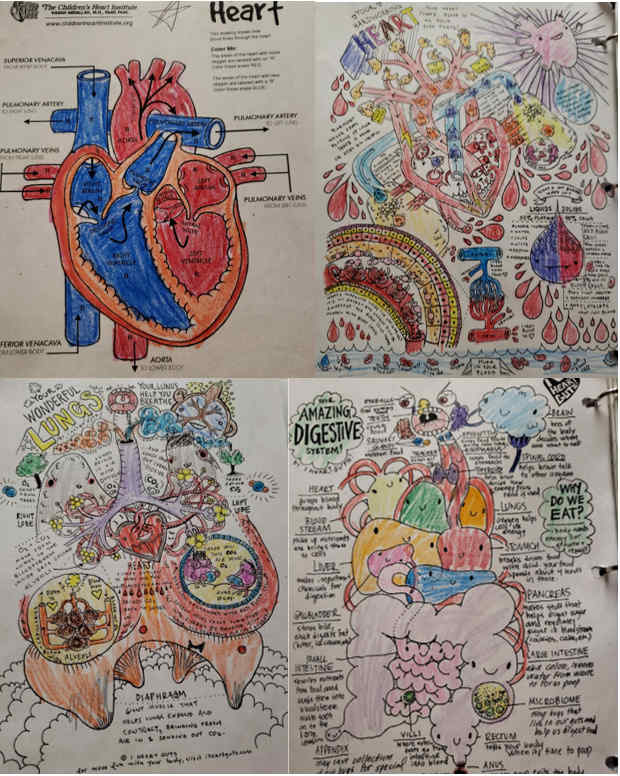
One of the homework worksheets and 3 extra credit pages
Looking for all my lessons?
- First Day of Class & Plant Identifications
- Parts of a Flower
- Amazing Plants (Horticulturist Guest Speaker)
- Seeds and Flower Families
- Photosynthesis and Plant Parts
- Cardiovascular, Respiratory, & Digestive Systems
- Skeletal, Muscular, & Integumentary Systems
- Endocrine & Nervous Systems and Healthy Living
- Human Baby Fetal Development (Pregnancy Care Center Guest Speaker)
- Creation and Science
- Creation, Evolution, & the Eyes of Faith
- Classifying Plants & Animals
- Amazing Mammals
- Mammal Dissection
- Semester Review & Winter Party
- Bird Anatomy
- Bird Features
- Bird Watching (Birding Guide Guest Speaker)
- Fish Anatomy and Dissection
- Invertebrates Anatomy and Dissections
- Frog Dissection
- Reptiles Show and Tell
- Insect Anatomy
- Singing & Social Insects
- Beneficial Insects (Entomology Guest Speaker)
- Arthropods (Crayfish & Grasshopper) Anatomy and Dissections
- Crustaceans & Arachnids
- Cells, Algae, and Fungi
- Protozoa and Bacteria
- Trees
- Ecology
- Semester Review & End of Year Party
- My Middle School American History Lessons
- All of My Hands-on Lessons & Unit Studies
© 2018 Shannon
Leave a Reply