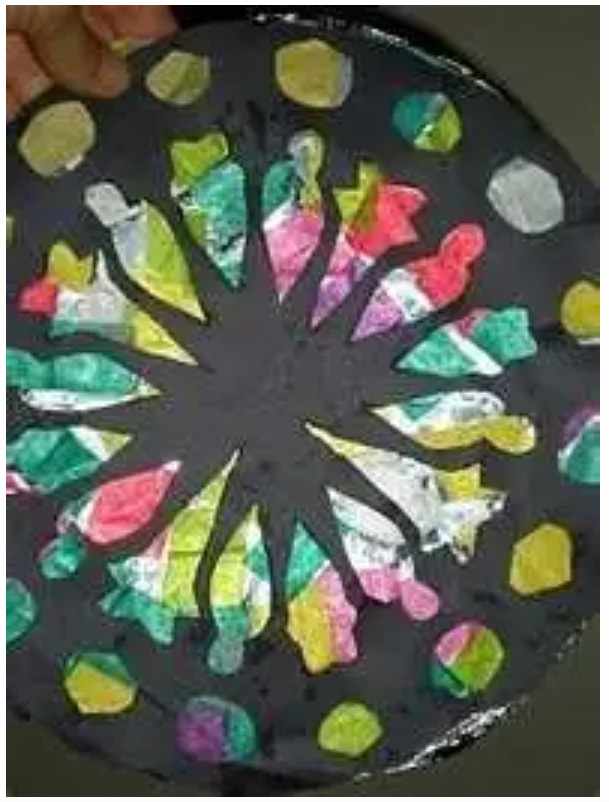
Tissue paper rose window
This is part 3 of a 4 (or 5) part hands-on unit on the Medieval Period with this lesson focused on Medieval Art. Alternatively, use this as a stand-alone lesson when studying CC Cycle 2 Week 5 History on the Hundred Years’ War. Mix together and paint with egg yolk paint, design and eat stained glass window cookies, create colorful tapestries, and more! These lessons are geared toward elementary children and their siblings. They were created for our weekly homeschool co-op. With a co-op, this lesson can take 2 1/2 hours. It can take less (or more) time if you’re doing this just with your family. Use these fun lessons with your class, family, co-op, after school program, or camp!
*Tip: Don’t get overwhelmed. You don’t have to do every activity we did.*
Illuminated Texts and Egg Yolk Paint
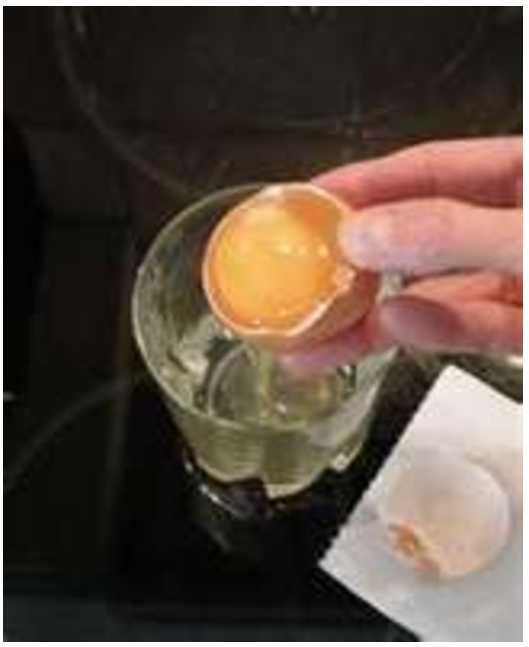
Making egg yolk paint
- Pray. Read & discuss Psalm 2:11.
- Read “Marguerite Makes a Book” by Bruce Robertson, which is a fabulous book! A daughter helps her father make an illuminated text prayer book. In the book you follow her as she buys parchment made from calfskin, old eggs for the paint, goose feathers for the paintbrushes, and apothecary roots and herbs for paint colors. My 3, 5, & 9 year old children loved this book. Of all the books we read about illuminated texts, this was by far the favorite and the most educational.
YOU WILL NEED:
- Make egg paint.
- Pass out eggs and have children separate the egg yolks from the egg whites. Have them place individual egg yolks in small, disposable cups. (The egg whites can be thrown away or you can save them to cook with them. Our kids got a lot of shells in the egg mixture, so we threw out the egg whites.)
- Ask children what people used to use to add color to the paint. After they have answered, tell them that we will be using colored chalk.
- Pass out bags of crushed sidewalk chalk, and have children mix in the sidewalk chalk into the egg yolk.
YOU WILL NEED:
- at least 1 egg per child
- disposable cups
- spoons
- a variety of colors sidewalk chalk that has been pounded into small granules the size of sand* (Note: If you’re not limited by time, allow the children to smash the chalk [inside bags] into pieces using a hammer. They LOVED doing this.)
Paint with Egg Yolk Paint
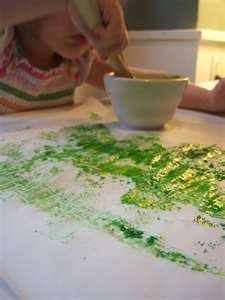
Painting with egg yolk paint
4. While listening to music from the medieval period, paint with egg yolk paint.
- Show children some examples of paintings from the Middle Ages. (If they don’t notice, you can point out that most of them were religious paintings.)
- Pass out paper and paintbrushes.
- Let children paint a picture using the egg yolk paint. Children should share paint. You can also pour some out onto small plates if children want their own “palates.”
YOU WILL NEED:
- Medieval period music (played on your phone or from a CD)
- pictures of paintings from the Middle Ages
- paper
- paintbrushes
Cathedrals & Stained Glass
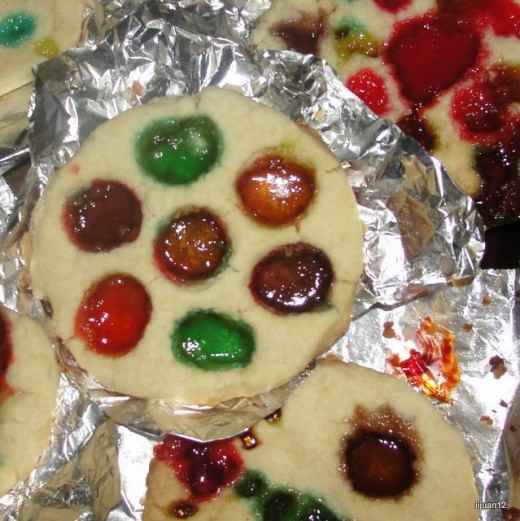
Stained Glass Window Cookies made using sugar cookie dough and crushed Jolly Rancher candy
(NOTE: If you are doing the optional lesson on cathedrals, make Cathedral Window Jell-O Dessert (recipe below) instead of Stained Glass Window Cookies.)
- Introduce cathedrals & stained glass windows. I used the book Cathedrals (First Discovery series). which gives a nice overview. As already mentioned, much of the art was religious. Not only did they paint religious scenes, but religious “art” was put up in cathedrals in the form of the stained glass windows. Show some pictures from books.
YOU WILL NEED:
- Cathedrals (First Discovery series) by Maurice Pommier or other book on Cathedrals
- Make stained glass cookies.
- Give each child a piece of aluminum foil. Have each child write their name on the foil with a sharpie marker so they can later identify their baked cookie. Spray the aluminum foil with non-stick cooking spray.
- Give each child a scoop of sugar cookie dough and have them roll it into a snake shape (about 1/4 inch thick). Have them form it into a shape (circle, star, diamond, etc.) and make sure to pinch the edges together.
- Let them sprinkle crushed Jolly Rancher candy inside the dough outlines, filling the spaces completely and heaping it slightly.
- Place them on a baking sheet and have a teacher or parent bake them at 375F for 8-10 minutes.
- (If you’re not limited by time, let children make more than one cookie and use cookie cutters to make the outline shapes. They can even place their cookies near each other on the baking sheet to have them bake together to form a window.)
YOU WILL NEED:
- prepared sugar cookie dough
- non-stick cooking spray
- aluminum foil
- sharpie marker
- crushed hard candies (Jolly ranchers, life savers, lollipops, etc.) of a few different colors
- baking sheets
*Note: If you are planning on including the lesson on Cathedrals in this Medieval Unit Study, then do not make these cookies as this activity is repeated in the Cathedral lesson plan. Instead, make Cathedral Window Jell-O Dessert, 1) Ahead of time (before class) prepare various colors of Jell-O. (We used red, green, and yellow.) 2) At the beginning of class, have the children work together to whisk together 1 1/2 cups water and 3 tbsp. unflavored gelatin. In a separate bowl they will mix up 1/2 cup pineapple juice, 1/2 cup condensed milk, 1/2 cup heavy cream, 4 tbsp. sugar, and 1/4 tsp. salt. Then you, the parent/teacher will add 1 cup of boiling water to the unflavored gelatin mixture. Then combine that with the pineapple and milk mixture. 3) Have the children crumble up the prepared colored Jell-o and put it in a mold (such as a silicone Bundt pan). 4) Pour the milk mixture over all of this. 5) Place this in the freezer for one hour and then in the refrigerator until you are ready to serve it.
Rose Windows
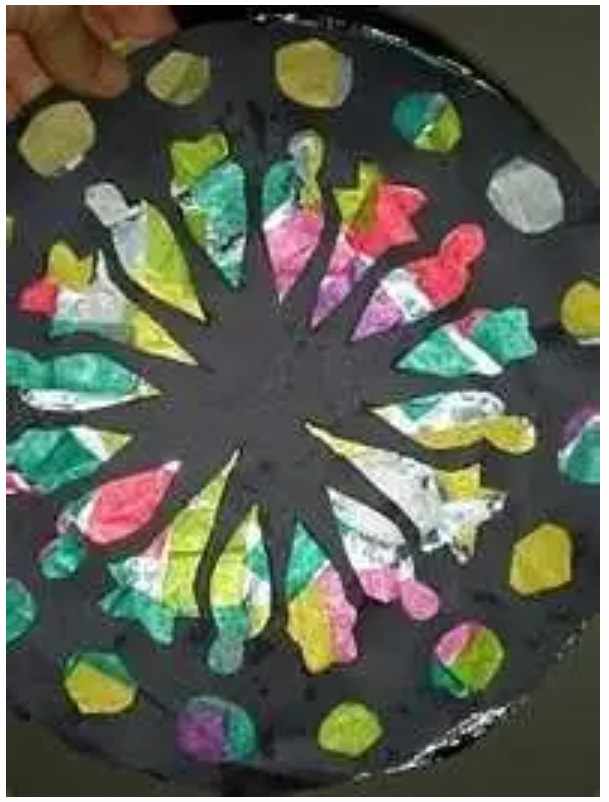
Tissue and construction paper rose window
- While the cookies are baking, make a stained glass rose window.
- Pass out 2 sheets of black construction paper to each child. Lay out scraps of various colors of tissue paper, pencils, scissors, and glue.
- If desired have children cut the 2 pieces of black construction paper into a large shape (dome, diamond, etc.). Use a pencil to outline about 1/2 inch all around the edge of the construction paper. This will be the frame for the window and should never be cut. Inside that “frame,” they can cut out various shapes. They should always cut both sheets of construction paper the same as one will be the front and one will be the back.
- Place glue all over the construction paper and then lay pieces of tissue paper over the holes. The tissue paper will act as the stained glass.
- After covering all of the holes, paste the second piece of construction paper over the piece of construction paper that has the ragged edges of tissue paper showing.
- Punch a hole in the top and string yarn through it so that it can be hung near a window.
*When doing this for young children, pre-cut out the black construction paper stained glass “frames” ahead of time and have the children simply place the glue and the tissue paper on the construction paper and then glue the 2 frame pieces together.*
YOU WILL NEED:
- 2 pieces of black construction paper per child
- scissors, pencils, rulers, glue
- scraps of tissue paper of assorted colors
- hole punch
- yarn or string
Learning About Tapestries
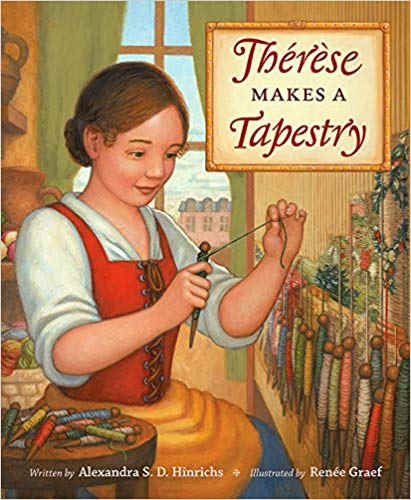
“Thérèse Makes a Tapestry” by Alexandra S.D. Hinrichs
- Use Thérèse Makes a Tapestry by Alexandra S.D. Hinrichs to introduce what tapestries are and how they were made. Using your phone or books, show pictures of additional tapestries and quickly discuss how they were made and their uses (decorating stone walls and keeping warmth in a drafty castle).
YOU WILL NEED:
- Thérèse Makes a Tapestry by Alexandra S.D. Hinrichs
- additional pictures of tapestries (from your phone or from other books)
Creating Tapestries
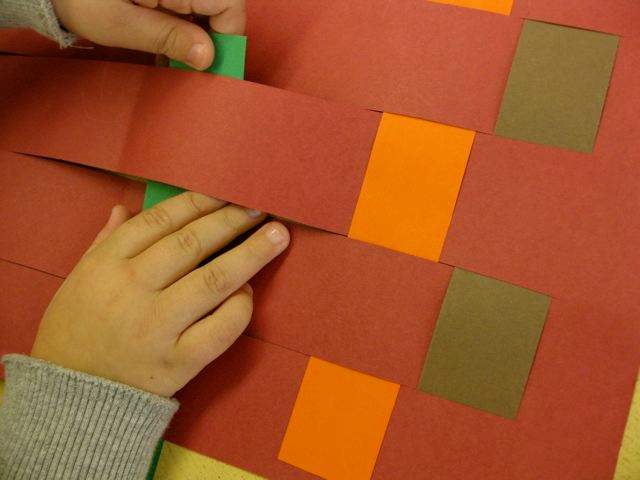
Paper weaving
9a. Option 1: Allow children to use construction paper strips to weave a “tapestry.”
- Cut strips of construction paper.
- Cut lines in a sheet of construction paper to within 1-inch of the border.
- Have children weave the cut strips over and under.
YOU WILL NEED:
- construction paper
- scissors
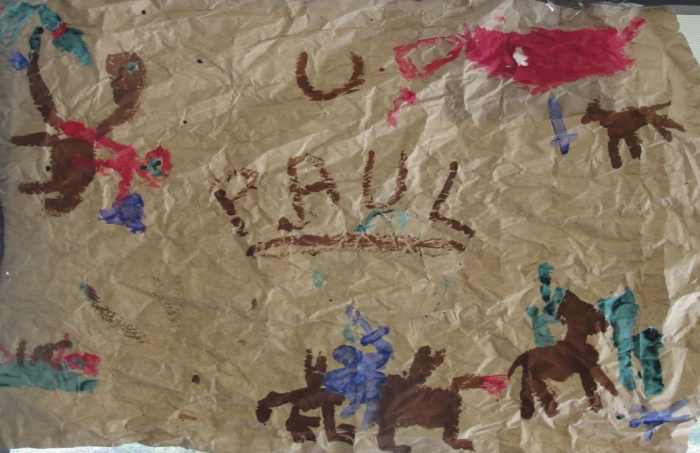
9b. Option 2: Pass out a piece of fabric to each child. (An old pillowcase works perfectly.) Even though tapestries would have been stitched together to form the designs, we will simply be painting the designs onto fabric. Allow children to paint a medieval-type design onto the fabric. If desired, staple the top ends over a stick. Tie a piece of string to each end of the stick so children can hang it up on the wall. Save these for the medieval feast!
YOU WILL NEED:
- large square or rectangular pieces of fabric provided by teacher/parent (you can tell each parent to bring an old pillow case for each child)
- paintbrushes
- paint
- smocks or old t-shirts to cover clothing (optional)
- (If time allows) Eat stained glass cookies and drink water.
- Review what we learned.
Looking for our favorite children’s books?
Our Favorite Books on Joan of Arc & the Hundred’s Year War
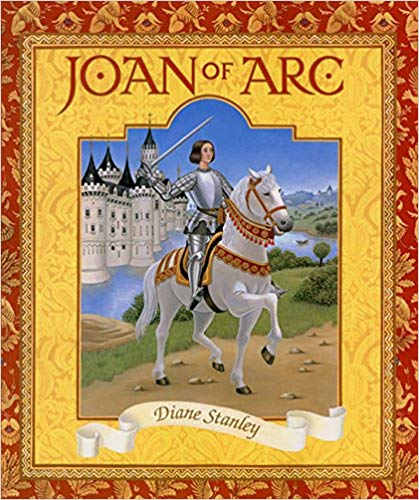
Joan of Arc by Diane Stanley – Book image is from amazon .com.
- Joan of Arc by Diane Stanley was our favorite picture book on Joan of Arc and the Hundred Years’ War, though it is a longer picture book.
- You Wouldn’t Want to Be Joan of Arc! by Fiona Macdonald was our second favorite book and was enjoyed by all my children.
- Joan of Arc by Demi is good, though it is longer.
Our Favorite Books on Illuminated Texts

The Ink Garden of Brother Theophane by C.M. Millen – Book image is from amazon .com.
- Marguerite Makes a Book by Bruce Robertson – If you can only read one book related to Medieval Art, this is by far our favorite. We learned so much from reading it, and it was a delight to all my children.
- The Ink Garden of Brother Theophane by C.M. Millen was our second favorite book. It is about a monk in a monastery in Ireland who grew tired of copying books and became inspired when asked to create ink. He collected various plants and started making beautiful colors and pictures. This does a great job of emphasizing that many of the colors for ink came from dried plants. It includes facts about the history of monasteries, scriptoriums, and illuminated
- Illuminations by Jonathan Hunt is a beautifully illustrated book that includes lots of vocabulary children will come across as they study the medieval period. At least one of the pages is featured per letter; sometimes the illustration goes across two pages. The illustrations are beautiful and highly detailed. With each word there is a 3-4-sentence explanation of what the word is about. The author states he has gone to great lengths to make the illustrations historically accurate.
- Magic in the Margins: A Medieval Tale of Bookmaking by W. Nikola-Lisa,
- Bestiary: An Illuminated Alphabet of Medieval Beasts by Jonathan Hunt
- Bibles and Bestiaries: A Guide to Illuminated Manuscripts by Elizabeth B. Wilson
- While not related to illuminated texts but relating to book-making, Johann Gutenberg and the Amazing Printing Press by Bruce Koscielniak is an excellent picture book about the invention of the printing press.
Our Favorite Children’s Books on Tapestries
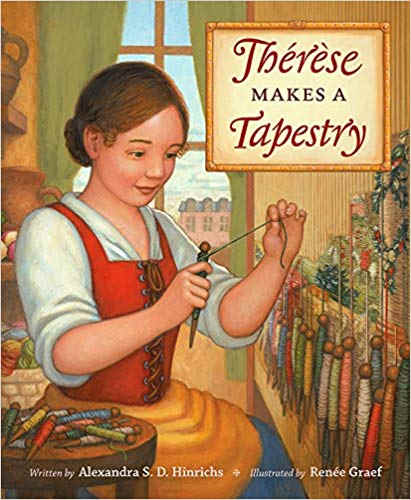
Thérèse Makes a Tapestry by Alexandra S.D. Hinrichs – Book image is from amazon .com.
- Thérèse Makes a Tapestry by Alexandra S.D. Hinrichs is about a young girl making a tapestry for for King Louis XIV. We learned so much about how tapestries used to be made. All of my children enjoyed this book.
- The Crystal Mountain by Ruth Sanderson is a fairy tale about a tapestry maker. It has gorgeous illustrations and an enjoyable story!
- The Tapestry Cats by Ann Turnbull is a cute picture book about a princess who makes up stories from the tapestries on the castle wall.
- Medieval Tapestries Coloring Book (Dover Fashion Coloring Book) by Marty Noble is a coloring book has gorgeous replicas of many of the famous tapestries. You can use it for coloring or you can simply use it as a picture book to read through as it does also include interesting text.
- Lady and the Unicorn by K. Price is a story made up about the characters in the famous tapestry of the lady and the unicorn.
- Tapestries: Stories of Women in the Bible by Ruth Sanderson includes a tapestry theme and tapestry-like illustrations to tell the stories of some of the women in the Bible.
Our Favorite Books on Medieval Monks
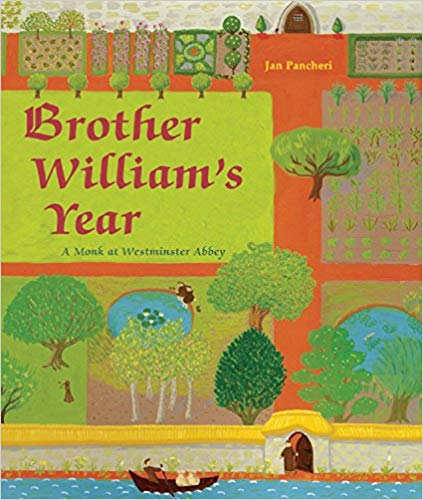
Brother William’s Year: A Monk at Westminster Abbey by Jan Pancheri – Book image is from amazon .com.
We did read about monks with this lesson since many monks were involved in the creation of illuminated texts and other forms of art during this time period.
- Brother William’s Year: A Monk at Westminster Abbey by Jan Pancheri describes what the typical daily life of a monk named Brother William during the fourteenth century. He gardens, illustrates a manuscript, builds a barn, prays, sings psalms, etc. The illustrations are also a delight!
- Do Re Mi: If You Can Read Music, Thank Guido D’Arezzo by Susan Roth is a fabulous picture book on the monk who developed our current system of written music. It is a must-read picture book!
- The Little Jester by Helena Olofsson tells the story of a jester who is taken in by monks and teaches the abbot about joys of generosity and laughter. It is similar to Tomie dePaola’s Clown of God, which is another great story book to read. Both have wonderful messages!
- Saint Francis of Assisi: A Life of Joy by Robert F. Kennedy was our favorite book on Saint Franscis of Assissi. We enjoyed numerous picture books about the life of Saint Francis of Assisi including this book and A Gift from Saint Francis: The First Creche by Joanna Cole and Clare and Francis by Guido Visconti.
Our Favorite YouTube Videos
Manuscripts as explained by the Getty Museum
CC Cycle 2 Week 5 History Song
Ready for the next lesson?

Knighting ceremony and joust from part 4 (or 5): Knights & Ladies Lesson
Bake medieval meals, create a medieval village, design stained glass window cookies, hold a jousting tournament, and more during this fun 5 or 6 week hands-on unit study of the medieval period!
- Medieval Life Lesson – Cook & eat a Medieval meal, play Medieval games, create Medieval crowns, and more! This is part 1 of a 5 (or 6) part hands-on unit on the Medieval Period.
- Castles Lesson – Build model castles, weapons, and more! This is part 2 of a 5 (or 6) part hands-on unit on the Medieval Period.
- Medieval Art Lesson – Mix together and paint with egg yolk paint, design and eat stained glass window cookies, create colorful tapestries, and more! This is part 3 of a 5 (or 6) part hands-on unit on the Medieval Period.
- Cathedral Lesson – This focuses on Cathedral design and architecture. Decorate stained-glass cookies, design a dome using blocks, sketch each type of cathedral, sing about the true foundation of cathedrals, and more in this fun lesson on cathedrals! This is part 4 of a 5 (or 6) part hands-on unit on the Medieval Period.
- Knights & Ladies Lesson – Create a Coat of Arms and swords, hold a jousting tournament, act out a knighting ceremony, and more! This is part 5 of a 5 (or 6) part hands-on unit on the Medieval Period.
- Medieval Feast Lesson Plan (Option A: Learn as a Lesson) – Decorate a banquet hall, prepare the feast (recipes included), provide entertainment, and more while learning about Medieval Feasts. This is part 6 of a 6 (or 6) part hands-on unit on the Medieval Period.
- Medieval Feast and Field Trip Ideas (Option B: Culminating Dinner Event) – This is the culminating activity we did after a 5 week hands-on unit on the Medieval Period. Hold a festive medieval feast dinner complete with entertainment and much merriment. Also included are the field trips we took during our unit.
- My World History Lessons and Unit Studies (8 unit studies & 40 lessons): Tabernacle, Medieval Period, Leonardo da Vinci, Protestant Reformation, Explorers, China, Russia, & Africa
© 2012 Shannon
Comments, questions, or ideas? – Please leave a note to let me know you dropped by. I LOVE getting feedback from you!
Shannon (author) from Florida on April 09, 2013:
@siobhanryan: Thank you!
siobhanryan on April 09, 2013:
Very interesting
Shannon (author) from Florida on January 16, 2013:
@julieannbrady: Thank you!
Shannon (author) from Florida on January 16, 2013:
@KarenTBTEN: Thank you!
Shannon (author) from Florida on January 16, 2013:
@sukkran trichy: Thank you!
sukkran trichy from Trichy/Tamil Nadu on February 22, 2012:
very interesting read. your lesson plans series are really great.
KarenTBTEN on January 30, 2012:
What a lot of good teaching ideas… and personalized reviews of books. SquidAngel blessings.
julieannbrady on January 30, 2012:
The Medieval Ages were sure an interesting time for us to learn from.
Leave a Reply