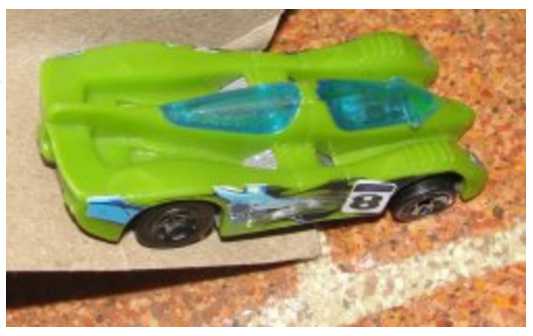
Cars racing down ramps
This is part 1 of a 5 part hands-on unit on Simple Machines and Inventions OR is a stand-alone lesson if studying CC Cycle 2: Week 16 on Newton’s First Law of Motion. Race cars down ramps, compare carrying luggage to pulling it up an inclined plane, slice through apples using wedges, and more! These are lessons I created to do with a weekly homeschool co-op children between the ages of 1-13. Each lesson takes 2 1/2 hours, though you can pick and choose activities if you’d like a shorter lesson. Use these fun lessons with your classroom, family, after school program, or co-op!
*Tip: You don’t have to do all the activities we did. Pick and choose what appeals to you.*
What is work?
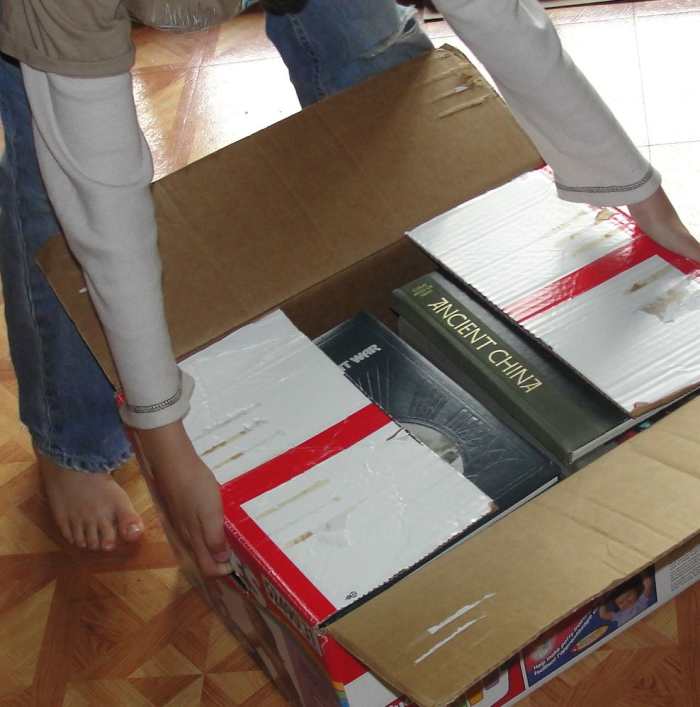
Demonstrating work
- Read & discuss Genesis 1:26-28 & Genesis 3:17-19. Mention about how God created work from the very beginning. After Adam disobeyed God by eating the forbidden fruit, God cursed Adam by making work difficult. After creating the entire world, God did create man in His own image. One of the ways we are like God is that we are creative like He is. Over the years people have created ways to try to make this difficult work easier. The way they do that is by using machines.
- Ask everyone what work they would like to do when they grow up. What does it mean to work? Before we learn about simple machines, we need to learn some science (specifically physics) words. Let’s start with work.
- Tell a child to lift a heavy box filled with many heavy books (or a duffle bag filled with weights) and place the box on the table. It should be too heavy for him/her to lift. Are you doing any work? (No!) Why not? You haven’t moved the box of books. Are you using energy to try to lift that box? (Yes!) According to scientists, work is defined as moving a mass over a distance. How do they define work?
- Okay, now what can s/he can do to actually work? How can he lift this box of books onto the table?
- a) S/he could take one book out of the box at a time until s/he can lift the box by herself and then put all the books back in the box. b) A few people could help him/her. c) He could build a contraption to lift it up there.
- Have him/her get the box of books on the table either way.
- Regardless of which way we solve the problem, would the amount of work done the same? (Yes. Regardless of how we did it, we lifted the heavy box with its contents to the table.)
- Did the box weigh the same when two, three or four people lifted it? (Yes, it weighed the same, but the people shared the work.)
- When you were lifting the box to the table what force were you working against? (Gravity.)
- When we do work we use energy. What do you think energy is? Scientists define energy as the ability to cause change; can change the speed, direction, shape, or temperature of an object. Who used energy in doing the work of lifting the box? (Yes, everyone who helped had to use energy to get the work done.)
- Who remembers the definition of work? (Moving a mass over a distance) What work was done here? (This box, this mass, we raised (moved) 38 inches.)
YOU WILL NEED:
- a heavy books filled box or a duffle bag filled with weights (It needs to be so heavy that a child cannot lift it.)
(This activity idea came from the lesson plan found at http://www.sedl.org/scimath/pasopartners/pdfs/machines.pdf .)
Force and Work
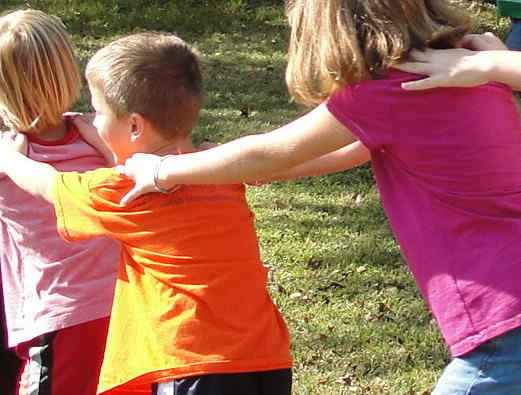
A force is a push or pull.
- Physicists came up with the law of machines, which states that little effort applied over a long distance can lift a great weight over a short distance. What does this mean? Give me an example?
- What do you think force means? We mentioned that gravity is a force. A force is a push or a pull. What is force?
- There are some fun laws you’ll get to learn about someday. They were created by a man named Isaac Newton, so they’re called Newton’s Laws of motion. There are 3 of them. Newton’s First Law of Motion says that objects at rest will remain at rest unless acted upon by an unbalanced force. Objects in motion will remain in motion at the same speed and direction unless acted upon by an unbalanced force.
- Have one child lightly push another child. Have a third child push a fourth child harder. You are all demonstrating force. Physicists, who are scientists who study how things move, measure force in Newtons or pounds. Which child exerted more Newtons or pounds? (Yes, child #3.)
- All simple machines transfer force. Some change the direction of force, some change the strength of the force, and some change both the direction and the strength. Most simple machines make work easier by allowing you to use less force over a greater distance to move an object. Some machines make work easier by allowing you to move things farther and/or faster. In these machines, a larger force is required, but over a shorter distance.
Simple Machines Introduction
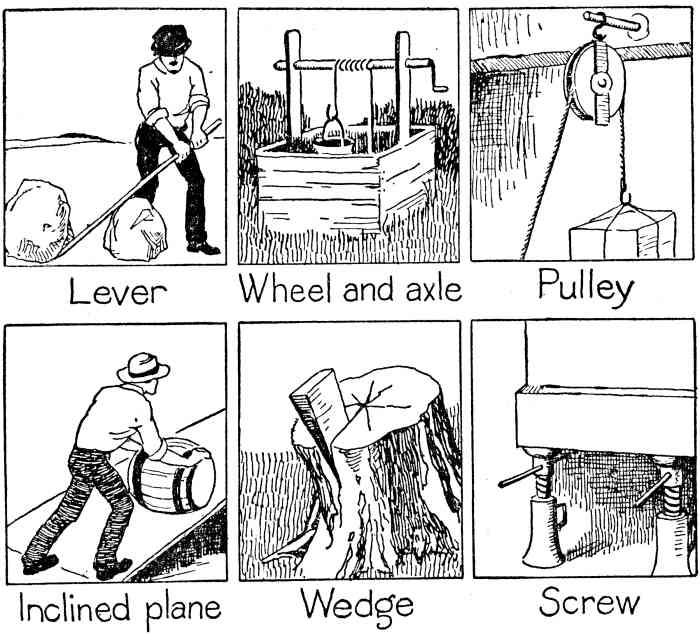
Simple Machines
- Now that we’ve learned a few new words, let’s talk about simple machines. How many of you have ever visited an aquarium with dolphins, or sharks? What is the largest animal the aquarium had? How do you suppose the aquarium moves the animals from the ocean to their location or from one tank to another? If you were a marine biologist asked to transport a killer whale (orca) that is 22 feet long and weighs over 7 tons from the sea to your aquarium, what would you do?
- Some of you suggested using machines to move the whale. What do you think of when you hear the word “machine?”
- Why do we use machines? Machines make our work easier. Can you think of some examples?
- Many machines are complex machines, with lots of moving parts. All complex machines are made from simple machines. What are simple machines?
- Simple machines are tools that make work easier. They have few or no moving parts, allow us to use a smaller force to overcome a larger force, use energy to work, work with one movement, make our work easier by letting us use less mechanical effort to move an object and by allowing us to push or pull over increased distances.
- Can anyone name a simple machine? Hold up each example as the type of simple machine is mentioned. If no one mentions one type, hold the item up and ask if anyone knows what type it is.
- There are six simple machines that are divided into 2 groups: Inclined planes include a ramp, wedge, and screw. Levers include levers, Wheels and axles, and pulleys
YOU WILL NEED:
- stuffed animal orca (optional), 1 example of each type of simple machine. Possible examples include a screw (screw), screwdriver (wedge), hammer (lever), toy car with wheels (wheel and axle), and window blinds (pulley). (You can just point to my window blind.)
- Pass out papers with the words to The Simple Machine Song. Sing the chorus of the song:
Tune: Yankee Doodle Dandy
Wheel and axle, pulley, wedge
Screw, inclined plane, lever
When you learn to use simple machines
You’ll show you are so clever.
YOU WILL NEED:
- a copy of the Simple Machine Song for each child
Inclined Planes
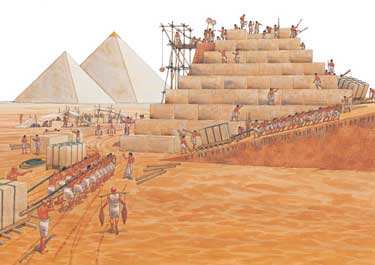
Image credit: http://www.ask-aladdin.com/Pyramids-of-Egypt/
- Do you know what a plane is? A geometric plane is a flat surface, like a table or a piece of paper. It’s the big, flat runway that an airplane needs to land on. Incline means slope or slant. An inclined plane is a flat surface with ends are at different heights. They make lifting and lowering things much easier.
- Read about inclined planes: Inclined Planes by Sarah Tieck, which is the best book we read to introduce inclined planes. While I normally prefer books that have illustrations rather than photographs, I was not able to find one that included enough of the vocabulary terms. My students and children really enjoyed this book. It is short enough to keep their attention but includes all the information they need to know.
- The way an inclined plane works is that to save effort, you must move things a greater distance. The longer the distance of the ramp, the easier it is to do the work
- How do inclined planes help us? (when we need to move objects: instead of lifting something straight up, you can move and lift little by little up an inclined plane).What are some examples?
- Inclined planes were used by the Egyptians to build the pyramids. Show pictures of this from the internet/laptop or use pictures from Great Ages of Man: Ancient Egypt by Lionel Casson. (This also has pictures of a plow, which we’ll show later.)
YOU WILL NEED:
- books: Inclined Planes by Sarah Tieck or Roll, Slope, and Slide: A Book About Ramps by Michael Dahl and Great Ages of Man: Ancient Egypt by Lionel Casson or pictures from the internet showing Egyptians using inclined planes
Using Less Effort Over a Longer Distance
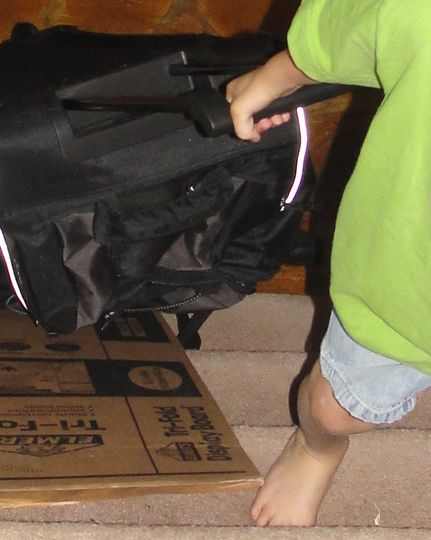
Using a ramp on stairs (Option 1)
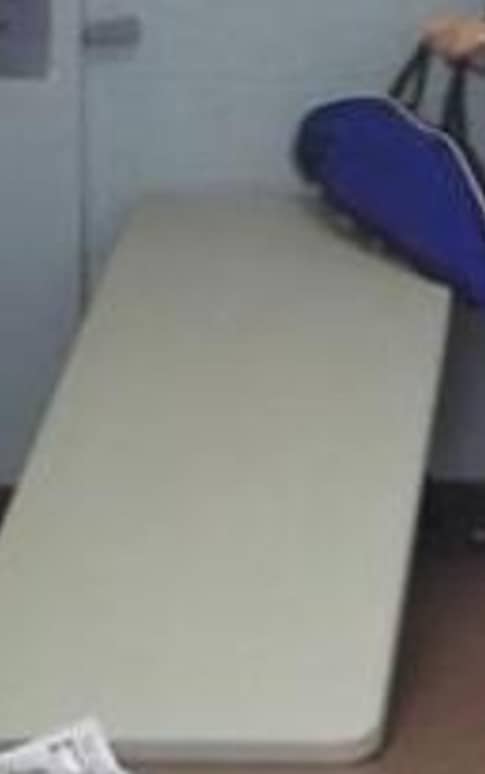
Using a table as an inclined plane ramp (Option 2)
- Divide children into 2 groups.
- Option 1 (Stairs): One group goes to the bottom floor and the other group goes to the middle floor. Have children take turns trying to carry the luggage up the stairs. Then place the board/box on the stairs and try to pull the luggage up the stairs over the “inclined plane.”
- *Option 2: No stairs: If you don’t have stairs available, simply create an inclined plane (such as a folding table with one side propped up on chairs. Have children take turns trying to lift the heavy luggage straight up onto the highest point of the table, and then have them slide it up the table.
-How does it compare? When might we use this? If there was someone in a wheelchair who needed to get over 4 steps to get inside a building, what could you do?
YOU WILL NEED:
- 2 sheets of wood or 2 large flattened boxes (both of which would fit on my staircase & would cover at least a few stairs) or 2 collapsible tables and 2 pieces of luggage filled with something heavy (like books or weights)
Inclined Planes Reducing Force: Egg Drop
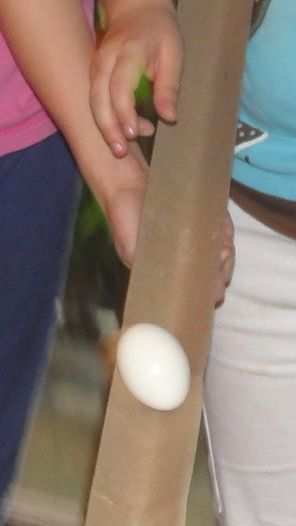
Inclined Planes and Eggs
- How many of you have chickens? How do you get the eggs from them? How many do you have? Let’s pretend have one thousand hens. That’s a lot of eggs, isn’t it? That would take you forever to collect all those eggs. You are going to need to design a way to get those eggs without you having to walk to each nesting box. What ideas do you have that would involve an inclined plane? What about if you put a hole in the bottom of each nesting box so that the egg would fall through into buckets? What would happen? What about if you added an incline plane? Let’s find out!
- Divide children into pairs. Place newspaper next to each group. Hand each child a hard-boiled egg. What is the best way to get the egg to the ground?
- What do you think will happen if you drop this egg on the newspaper from a standing position? Let one child in each pair hold the egg and drop the first egg onto the newspaper.
- Now use the ramp to lower the egg to the floor. What happened?
- The ramp (inclined plane) helped lower the egg with less force so it didn’t break as much.
- If desired, have each group roll their egg down incline planes of different heights and lengths. Ask, “When might you need to use an incline plane like this?” (If you’re not limited by time, the children can then eat the hard-boiled eggs.)
YOU WILL NEED:
- 1 hardboiled egg per child, newspaper, & 4 ramps (such as sturdy pieces of cardboard)
Inclined Planes Increase Speed and Force: Car Race
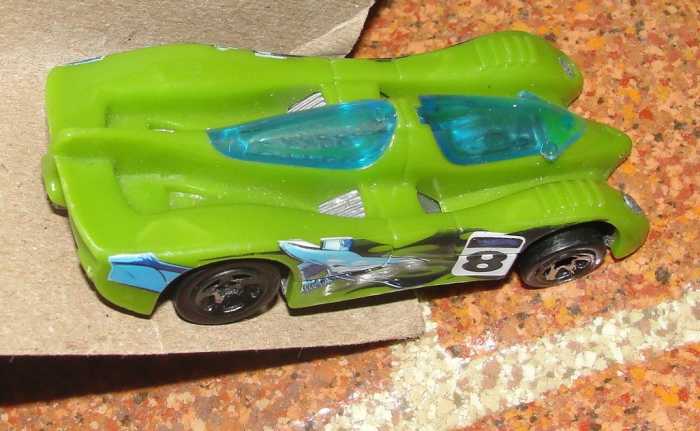
Inclined Planes Car Race
- Sometimes you don’t want a gradual incline plane. Who likes to ride on roller coasters? Do you like the ones that have you go slowly down small slopes or going really fast so that you feel like you’ll fly out of your seat? That’s when you want lots of force and lots of speed. Let’s test out which inclined plane will work the best our roller coasters. Since I don’t have roller coaster cars to test out, we’ll use Hot Wheels cars instead.
- Have each group lay their ramp on the ground and place their car at the top. How fast is the car moving? (It shouldn’t be moving at all.) Now have each group place 5-10 books under their ramp so that each of their cars will slowly glide down the ramp. Finally have each group place their ramp on the top of the sofa and let them race their cars down. Let them repeat this a few times for fun. How does the angle change the time it takes for the car to slide down the inclined plane? When might you need to use an incline plane to assist you in this way?
- *Force will vary depending on the incline of your ramp just like the less steep egg ramp helped the egg to use the least amount of force and crack less. Physicists call this the mechanical advantage. It’s the length of your incline plane (ramp) divided by your height.
YOU WILL NEED:
- 4 ramps, 40 books, & 10 Hot Wheels type cars
- Sing the first verse and the chorus from The Simple Machine Song.
Tune: Yankee Doodle Dandy
The inclined plane is like a ramp,
a ladder, stairs, or hill.
Increase the distance =
reduce the work.
Mechanical Advantage thrill.
CHORUS
Wheel and axle, pulley, wedge
Screw, inclined plane, lever
When you learn to use simple machines
You’ll show you are so clever.
Calculating Mechanical Advantage

Calculating Mechanical Advantage
- (Optional) How much does the changing the height of an inclined plane affect the force? Physicists call that your mechanical advantage. It’s the length of your incline plane (ramp) divided by your height. Have one group measure how long their ramp is. Have one group lay their ramp on a few books and measure how high their ramp is. Have another group lay their ramp against the seat of the sofa and measure how high their ramp is. Have the third group lay their ramp on the top of the sofa and measure how high their ramp is. As a group, work out the mechanical advantage of the three groups. Compare which is better. Emphasize that a higher mechanical advantage means that you’ll have to do less work to get the same result.
YOU WILL NEED:
- calculator (optional), marker board with marker, & 4 rulers
Wedges
Wedges
- When you think of the word wedge, what do you think of? A wedge is a simple machine that is used to push things apart. It’s actually 2 inclined planes put back to back. It’s wide at one end and thin at the other. The thin edge is first pushed into an object. As it moves in, the wide edge separates the materials, pushing them apart. A wedge is like a moving inclined plane, using force to come between 2 things. It can be used to split, cut, or divide.
- Read a book about wedges: Wedges to the Rescue by Sharon Thales, which was our favorite from the ones that have photographs rather than illustrations. It’s simple (but not too simple) and interesting. It includes historic uses and modern uses.
- How do wedges help us. What are some examples?
YOU WILL NEED:
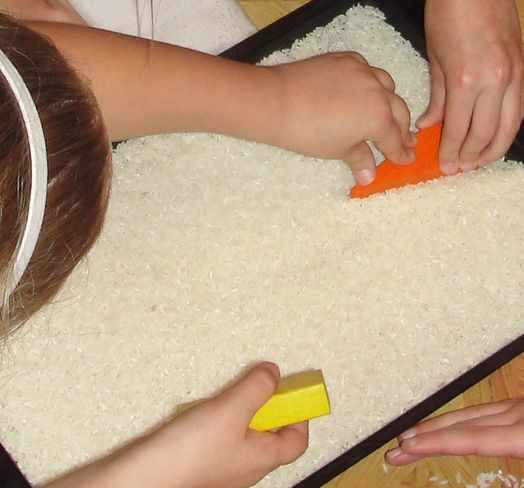
- How might a wedge be used to make work easier? How does a wedge decrease the amount of force needed to penetrate a substance? Evenly cover 4 baking sheets each with about 1 pound of rice. Pass out a block and a wedge to each pair of children. Instruct them to pick up the block and the wedge and placing them in the rice, making sure both are touching the baking sheet and are submerged in the rice. Have them each take a turn pushing the block and wedge to the other end of the baking sheet, paying close attention to the amount of effort used. Did you notice any differences? Was it easier to move the rectangular block or the triangular block through the rice? (Triangular) What happened to the rice as the triangular block was pushed through it? Where did it go? (It was pushed to the sides) How might a wedge be used to make work easier?
YOU WILL NEED:
- at least 4 pounds of uncooked rice, 4 baking sheets, 4 wedges, and 4 blocks
- Explain that a wedge is a simple machine that is used to spread an object apart or to raise an object. It spreads things apart by exerting a great deal of sideward pressure in both directions as it enters an object. Cutting tools generally contain a wedge. Ask if anyone can guess what is probably the most important use for a wedge? (The plow.) Show a picture of a plow from the Egyptian book or from the internet.
Wedges on Planes
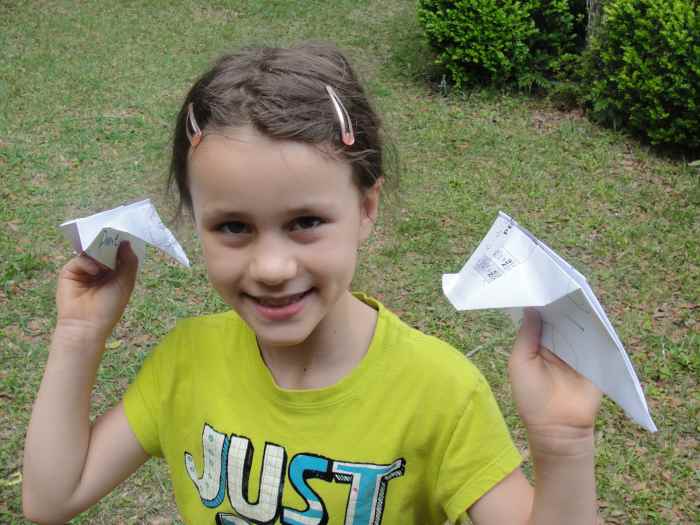
Pointed (wedge) and flat noses on paper airplanes
- Wedges don’t always cut through something we can see. Sometimes they cut through something we can’t see like air. Can you think of anything that cuts through air? Airplanes! Pass out 2 sheets of paper to each child and have them write their names on them. Have them make a paper airplane with a pointed nose and with a flat nose. After everyone is finished, have them throw their planes trying to use the same force with each throw. Which travels further? How is a paper airplane a type of wedge?
YOU WILL NEED:
- markers & paper
Doorstop Wedges
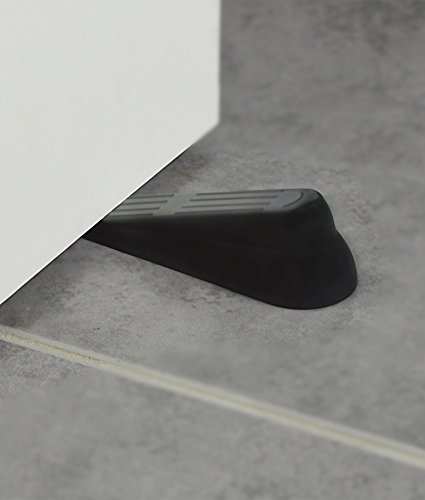
Image credit: http://www.ibookstore.com/products.php?n=1069196&i=B00XHMMPWO
- Divide children into 2 groups. Have each child get a turn opening a door regularly and then trying to open a door that has a doorstop wedge in it. (We have a parent on the other side of the door put the doorstop in each time.) What happened? Why?
- As explained in The New Way Things Work: The wedge acts as a moving inclined plane. Instead of having an object move up an inclined plane, the plane itself can move to raise an object. As the plane moves a greater distance than the object, it raises the object with a greater force. The door wedge works in this way. As it jams under the door, the wedge raises the door slightly and exerts a strong force on it. The door in turn forces the wedge hard against the floor, and friction with the floor makes the wedge grip the floor so that t holds the door open.
YOU WILL NEED:
- 2 doorstop wedges
Wedges & Apples, Simple Machine Song, & Review
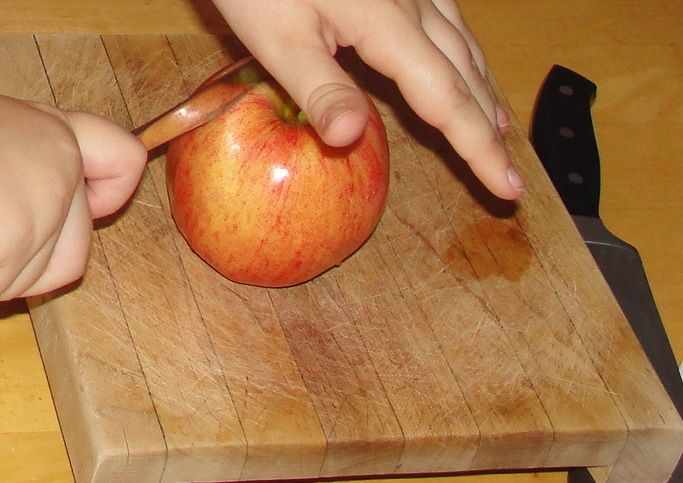
Wedges, Knives, and Apples
- Have children wash their hands. Give each child a slice of an apple. Have them take one bite using their incisors (front teeth). Have take a second bite using their back teeth (premolars or molars). Which was easier? They slice into and divide the apple slice. Your premolars are like those square blocks we used to separate the rice.
- As children finishing eating their apple slices, let them each have a turn cutting other apple slices with a kitchen knife/butter knife and a paring knife. Which is easier to use? The mechanical advantage of a wedge depends on how thick the wedge is. The thinner the tip/sharper the blade of a wedge, the better it will be at exerting equal pressure in both directions and slicing through what you want to cut through. That’s why it’s best to sharpen knives, plows, hoes, etc.
YOU WILL NEED:
- half an apple per child, a napkin per child, a butter/kitchen knife per child, and a few paring knives
- Sing the first 2 lines and chorus of The Simple Machines Song: (Tune: Yankee Doodle)
When it’s moved by force we call it work,
but here’s what I’ve been told:
Use any simple machine to help and ease that heavy load.
CHORUS: Wheel and axle, pulley, wedge
Screw, inclined plane, lever
When you learn to use simple machines
You’ll show you are so clever.
The inclined plane is like a ramp,
a ladder, stairs, or hill.
Increase the distance =
reduce the work.
Mechanical Advantage thrill.
The wedge is used to separate,
lift, or hold in place.
You use a wedge to cut your cakes,
Long and narrow means less force it takes.
- Review what we learned: What is the scientific definition of work? (moving a mass over a distance.) What is the scientific definition of force? (a push or a pull) What is an inclined plane? (a flat surface that is slanted). Who can name an example of one? How does it make it easier to move heavy things (Increase the distance =reduce the work; instead of lifting something straight up, you are able to move and lift little by little up the inclined plane; reduce the force to items being lowered) What is a wedge? (used to separate, lift, or hold in place) Name an example of a wedge. How can a wedge be used to make work easier? (Long and narrow means less force it takes; decrease the amount of force needed to penetrate a substance, spread an object apart or to raise an object. It spreads things apart by exerting a great deal of sideward pressure in both directions as it enters an object)
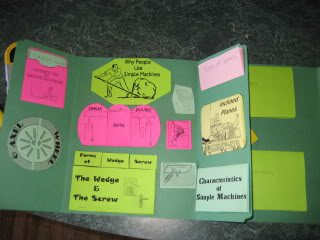
Simple Machines Lapbook
Simple Machines Lapbook Homework
If you’d like to create a Simple Machines lapbook this week, here are some options:
- Lapbook cut-out for each simple machine at the end of this lesson plan. You will have to click on a button to download the pdf.
- A coloring page of each simple machine You can use these for a notebook.
- Simple Machines Lapbook from Hands of a Child This one costs money.
Joke: What did the tree say to the wedge?
I’m stumped!
Looking for Great Children’s Books to Accompany This Lesson?
Our Favorite Picture Books on Forces
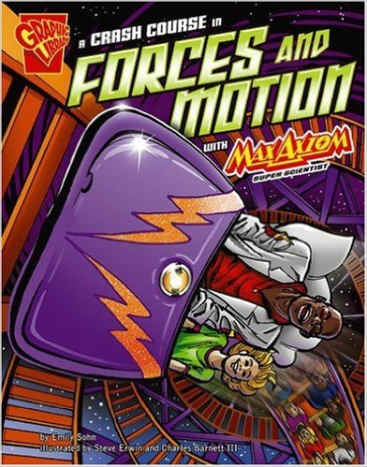


A Crash Course in Forces and Motion with Max Axiom, Super Scientist (Graphic Science) by Emily Sohn – Image credits: amazon.com
1 / 6
- Forces Make Things Move is our favorite children’s book on forces. It gives wonderful explanations that even younger children (and adults who haven’t taken physics in a loooong time) can understand, and it has great illustrations!
- A Crash Course in Forces and Motion with Max Axiom, Super Scientist (Graphic Science) by Emily Sohn was the favorite of my children (ages 2, 5, and 8). It demonstrates Newton’s 3 Laws of Motion in a manner that is easily understood by my children. They visit the amusement park, swimming pool, and skate park. We also enjoyed reading
- The New Way Things Work is much longer than a children’s picture book. My family is reading a few pages of this each week. It has a funny section featuring a mammoth and the simple machine (which my 3 and 5 year olds especially love) and then a few pages showing everyday machines that use the particular simple machine (enjoyed by my 8 year old).
- Newton and Me by Lynne Mayer
- Isaac Newton and the Laws of Motion (Inventions and Discovery) by Andrea Gianopoulos
- Move It!: Motion, Forces and You (Primary Physical Science) by Adrienne Mason
- Motion: Push and Pull, Fast and Slow (Amazing Science) by Darlene R. Stille
- The Magic School Bus Plays Ball: A Book About Forces by Joanna Cole.
Our Favorite Children’s Books About Inclined Planes
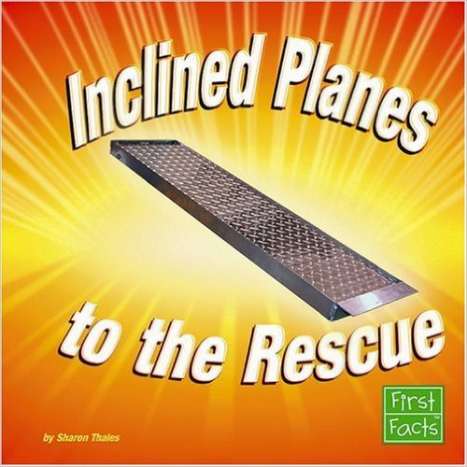


Inclined Planes to the Rescue (Simple Machines to the Rescue) by Sharon Thales – Image credit: amazon.com
1 / 7
- Roll, Slope, and Slide: A Book About Ramps (Amazing Science) is perfect if you are teaching preschool or kindergarten aged children, use this as your read aloud book. It is simplistic and has nice illustrations. My children also really really this book as well.
- Inclined Planes to the Rescue (Simple Machines to the Rescue) by Sharon Thales
- Slopes (Simple Science) by Caroline Rush is another good book on inclined planes that has illustrations. It would appeal to preschoolers and kindergarteners.
- Sloping Up and Down: The Inclined Plane (Robotx Get Help from Simple Machines) by Felicia Law
- Fred Flintstone’s Adventures with Inclined Planes: A Rampin’ Good Time (Flintstones Explain Simple Machines) by Mark Weakland
If you would like a couple extra picture books that show inclined planes at work, a couple good, quick options include:
- Samantha on a Roll by Linda Ashman
- Roller Coaster by Marla Frazee
Great Ages of Man: Ancient Egypt by Lionel Casson is not a picture book. It was written for adults and has photographs. It does a great job of showing how the Egyptians used simple machines including inclined planes and plows, which we’ll look out when we study wedges.
Our Favorite Picture Books on Wedges
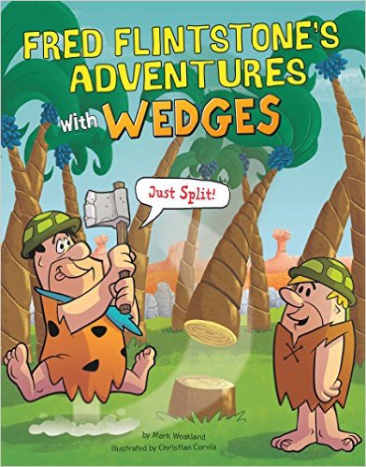


Fred Flintstone’s Adventures with Wedges (Flintstones Explain Simple Machines) by Mark Weakland – Image credits from amazon.com
1 / 4
- Fred Flintstone’s Adventures with Wedges (Flintstones Explain Simple Machines) by Mark Weakland
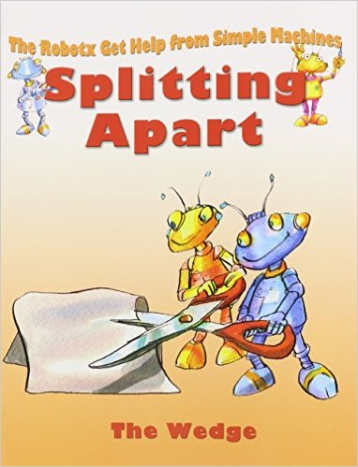
- Splitting Apart: The Wedge (Robotx Get Help from Simple Machines) by Gerry Bailey
- Cut, Chop, and Stop: A Book About Wedges (Amazing Science: Simple Machines) by Michael Dahl is nice because it has illustrations that hold the interest of both younger and older children; however, it combines a wedge simple machine with a wedge shape. All my kids remembered from this book was that pizza is a wedge. If you skip that page, this would be good.
- Wedges by Sarah Tieck is a great children’s book on wedges, though it has photographs rather than illustrations.
Our Favorite YouTube Videos
Good video clip on work
Good video on Newton’s 3 Laws
Ready for the next lesson?
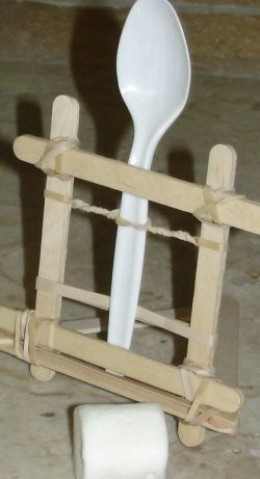
Marshmallow catapult from lesson on levers (part 2 of 5)
Race cars down ramps as you study inclined planes and wedges, build and test catapults as you study levers and screws, create waterwheels as you study wheels and axles, lift each other using pulleys as you study gears and pulleys, use static electricity lift hair and separate salt and pepper as you study electricity, devise Rube Goldberg machines to place toothpaste on a toothbrush without touching either one, present on famous inventors, and more during this exciting 5 part hands-on unit study on simple machines and inventions!
- Inclined Planes and Wedges Lesson – This is part 1 of a 5 part hands-on unit on Simple Machines and Inventions. Race cars down ramps, compare carrying luggage to pulling it up an inclined plane, slice through apples using wedges, and more!
- Lever and Screw Simple Machines Lesson – This is part 2 of a 5 part hands-on unit on inventions and simple machines. Build and test catapults, lift an adult using a lever, test out screws of various threads, and more!
- Wheels and Axles Lesson – This is part 3 of a 5 part hands-on unit on Inventions and Simple Machines. Build and test waterwheels, use cylinders to make wheel cookies, experiment with matchbox cars to demonstrate friction, compare the mechanical advantage of an adult and a child’s bicycle, and more!
- Gears and Pulleys Simple Machines Lesson – This is part 4 of a 5 part hands-on unit on inventions and simple machines. Build and test pulleys, play pulley tug-of-war, find out how a clock works, and more!
- Electricity Lesson – This is part 5 of a 5 part hands-on unit on inventions and simple machines. Watch static electricity lift hair and separate salt and pepper, build and test circuits and switches using household materials, play an electron game to demonstrate how electricity is conducted.
- Inventions and Simple Machines Presentations and Field Trip Ideas – Included are the presentations on famous inventors our students created following our 5 part hands-on unit on Inventions and Simple Machines. They also sang the Simple Machines song and ate a simple machine-themed lunch. (Recipes are provided.) Also included are the field trips we attended during this unit.
KONOS Curriculum
Konos Volume 3
Would you like to teach this way every day?
I use Konos Curriculum as a springboard from which to plan my lessons. It’s a wonderful Christian curriculum and was created by moms with active children! You can even watch free on-line videos as Jessica, one of the co-authors of Konos, walks you through a unit. (Look for the Explanation Videos tab.)
© 2011 Shannon
How Do You Use an Inclined Plane or Wedge Every Day? – Or just leave a note. I love getting feedback from you!
Shannon (author) from Florida on March 09, 2014:
@nanselm2: Thank you so much!
nanselm2 on March 07, 2014:
Wow. I’ve been teaching science for a few years and consider myself decently creative and hands-on, but you plans blow mine away! Keep up the great work!
Shannon (author) from Florida on April 09, 2013:
@anonymous: You’re welcome! Thank you for visiting!
anonymous on April 07, 2013:
Thank you for posting these amazing lesson plans!!!
Shannon (author) from Florida on January 20, 2013:
@suzanne-shafford: Great! Thank you!
suzanne-shafford on January 20, 2013:
Just what I was looking for! A million thank yous for sharing your lesson plans. I’m so excited to use them.
Shannon (author) from Florida on August 25, 2012:
@anonymous: Great! Thank you for stopping by! I am active on the Konos Yahoo Group. It is a great curriculum! I have my lessons for Volume 1 posted at https://discover.hubpages.com/education/my-konos-u .
anonymous on August 25, 2012:
Great study! I just purchased Konos but am still learning how to use it. We’re starting this study Monday and are super excited. Finding this made my day!!!!
TransplantedSoul on May 03, 2012:
It is great to share lesson plans. I hope this gets spread.
anonymous on April 18, 2012:
Incrediable, great job. Thank you
julieannbrady on January 28, 2012:
Gosh, I am inclined to applaud you for such an interesting, educational lesson! I will never think of inclined planes OR wedges, for that matter, in the same manner!
janeaustengirl lm on May 02, 2011:
You should write an ebook! This is a great unit study.
Leave a Reply