Middle School Biology Lesson on Amazing Plants
This is the 3rd lesson in a series of 32 hands-on lessons covering middle school biology. This lesson covers the importance of plants and their amazing design as we examine various types and go on a botany scavenger hunt. I used this plan while teaching a 55 minute middle school biology class. Each lesson plan includes homework assignments and a variety of hands-on activities to make each lesson engaging & memorable. Use these fun lessons with your classroom, homeschool, after-school program, or co-op!
These lessons are written for a class that meets once a week. If your class meets 5 days a week, simply do this lesson one day a week and use the homework assignments (at the bottom of the page) for the work for the other days of the week.
Homework Review
- Pass out tickets to students who did their homework. Quickly go over the homework questions from the book. (I give out tickets for students who volunteer to answer the questions.)
Horticulture Guest Speaker
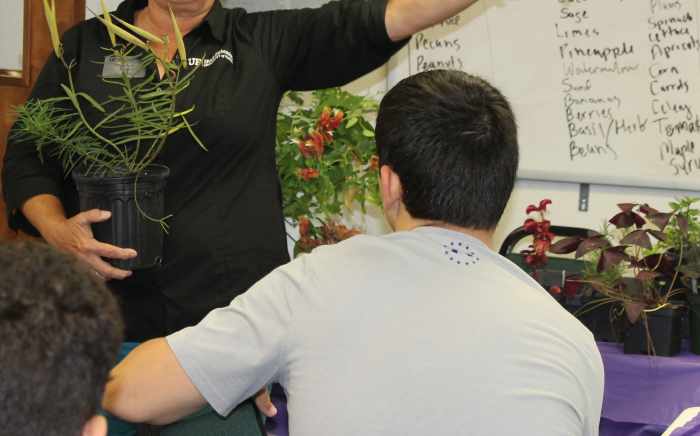
Horticulture Guest Speaker
- For today’s class we invited a local horticulture Extension Agent (which is related to the 4-H office) to speak to our class about the importance of plants and jobs opportunities in horticulture. I asked her because she trains Master Gardeners. If you have Master Gardeners in your area, contact them about coming as it would help them earn service hours. Asking someone who works in a nursery, with the forestry department, or a florist would all be good options as well for guest speakers. If you have a small enough group, you could instead tour a local nursery.
*If you don’t want to invite a guest speaker to share with your class, I’ll share what our guest speaker lead the class in doing, so that you can do the same.*
Importance of Plants
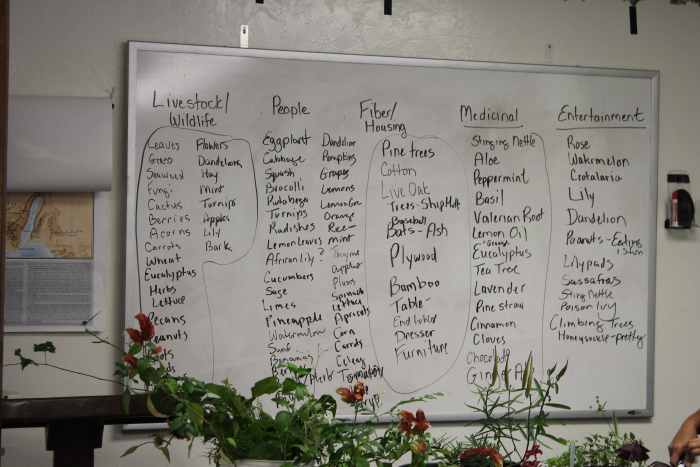
How plants are important to us
2a. Divide students into 5 groups. Have each group brainstorm how plants are important in these areas: Livestock/Wildlife, People, Medicinal, Fiber/Housing, & Entertainment. After a few minutes, allow for each group to share their ideas and write them on the board. The students went a different way with this than I would have. They listed individual plants that were applicable to each area. I would have listed how the plants were important in each category (i.e. entertainment: visiting botanical gardens; trees provide something to climb & place to build a tree house; creating nature crafts, watermelon speed spitting contests; etc.). Either way works.
Amazing Design of Plants

Examining lichen
2b. Allow students to use hands lenses to examine a variety of different plant specimens. Discuss each one. Here are some examples:
- Lichen looks like coral when magnified. If it’s pinkish, that means the air quality around you is really good. Lots of people think it kills trees, but it doesn’t. It does frequently grow on branches and trees that are unhealthy & about to die. Pay attention to where it’s growing before a huge storm or hurricane hits. It might keep you from having a tree fall on your roof.
- The resurrection fern looks like it’s dead but then it comes back to life again.
- Vanilla extract comes from the pod of an orchid, vanilla planifolia! To grow it in non-tropical areas like where we live, it needs to be kept in a greenhouse. Vanilla is the only edible fruit of the orchid family, the largest family of flowering plants in the world. There are over 150 varieties of vanilla plants. The flower is only open for 24 hours and needs to be pollinated in order to produce a pod with beans, which is what is used to get the vanilla flavoring.
You will need:
- hand lenses (magnifying glasses) for each student plus plant specimens
Job Opportunities in Horticulture
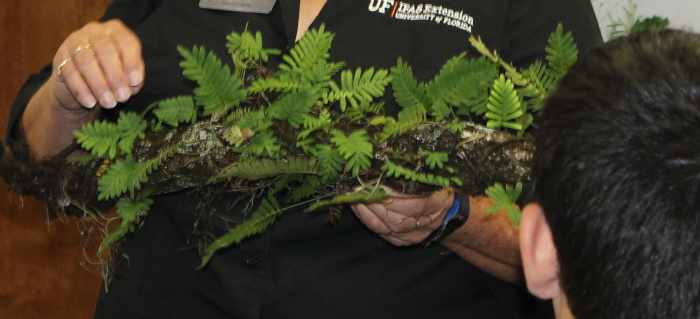
Resurrection Fern specimen
2c. Share job opportunities in horticulture. You can get paid $1,000 a day to be a guide for hunting trips or on canoeing or kayaking expeditions. Plant genetics is a lucrative field right now. You can research ways to improve the breeding and stock of plants or food grown for food. Working at or managing a nursery or working in landscape design will provide a stable career that lets you be outdoors all day.
Homework
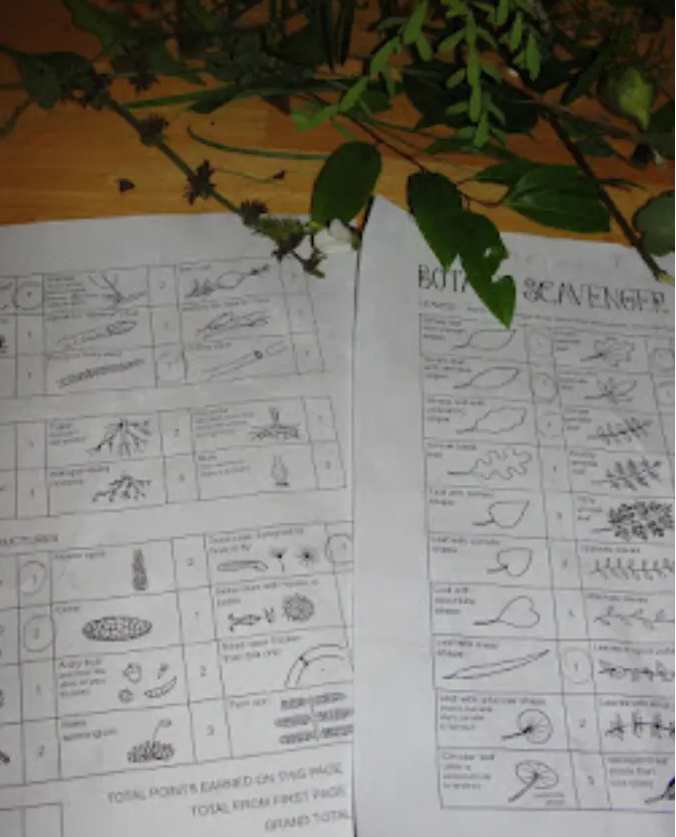
Botany Scavenger Hunt Homework
Page numbers refer to the pages in A Beka’s Science: Order & Design.
- Friday: Leaves: Read pp. 60-62 & & answer 3 questions of your choice on p. 62.
- Monday: Earn at least 7 points on the Botany Scavenger Hunt*
- Tuesday: Earn at least 7 points on the Botany Scavenger Hunt*
- Wednesday: Earn at least 7 points on the Botany Scavenger Hunt*
*Botany Scavenger Hunt: Using this botany scavenger hunt page as your guide, find specimens anywhere outdoors. The worksheet assigns point values to each item. You may only find 1 specimen for each type (i.e. only 1 simple leaf with smooth edges). You may either collect the specimens (checking off what you’ve found), or you can take a photograph of each specimen. If you are taking photos, please include a consistent item (such as a small toy or stuffed animal) in each photo in addition to a close-up of the plant specimen. If you’re taking photos, please upload them to our class page before 3 PM on Wednesday. If you’re opting for the live specimen collection option, please bring your specimens to class on Thursday along with your sheet that has checked off what you collected. You can combine both options, taking some photos and collecting some specimens. There will be prizes for the top 3 students who earn the most points.
Looking for all my lessons?
- First Day of Class & Plant Identifications
- Parts of a Flower
- Amazing Plants (Horticulturist Guest Speaker)
- Seeds and Flower Families
- Photosynthesis and Plant Parts
- Cardiovascular, Respiratory, & Digestive Systems
- Skeletal, Muscular, & Integumentary Systems
- Endocrine & Nervous Systems and Healthy Living
- Human Baby Fetal Development (Pregnancy Care Center Guest Speaker)
- Creation and Science
- Creation, Evolution, & the Eyes of Faith
- Classifying Plants & Animals
- Amazing Mammals
- Mammal Dissection
- Semester Review & Winter Party
- Bird Anatomy
- Bird Features
- Bird Watching (Birding Guide Guest Speaker)
- Fish Anatomy and Dissection
- Invertebrates Anatomy and Dissections
- Frog Dissection
- Reptiles Show and Tell
- Insect Anatomy
- Singing & Social Insects
- Beneficial Insects (Entomology Guest Speaker)
- Arthropods (Crayfish & Grasshopper) Anatomy and Dissections
- Crustaceans & Arachnids
- Cells, Algae, and Fungi
- Protozoa and Bacteria
- Trees
- Ecology
- Semester Review & End of Year Party
- My Middle School American History Lessons
- All of My Hands-on Lessons & Unit Studies
© 2018 Shannon
Leave a Reply