
Hands-on History Lesson for Kids: French and Indian War
This is the 5th lesson in a series of 27 hands-on lessons covering American History through 1865. This lesson focuses on the French and Indian War. I used this plan while teaching a 45 minute history class for children in Kindergarten, 1st, & 2nd grades. Use these fun lessons with your classroom, homeschool, after-school program, or co-op!
Student Biography Presentation: Daniel Boone

Biography report on Daniel Boone
- Student Biography Presentation on Daniel Boone, who served in Braddock’s Expedition campaign against Fort Duquesne during the French & Indian War.
Review & Introduction to French & Indian War
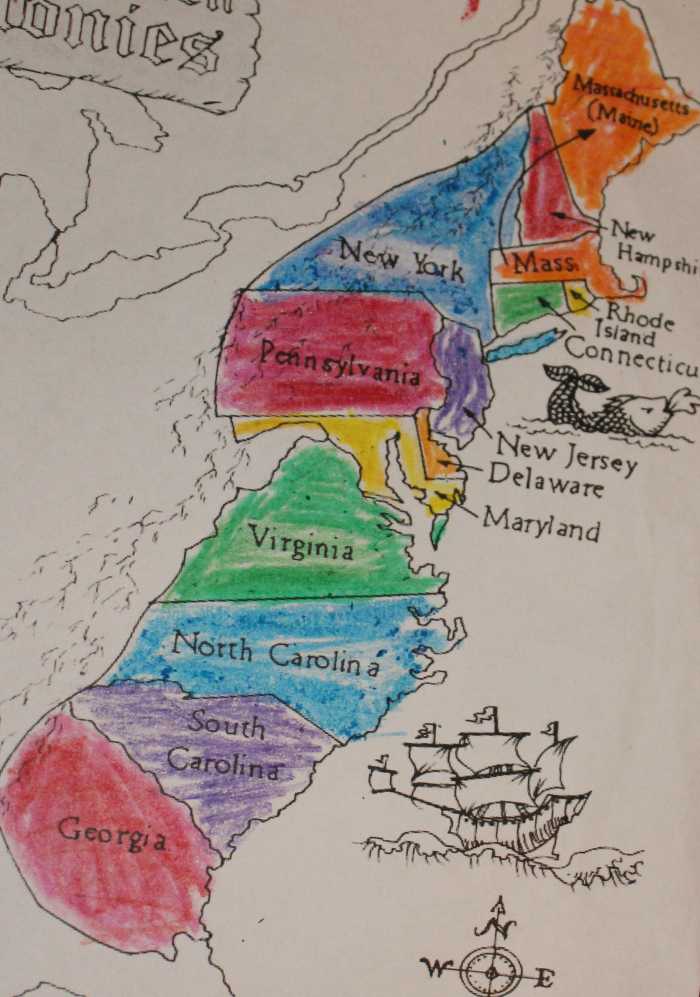
Review the Thirteen Colonies Song
- Review: Jamestown was England’s first successful colony. When you hear Jamestown, which 2 people should you remember? (Pocahontas & John Smith) After Jamestown, another colony was established at Plymouth, Massachusetts. Who were these people? (the Pilgrims) Which Native American man helped the Pilgrims? (Squanto) Eventually how many English colonies were founded in America? (13) Can you name them all? Yes!
- Everyone should open their notebooks to their 13 Colonies map from last week. Together sing 13 Colonies Song (Tune: Yankee Doodle) while pointing to each colony on their maps.
New Hampshire, Massachusetts, Rhode Island and Connecticut
New York, New Jersey, Pennsylvania, little Delaware…
Maryland, Virginia, North Carolina
South Carolina, Georgia, thirteen colonies!
- Who was here before the English started sending over colonists to live in America? (Native Americans/American Indians) Which country started the 13 colonies? (England) England wasn’t the only country sending people here & trying the claim America’s land & resources. France was also sending people here. Over in Europe England & France went to war with each other & their war spread to America. The French & some of the Indian tribes were on one side & the British colonists of the 13 colonies & a few other Indian tribes were on the other side.
- Quickly introduce the French & Indian War by summarizing & flipping through the pages of Struggle for a Continent: the French and Indian Wars, 1689-1763 by Betsy Maestro.
YOU WILL NEED:
- Struggle for a Continent: the French and Indian Wars, 1689-1763 by Betsy Maestro or other book about The French & Indian War
Fur Trading Post
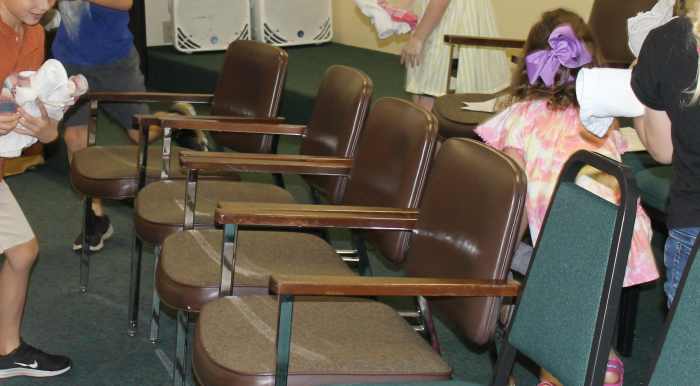
Trapping “beavers” (rolled up kitchen towels)
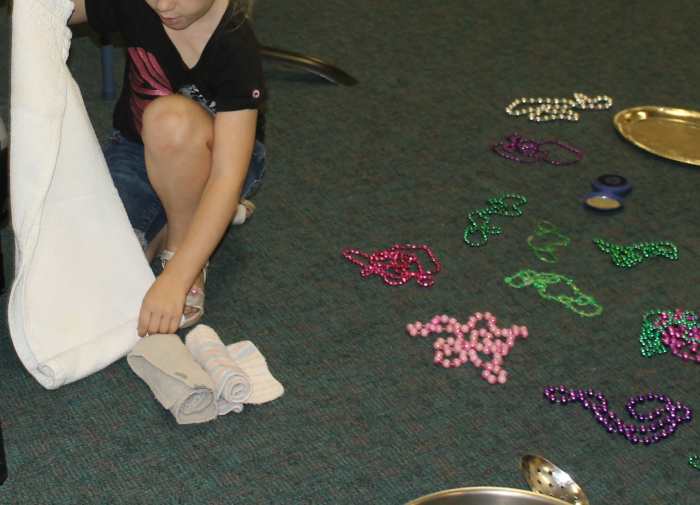
Visiting the “trading post” with “beaver pelts”
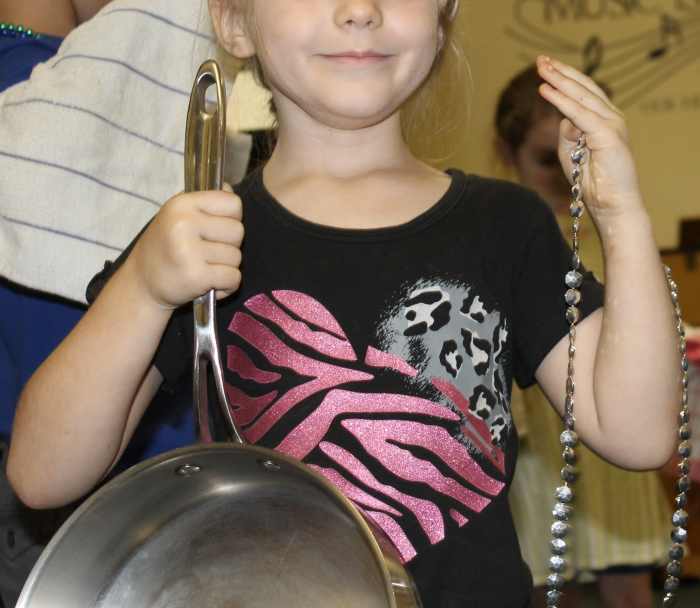
European goods that were traded for “beaver pelts”
- Give a quick background on the Colonial Fur Trade:
- While American colonists were not able to find gold in North America, they were able to find something of great value: furs.
- Both the French and British had been in North America for over a hundred years seeking out fur from animals such as beavers. What do you think they did with that fur? (Made it into warm clothing or sent it back to Europe to make money.)
- Sometimes they would trap the animals themselves such as what Daniel Boone did, but they also frequently traded with the Native American tribes in the area. The Native Americans would trap the animals, skin them, and then take the “pelts” to a fur trading post to swap the furs out for goods.
- Some of the European goods included weapons, metal pots and other metal kitchen utensils, beads for jewelry, and mirrors.
- (Ahead of time, roll up individual kitchen towels and hid them in a room.) Have children search a room to collect as many “beavers” (kitchen towels) as they can. After they’ve collected them all, have them “skin” their animals by rolling out the towels.
YOU WILL NEED:
- at least 2 kitchen towels per student
- After the students have “skinned” their animals, have them bring them to the “Fur Trading Post” and trade out their pelts for goods. Either students or teachers/adults can act as the European traders.
YOU WILL NEED:
- “European” goods for trading such as metal cooking pans and utensils, bead necklaces, mirrors, and toy weapons (if allowed)
Battle Reenactment: British vs. French
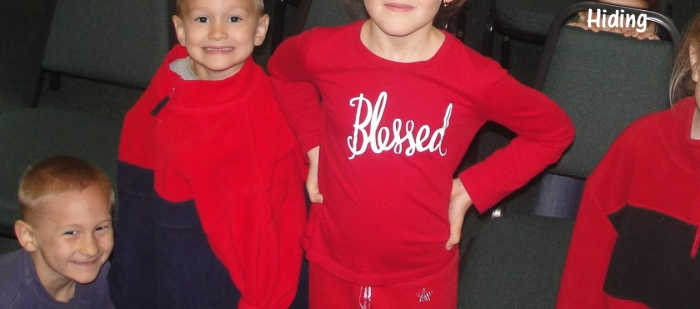
French & Indian War battle reenactment
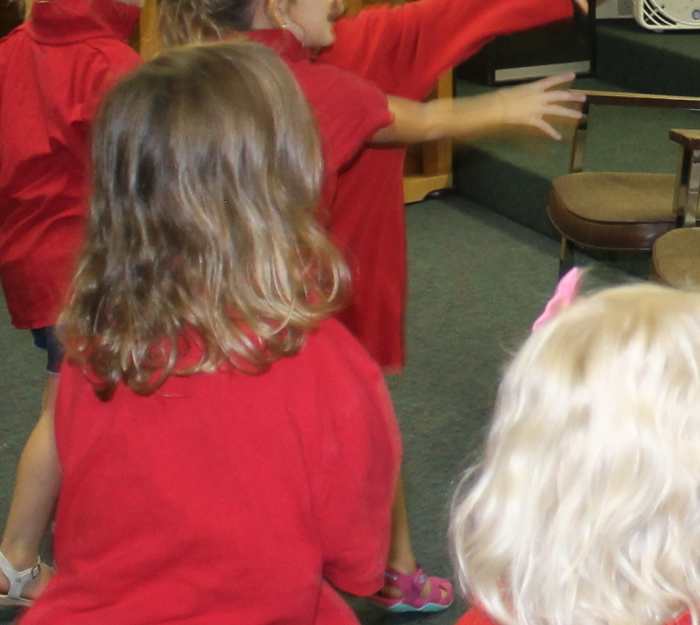
The “Red Coats” lined up during battle
- During the French & Indian War the soldiers from England, called the British, had an interesting way of fighting. They wore bright red coats and marched in straight lines. The French learned some fighting tactics from the Indians: they tried to wear camouflage clothing & tried to hide in the wilderness & surprise the British. Let’s try it out.
- Dress half the children in red. (If a child was already wearing red, I chose them to be a British soldier. For the others I passed out red jackets, fleeces, & sweaters.) They must stand in a straight line. They are the British army.
- Dress half the children in dark colors. (If a child was already wearing something dark, I didn’t add any clothing. If needed dress other children in dark or camo colored tops.) They are the French & Indian army.
- Give each child 2 soft foam balls (or wadded up paper balls). These will be their muskets, which is what they called their gun type.
- Allow the French & Indian army hide behind items. The British army must stand in the straight line.
- Tell children they will get to battle for 15 seconds. When you say it’s time, they must freeze. No more throwing. Have the children go to battle, throwing their balls at each other for 15 seconds. (Count slowly out loud.)
- Ask, “If those balls were real bullets, which side you do think would have won more battles?”
- Have children pick up the balls & put them away.
- Explain: A number of American colonists, like George Washington, Robert Rogers, & Daniel Boone, told the British army commanders that they should hide like the French & Indians did, but the British wouldn’t listen to them.
- The American colonists who fought had to especially trust in God during this time. One of the American colonists who fought with the British soldiers memorized Psalm 18:2 to give him courage: “The Lord is my rock, my fortress and my deliverer; my God is my rock, in whom I take refuge, my shield and the horn of my salvation, my stronghold.”
YOU WILL NEED:
- red tops (jackets, fleeces, sweaters, etc.) for half the class
- dark or camo tops for half the class
- 2 soft foam balls or wadded up paper balls per child
Powder Horns
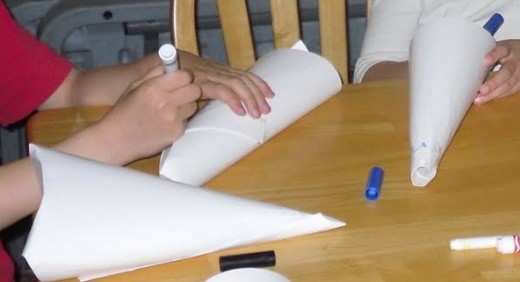
Powder Horns
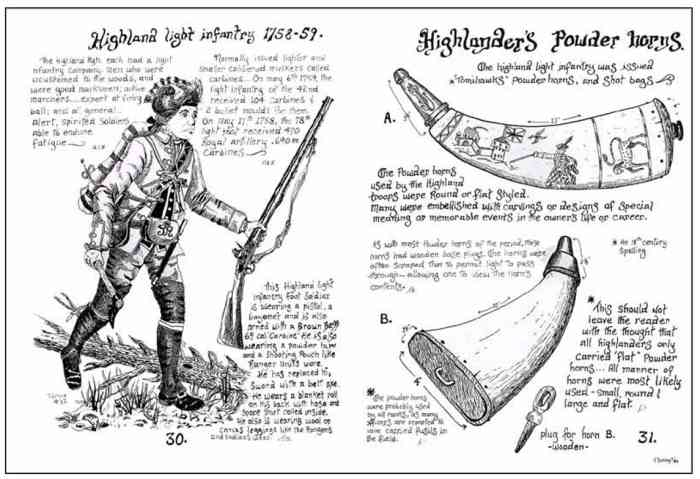
Power Horn Sheet to pass out to the children from https://www.trackofthewolf.com/Categories/PartDetail.aspx/289/1/BOOK-SB56V3
Powder Horns (Optional)
- Show powder horn. Ask the children what they think it might have been used for. They stored their gun powder in it. They didn’t have bullets like we have today. They had to make their own. (If you have a toy rifle, use it as a model.) They’d take their musket & put it on the ground. Then they’d dump gun powder in the barrel of the musket. They needed it to be dry so it would explode out the bullet. To keep it dry, they’d store it in a horn from a cow! Then they’d add a strap leather so they could carry it with them. When soldiers weren’t fighting, they might carve pictures into their powder horn.
YOU WILL NEED:
- a picture of a powder horn (from online or from a book. I used the illustration from p. 33 in the book Revolutionary Soldier: 1775-1783 by C. Keith Wilbur.)
- a copy of the above worksheet showing a powder horn which can be printed free at from the above link (https://www.trackofthewolf.com/Categories/PartDetail.aspx/289/1/BOOK-SB56V3)
- a toy rifle (optional)
- Make powder horns. (Only do this if you have capable students or enough adult help. When I had a class that was mostly kindergarten-aged, we skipped this.)
- Give each child a 12-inch square of white poster board & a piece of scotch tape.
- Have the children roll the paper into a cone shape. (Some children will need help with this.) Tape it.
- Bend over the pointed top to be the lid for the horn.
- Children may write their names & can draw (“carve”) pictures on their powder horns using their marker “knife.”
- As children are drawing on their powder horns, pass around staplers so that the children can staple the yarn to each side of the powder horn so they can wear it. Staple the yarn on the tip of the cone on the small end and on the inside of the cone on the wide end. (Some children may need assistance doing this.)
YOU WILL NEED:
- a 12-inch square of poster board per child
- scotch tape
- a marker (preferably black) per child
- a piece of yarn or string (about 20 inches) per child
- 1-3 staplers
Maps, Snack, & Review
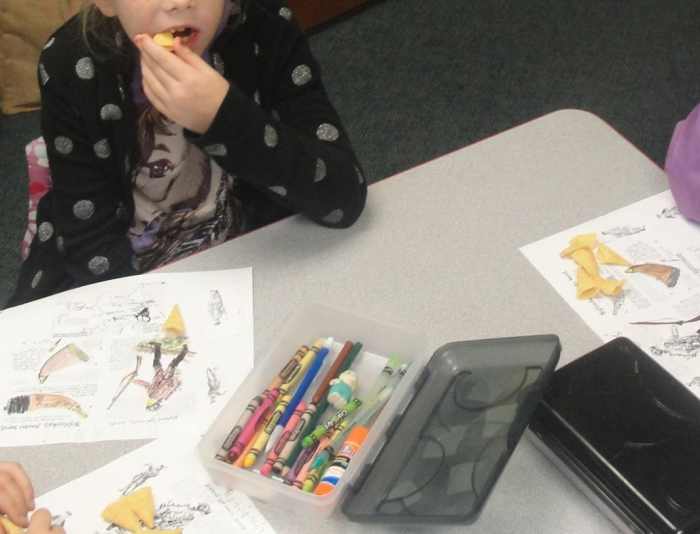
French & Indian War map work & snack
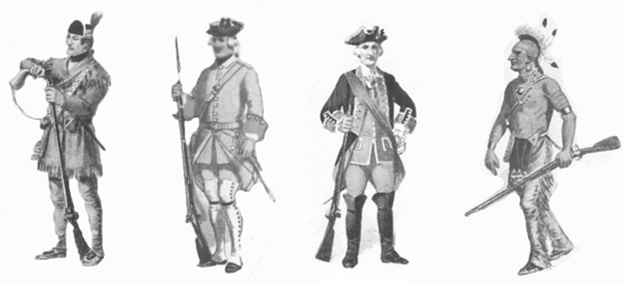
- Pass out a map to each child & a paper with soldiers and an Indian from that time period.
- Point out on the map the 13 colonies & note that most of the battles were fought near Canada, which is where many of the French were.
- Who do you think won? Surprisingly, the British won largely because they had more soldiers fighting. They won control of Canada, so the French had to leave that area. That’s part of the reason why we speak English, not French, in America today.
- Have children cut out the soldiers & Native American & paste them to the map.
- They can color them if time allows.
- Place in the 3 ring history binder.
YOU WILL NEED PER CHILD:
- Map of the French & Indian War major battles (p. 1 from this pdf worksheet) punched using 3 hold punch
- Picture of soldiers & Native American I used the man with his powder horn and the 2 groups of armies & Native Americans. (I copied & pasted them into a Word document & then printed off multiple copies.)
- Student supplies: scissors, crayons, & glue sticks
- Pass out a snack of Bugles, which look like miniature powder horns. Allow children to eat the snack while going through the review questions.
YOU WILL NEED:
- Bugles (found in the chip or cracker aisle)
- Review: Which war did we learn about today? (French & Indian War) What color did the British soldiers wear? (red) How did they fight? (in a straight line) How did the French & Indians fight? (hiding) What did the soldiers use a powder horn for? (holding their gun powder & to keep it dry) Who won the French & Indian War? (the British)
- Assign next week’s biography presentation on Patrick Henry.
A Picture Book to Read Each Day (Plus one Audio CD)
Optional Homework
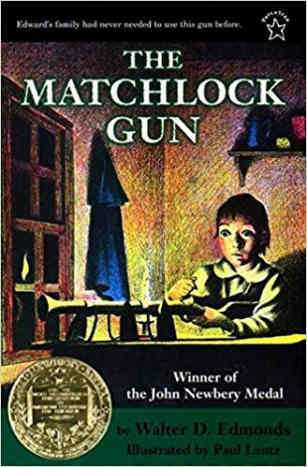


The Matchlock Gun by Walter D. Edmonds – Book images are from amazon .com.
1 / 8
These were our favorite children’s picture books (in addition to the book used in the lesson):
- The Matchlock Gun by Walter D. Edmonds – This true story might be a little intense for some younger children, so pre-read it.
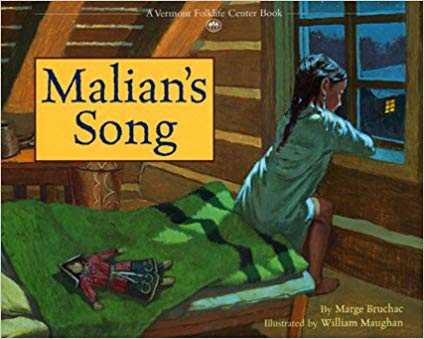
- Malian’s Song (The Family Heritage Series)– This true story might be a little intense for some younger children, so pre-read it.
- A Picture Book of Daniel Boone by David A. Adler is a good picture book on Daniel Boone, who served with the British colonists during the French and Indian War. This book includes a brief bit about that.
- Revolutionary Rumblings (Chester the Crab’s Comix With Content) by Bentley Boyd has one section on the French and Indian War & how it led to the American War for Independence
- Daniel Boone’s Great Escape by Michael P. Spradlin is an exciting and true story about Daniel Boone getting captured by the Shawnee and then escaping to warn the fort of an impending attack. It’s not specifically about the French and Indian War, but it’s a memorable story about Daniel Boone.
- The Last of the Mohicans (Saddleback’s Illustrated Classics) by James Fenimore Cooper -The ending of this story might be a little intense for some younger children, so pre-read it or skip the end. This is the less violent of the two options. The Last of the Mohicans (Marvel Illustrated) by James Fenimore Cooper is the same story but includes more violence in the illustrations.
- Your Story Hour, Vol. 2 Audio CD: Great Stories: George Washington, Henry Ford, Honey Creek Heroine Plus 7 More Adventures – This is a dramatized audio CD set that covers George Washington’s life and includes quite a bit about his time during the French & Indian War, which isn’t included in most children’s books. Even my younger children enjoyed listening to this! The CD set includes 6 CDs that cover the lives of other people as well.
Optional Homework: French and Indian War | 3 Minute History
History Quips
I have never been lost, but I will admit to being confused for several weeks.
– Daniel Boone
Looking for all of my American History Lessons?
(My middle school level
American History lessons can be found at https://hubpages.com/education/TeachingAmHistory .)
AMERICAN HISTORY FOR EARLY ELEMENTARY:
Native Americans & Columbus Lesson
Jamestown Lesson
Pilgrims Lesson
Thirteen Colonies Lesson
French and Indian War Lesson
Colonial Period & Revolution Rumblings Lesson
Boston Massacre & Boston Tea Party Lesson
First Shots & Declaration of Independence Lesson
American War for Independence Battles Lesson
Valley Forge & Battle of Yorktown Lesson
American Literature Lesson & American War for Independence Review
Colonial Christmas Party
Constitution Lesson
Three Branches of Government Lesson
President George Washington Lesson
Louisiana Purchase Lesson
War of 1812 Lesson
Monroe Doctrine Lesson
Trail of Tears Lesson
Oregon Trail & Battle of Alamo Lesson
California Gold Rush & Pony Express Lesson
American Industrial Revolution Lesson
Underground Railroad Lesson
Abolitionists & Women Suffragists Lesson
Civil War: The Confederate States & Abraham Lincoln Lesson
Civil War Battles Lesson
Civil War Party & End of Year Review Game
BONUS LESSONS (if you have room for a few extra classes):
Reconstruction Lesson
Wild West Lesson
Immigrants Lesson
Tycoons & Theodore Roosevelt Lesson
World War I Lesson
Roaring Twenties Lesson
Great Depression and the 1930s Lesson
World War II Lesson
ALL MY LESSONS:
Fun, Free Hands-on Unit Studies (My Lessons in All Subjects)
© 2018 Shannon
Comments
Shannon (author) from Florida on July 19, 2018:
I’m so glad! Thank you!
Liz Westwood from UK on July 19, 2018:
I’m learning a lot from these lessons.
Leave a Reply