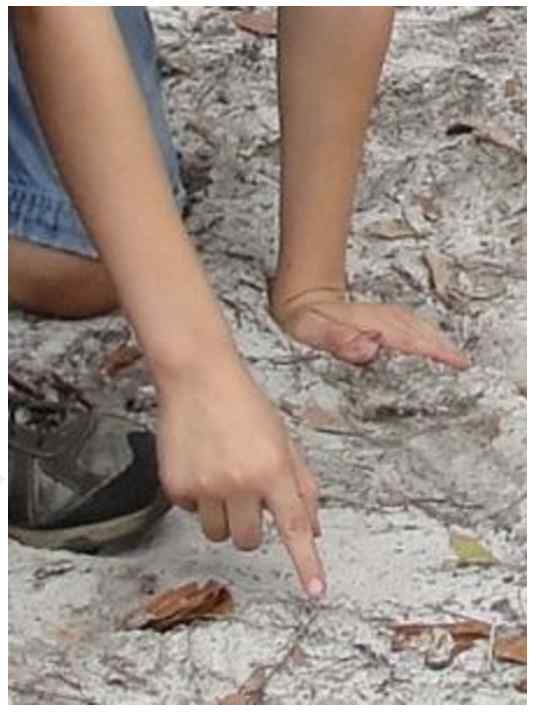
Locating tracks on our nature walk
This is part 1 of a 4 part hands-on unit study on Westward Expansion and Pioneers. Go on a nature walk to practice tracking, cook Daniel Boone’s favorite fried chicken recipe, create salt dough maps of the US, and more! My lessons are geared toward 3rd-4th grade level children and their siblings. These are lessons I created to do with a weekly homeschool co-op. We meet each week for 2 1/2 hours and have 26 children between the ages of 1-13. Use these fun lessons with your class, family, homeschool co-op group, after school program, or camp!
Joke: How many ears did Daniel Boone have?
Three: his right ear, his left ear, and his wild front-ear (frontier)!
Mountain Ranges of the United States
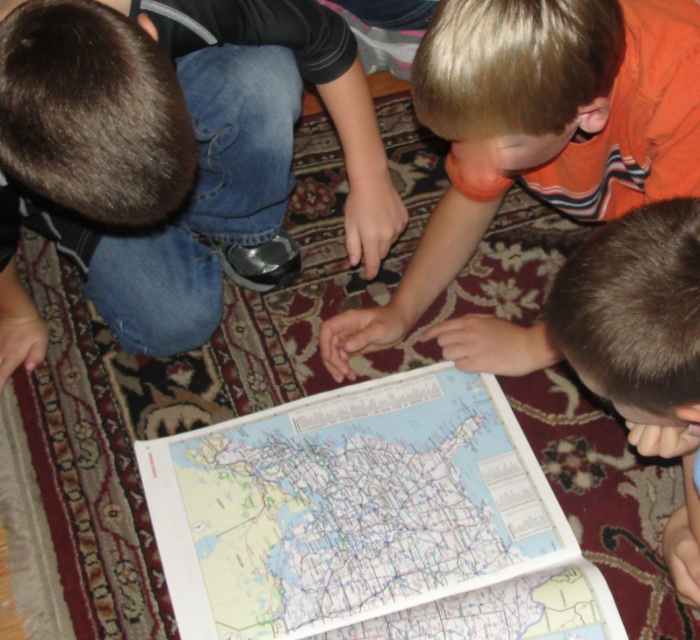
Locating the Appalachian Mountains in an atlas
- Stretch, pray, & read I Peter 5:8. Say something such as: How is the devil described in this passage? [Allow children to answer.] Think of the camouflage, imitation, tricks, and bait the devil uses. How does the devil try to trap us into doing evil? [Allow children to answer.] What does this passage command us to do so that we won’t be trapped by the devil? [Allow children to answer.] We must ever be alert and attentive against the devil and his schemes! What does it mean to be attentive? [Allow children to answer.] If you are attentive that means you are listening closely and watching carefully. Repeat this after me: “listening closely and watching carefully.” What does it mean to be attentive? [Allow children to answer.] The frontiersmen are practical examples of the importance of attentiveness. Without being attentive to sights and sounds around them they could have been attacked by wild animals or by enemies, starved by not sighting game, or lost their jobs as trappers and hunters. We too should be attentive.
- Have children pull out their maps of the US. Tell them that they will usually come across two types of maps. A political map of the US will show the borders of all of the 50 states and might include cities as well. A physical map of the US will show its physical features including mountains, rivers, lakes, etc. Ask, “Which type of map do you have, a political map or a physical map?”
- Have them locate the Appalachian Mountains and point to them as they say, “Appalachian Mountains.” Using your computer or a book that you bring, show them pictures of the mountains. Ask them to describe those mountains.
- Explain that after the colonial period in American history, most American colonists only lived from the coast of the Atlantic Ocean to the Appalachian Mountains. Tell the children to rub their fingers on that part of the United States. Ask, “What that a big space for lots and lots of people?” Some people thought so, but not everyone agreed. Some settlers wanted to cross these mountains and live in the wilds beyond the mountains. They had many dangers to face. Ask, “What kind of dangers do you think they would face crossing those mountains?” (wild animals, difficulty in getting over the mountains, hostile Native Americans who did not want settlers living here, etc.) Some of those first people who crossed over these mountains are the men we are going to call frontiersmen. Say, “Frontiersmen.”
- Have the children locate the Rocky Mountains and point to them as they say, “Rocky Mountains.” Using your computer or a book that you bring, show them pictures of the mountains. Have the children describe what they look like.
- Explain that about 50 years after frontiersmen and settlers crossed over the Appalachian Mountains and started settling in the middle of the US, some of them started to feel squished. They wanted to live in more open spaces, so they continued to move west. First they had to cross the Mississippi River. Have the children locate and then run their fingers down the Mississippi River as they say, “Mississippi River.” Ask, “Have you ever seen the Mississippi River? If so, describe it.” It is very wide and very deep.
- Next they had to cross the Rocky Mountains. Ask, “How do the Rocky Mountains look different from the Appalachian Mountains?” (higher, colder, etc.)
- Along the west coast of the United States near the Pacific Ocean there is a third mountain range called the Sierra Nevadas. Have the children locate the Sierra Nevadas and point to them as they say, “Sierra Nevadas.”
- Tell the children that in the next few weeks we will talk about explorers and settlers who crossed the Rocky Mountains and the Sierra Nevadas, but today we are only going to focus on frontiersmen who crossed the Appalachian Mountains. Have the children again point to the Appalachian Mountains.
- Let each child glue an outline of the United States to a piece of cardstock or cardboard.
YOU WILL NEED:
- pictures of the Appalachian and Rocky Mountains from your computer or from books and items brought by families: US maps such as the map at the bottom of http://courses.ttu.edu/mstoll/HIST2301/2011/Syllabus.htm or any other map), cardstock or other heavy paper, and glue sticks
Making Salt Dough
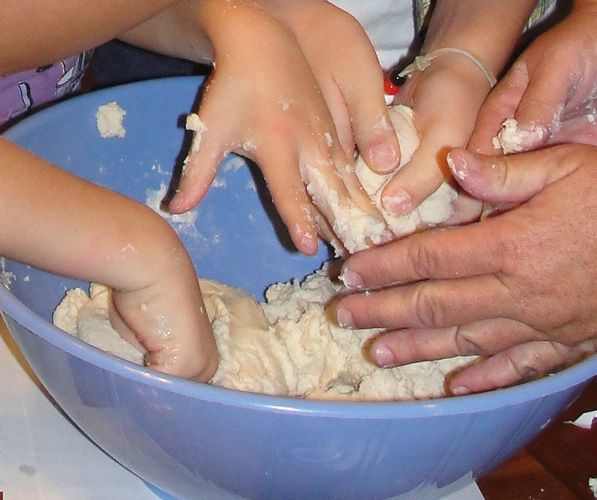
Mixing together the salt dough
- Divide children into groups of 4-5 and have each group make a batch of salt dough. Allow children to take turns measuring dumping, and mixing the ingredients.
- Let each child dump in ½ cup of salt and then each dump in ½ cup of flour. Have children mix together salt and flour.
- Let each child dump in ¼ cup of water and then mix it in.
- Divide the dough equally between the children.
YOU WILL NEED 1 SET OF THIS FOR EACH GROUP OF 4-5 CHILDREN:
- one 16 oz. container of salt, 5 lb. bag of flour, 1 mixing bowl, 1 mixing spoon, 1/2 cup measuring cup, & either a ¼ cup measuring cup or a 1 liquid measuring cup
Salt Dough Maps of the US
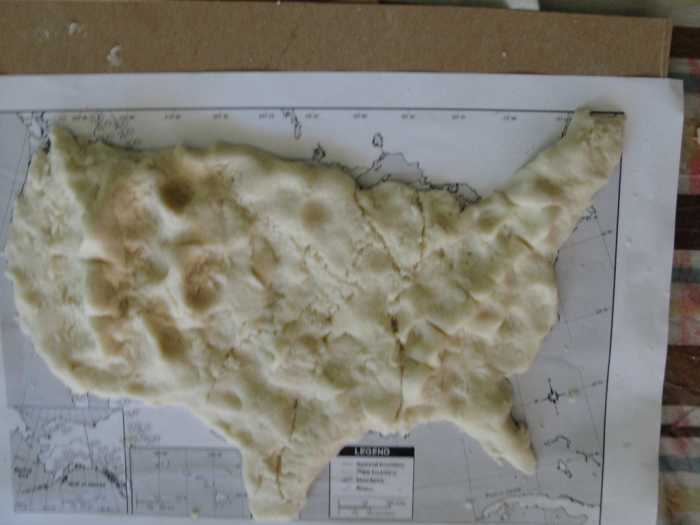
Salt Dough Map of the US including the Appalachian and Rocky Mountain Ranges and the Mississippi River
- Let children flatten and shape the salt dough over their paper maps to form the map of the United States.
- Have the children elevate the land at the mountain ranges.
- Have the children use a toothpick to carve the Mississippi River approximately where it would be.
- ***Tell the families to take these home to dry but don’t throw them away. We’ll be painting them during week 3 when studying the Oregon Trail.***
YOU WILL NEED:
- 26 toothpicks and dough and maps from the above activities
Daniel Boone’s Fried Chicken
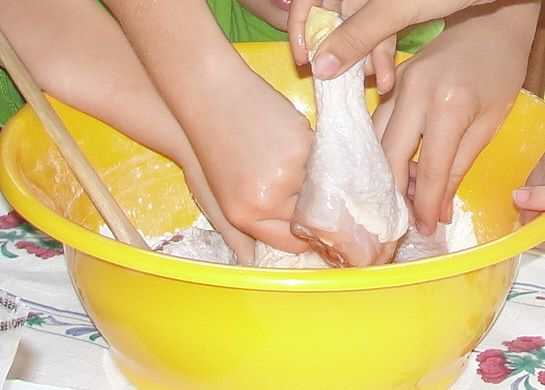
Making Daniel Boone’s Fried Chicken
5. (Prep: Get 2 large cast iron skillets. Melt ½ cup of butter or margarine in each skillet.) Mention that we are now going to study one of the early frontiersmen who crossed the Appalachian Mountains. His name was Daniel Boone.
- [Show the picture on the cover of the book about Daniel Boone such as Daniel Boone’s Great Escape, which has great illustrations and focuses on Boone’s escape from the Shawnee Indians. It is full of adventure and includes how Boone had to use his tracking and survival skills to get away. ]. Ask the children to describe him.
- Tell the children that before we learn anything more about him, we are going to begin making one of Daniel Boone’s favorite recipes, fried chicken.
- Allow children to take turns adding the 3 c. flour, 1 T. salt, 1 t. pepper, and 1 t. paprika to a large mixing bowl. Children who don’t get to add ingredients will get to whisk the mixture a couple of times. Make sure that everyone gets a turn doing something.
- Each child will get to pick a chicken leg, roll it in the flour mixture, and then place it in the skillet that has melted butter. They will then go straight to the sink to wash their hands with soap and water.
- A teacher/parent will fry the chicken.
- 1 cup butter or margarine
- 8 lbs. uncooked chicken legs/drumsticks
- 3 cups flour
- 1 tablespoon salt
- 1 teaspoon pepper
- 1 teaspoon paprika
- 4 cups water
Get 2 large cast iron skillets. Melt ½ cup of butter or margarine in each skillet. Allow the children to roll the pieces of chicken in a mixing bowl of flour heavily seasoned with salt, pepper and paprika. Brown the chicken well on both sides. Then reduce the heat slightly and add the water (adding 2 cups to each skillet). Cover the skillet and cook for about 15 minutes or until they are cooked through. Keep them covered until the end of co-op when the children will eat them.
YOU WILL NEED:
- Daniel Boone’s Great Escape or other book on Daniel Boone, 2 large cast iron skillets with lids or sturdy pots with lids, 1 cup butter or margarine, 8 lbs. uncooked chicken legs/drumsticks, ½ cup measuring cup, measuring spoons, 3 cups flour, 1 tablespoon salt, 1 teaspoon pepper, 1 teaspoon paprika, whisk, tongs, (You can use the mixing bowl from the salt dough activity above.), & book “Daniel Boone’s Great Escape” by Michael P. Spradlin
Frontiersmen and Daniel Boone
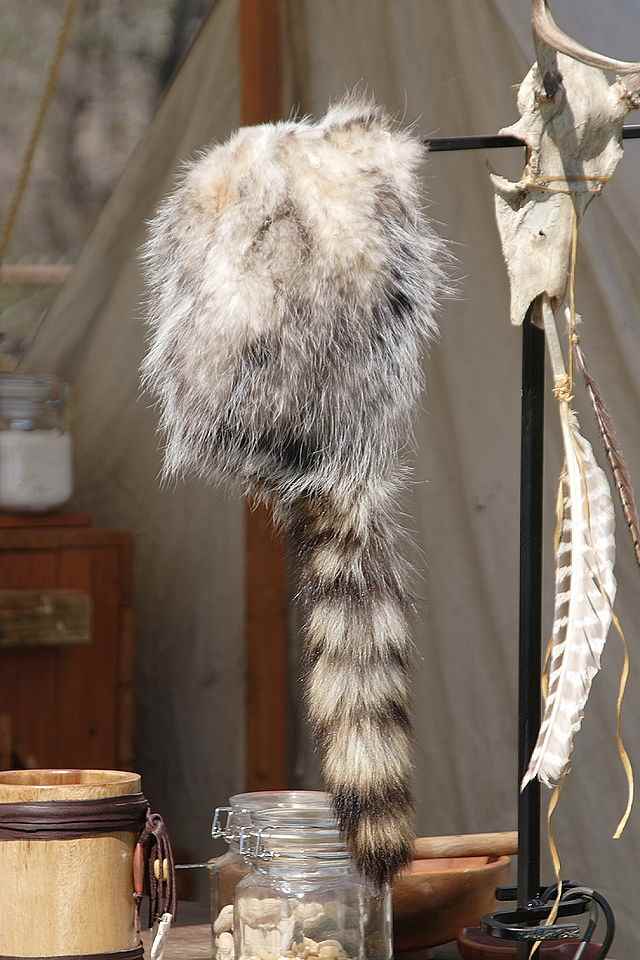
Coon Skin Hat
- Ask the children if they remember whose recipe we used for the chicken. (Daniel Boone.)
- Read “Daniel Boone’s Great Escape” by Michael P. Spradlin.
- Ask the children to remind you of what it means to be attentive (listening closely and watching carefully.)Have the childrengive examples of how Frontiersman Daniel Boone needed to be attentive.
- Tell the children that Daniel Boone was one of the earlier frontiersmen, but he wasn’t the only one. Show pictures of some of the early frontiersmen. Mention a little bit about each one. At least include Daniel Boone (1734-1820), Johnny Chapman/Appleseed (1774-1845), & Davy Crockett (1786-1836).
- Explain that each of those men were real people, though they are best known as legendary folk heroes. Ask, “What is a legend?” A legend is a greatly exaggerated story about a real person.
– [If someone brought a coonskin hat, show it to the children.] The coonskin cap is frequently associated with American frontiersmen such as Daniel Boone and Davy Crockett. Daniel Boone did not actually wear coonskin caps, but instead wore felt hats. Next week we will learn about Lewis and Clark. Explorer Meriwether Lewis wore a coonskin cap during the Lewis and Clark Expedition after his original military hat wore out during the expedition.
YOU WILL NEED:
- pictures of early frontiersmen (from the Internet, your computer, or books you bring), a coon skin hat (optional – only if someone brings one), & book Daniel Boone’s Great Escape by Michael P. Spradlin
***If you are not limited by time and would like to create a Daniel Boone Lapbook, check out this wonderful free printable one at http://www.tinasdynamichomeschoolplus.com . ***
Tracking Skills
- Ask the children if they have ever seen animal tracks. Have them raise their hands if they have seen deer tracks, dog tracks, bear tracks, etc.
- Emphasize how frontiersmen like Daniel Boone had to be great nature detectives in order to survive. Ask, “Why did frontiersmen need to be attentive to animal tracks?” (to avoid dangerous animals, to find animals to trap for food or for pelts/fur, etc.)
- Read “Big Tracks, Little Tracks: Following Animal Prints” by Millicent Ellis Selsam, which is a simple book explaining how to follow animal tracks. It encourages children to be attentive as they observe what they see outdoors.
YOU WILL NEED:
- book: Big Tracks, Little Tracks: Following Animal Prints by Millicent Ellis Selsam or other book on animal tracks
Nature Walk Part 1: Pine Needle Tea
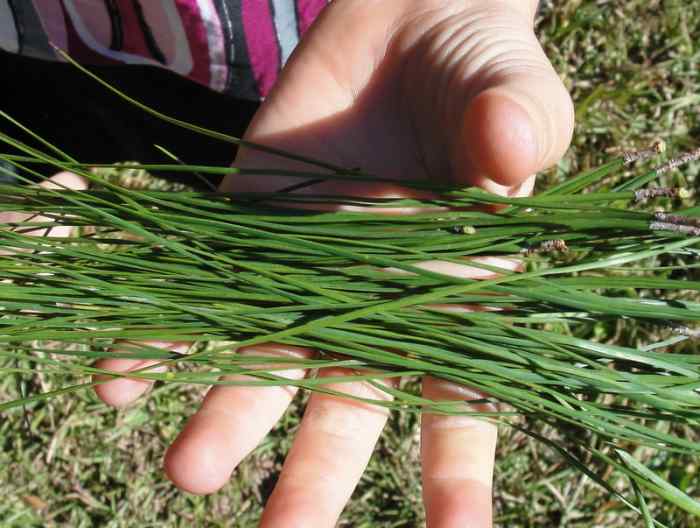
Collecting pine needles for pine needle tea
8a. (Optional — if you have available pine trees) (Prep: Bring a pot of water to boil. You will want about 3 cups of water for every 10 children if you want them to each have a small taste. You will want a ratio of about 1 cup of pine needles for every 3 cups of water.) Make Pine Needle Tea: Go outside and have each child child grab a handful of green pine needles from a pine tree. Use scissors to cut the needles into smaller pieces. Only use the green parts of the needles. (A parent can do this or the children can do it.) After the pine needles have been cut, a parent/teacher should drop them into the boiling boiling water. After all the needles have been put into the pot of water, cover it and lower the temperature to simmer/low. Simmer the needles for about 20-30 minutes [the amount of time we went on the nature walk]. After you return, strain the needles from the tea and add desired amount of sugar or honey.
- Mention to the children that out in the wild frontier, frontiersmen did not have readily available doctors of medicine. If they got sick, they had to create their own medicines. Frequently they would learn this information from Native Americans who lived in the area. Pine needle tea is high in vitamins A and C, so it would be something that frontiersmen might have made if they were getting sick to help strengthen their immune systems.
YOU WILL NEED:
- pine tree with accessible pine needles, scissors, kettle or pot with a lid, sugar or honey, and strainer
Nature Walk Part 2: Tracking
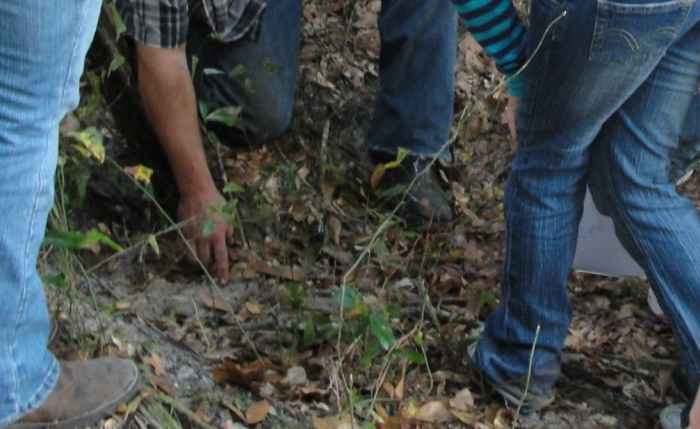
Studying tracks on the nature walk
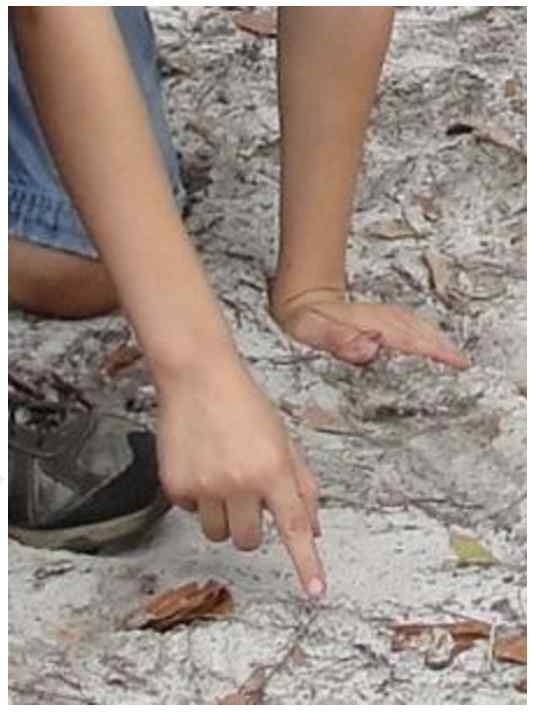
8b. Go on a nature walk and look for animal tracks, scat, dens, and paths. Look for edible or medicinal plants. Also look for signs of human activity. Discuss why these would have been important skills for the frontiersmen and pioneers.
- I have done this when living in the country and we actually saw deer tracks and scat. We examined empty wolf dens. We followed horse hoof prints and noted how some were deeper than others, which meant the rider would have been heavier. We talked about how you had to listen for animals; if you couldn’t hear any, that most likely meant that people were in the area. We tried sparkleberries, wild fennel, and clover. We found a sassafras tree and discussed how the tea from its roots was used medicinally.
- I have also done this when we lived in the city. We walked along the sidewalk in front of our house and saw dog tracks and scat [poop] and found bird feathers. We found evidence of squirrels and the children examined acorns with gnaw marks. We also found plenty of evidence of people and compared bike tire marks with car tire marks and tried to follow some. The kids munched on dandelion greens and clover.
- If you have a park nearby, that would be another great place to head for this activity.
Eating Daniel Boone’s Fried Chicken & Review
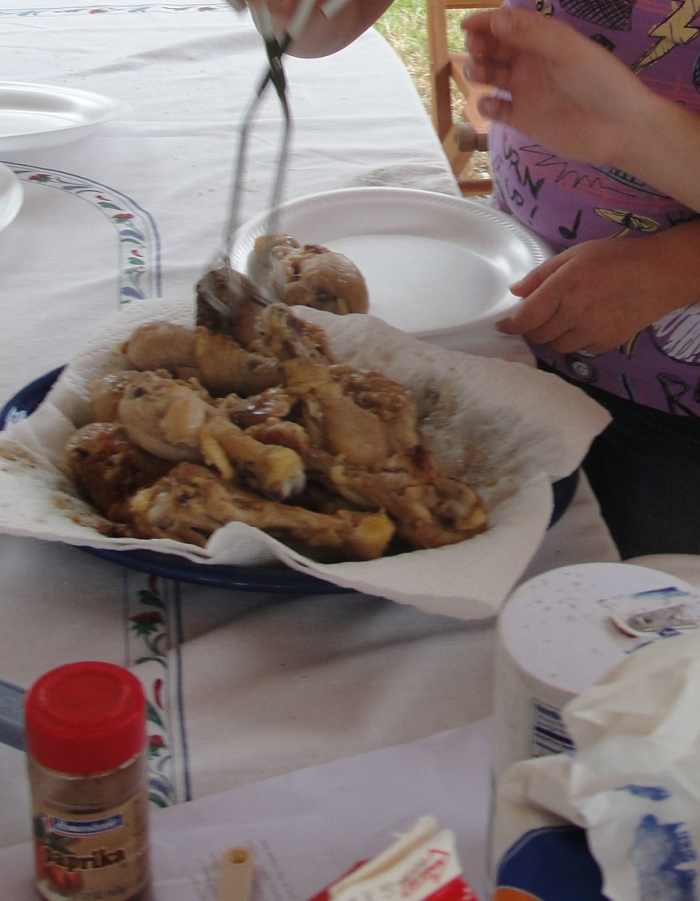
Daniel Boone’s Fried Chicken
9. (Prep: Pour 26 cups of water and put a piece of chicken on each plate. Pour pine needle tea into small cups if serving it.) Sanitize children’s hands. Serve the fried chicken and water for the children to eat and drink.
YOU WILL NEED:
- disposable plates, cups, & napkins
- Review what we learned today: What does it mean to be attentive? (listening closely and watching carefully) Which type of map did we make today, a political map or a physical map? (physical – because it shows the physical features) Name one of the mountain ranges in the US (Appalachian, Rocky, & Sierra Nevadas) [Ask 3 children so they all get named.] Which mountain range did the early frontiers have to cross? (Appalachian) What is the longest river in the US? (Mississippi) Name an early frontiersmen. (Daniel Boone, Johnny Chapman/Appleseed, Davy Crockett, etc.) What is a legend? (a greatly exaggerated story about a real person) What type of hat were frontiersmen known for wearing? (coonskin cap) What is something you learned today about tracking? [Allow multiple children to answer.] What was your favorite activity from today? [Allow each child to answer.]
- Remind the families to take the salt dough maps home to dry but don’t throw them away. We’ll be painting them during week 3 when studying the Oregon Trail.
More of our Favorite Children’s Books
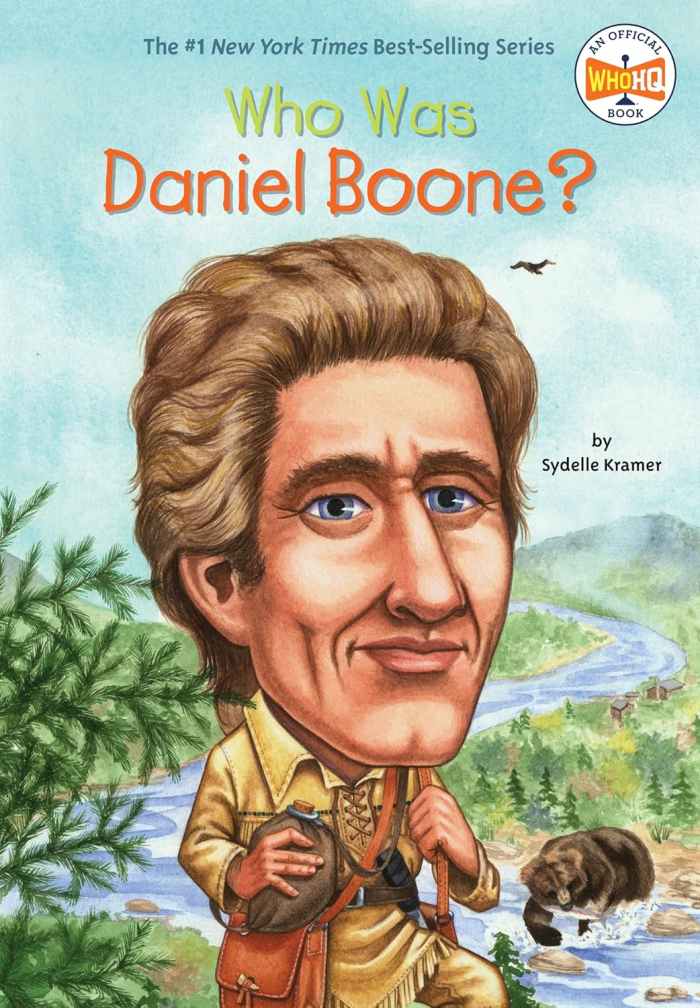
Who Was Daniel Boone? by S. A. Kramer – Image is from amazon.com
More of our for This Lesson
In addition to the books we used during the lesson, we also enjoyed reading:
- Crinkleroot’s Book of Animal Tracking is a 48 page picture book following Crinkleroot as he and his pet snake follow various animals through the forest.
- Who Was Daniel Boone? by S. A. Kramer is a short chapter book that we read over 3 days. It has some black and white illustrations
- Daniel Boone : Frontier Adventures by Keith Brandt was our favorite picture book biography on Daniel Boone. It’s long, though.
- Daniel Boone, Graphic Biography (Saddleback Graphic: Biographies) – Both my boys enjoyed this 32 page historically accurate book written in a comic book style.
- Wild Tracks!: A Guide to Nature’s Footprints is a simple animal track guidebook but is very child friendly. In the 32 pages it includes a beautiful illustration of each animal, some information about them, and a life-size illustration of the animal track.
- Tracks, Scats and Signs (Take Along Guides) – If you want to add scat (poop) identification to your walk, this is the most child-friendly version we found. It has great illustrations.
- Stella and Roy Go Camping is a fun 40 page story book follows a brother and sister as they camp at Yosemite and test out their newly learned animal tracking skills. Both my 4 and 8 year old enjoyed this.
- Jim Bridger’s Alarm Clock and Other Tall Tales (Unicorn Book) is a 56 page picture book has 3 fun tall tales about Jim Bridger
- The Value of Love: The Story of Johnny Appleseed (Valuetales Series) – Both my boys enjoyed this biography about Johnny Appleseed. The illustrations are fun and it provides lots of information in an engaging manner.
- Jed Smith, trailblazer and trapper (American Heritage) – My 8 year old loved reading about all the adventures of the frontiersmen who headed west, so we read a number of chapter books about them. This is a 197 page chapter book with illustrations on many pages. We also read “Jim Bridger” by Willard Luce, which is an 80 page biography with illustrations on most pages. My 4 year old sat through most of that book because Bridger’s life (like all the lives of the frontiersmen) was so exciting.
Ready for the next lesson?
Fry up Daniel Boone’s favorite fried chicken recipe and talk a walk outdoors in search of tracks and you study frontiersmen and tracking. Dramatize the purchase of Louisiana from France and more as you study Lewis and Clark! Build a pioneer wagon and the transcontinental railroad. Pan for “gold” and deliver mail on the pony express (using bicycles rather than horses). Wrap up the unit on Westward Expansion and pioneers with a wagon roundup dinner and presentations on various frontiersmen and pioneers.
- Daniel Boone, Frontiersmen, & Tracking Lesson – This is part 1 of a 4 part hands-on unit study on Westward Expansion and Pioneers. Go on a nature walk to practice tracking, cook Daniel Boone’s favorite fried chicken recipe, create salt maps of the US, and more!
- Lewis and Clark Lesson – This is part 2 of a 4 part hands-on unit study on Westward Expansion and Pioneers. Dramatize the Louisiana Purchase, taste and see some of the plants and animals Lewis & Clark discovered on their journey, visit with Sacajawea and Pomp, create a Lewis and Clark lapbook, and more!
- California Gold Rush, Pony Express, & Transcontinental Railroad Lesson – This is part 3 of a 4 part hands-on unit study on Westward Expansion and Pioneers. Pan for “gold,” bake Gold Rush Sourdough Biscuits, race to deliver mail on the Pony Express, build the Transcontinental Railroad out of craft sticks, and more!
- Oregon Trail Lesson – This is part 4 of a 4 part hands-on unit study on Westward Expansion and Pioneers. Build prairie schooner, head out on a scavenger hunt using only landmarks to navigate, bake Pioneer Persimmon Pudding, practice pioneer children’s chores, and more!
- Westward Expansion & Pioneers Presentations & Field Trip Ideas – The end of the unit activity and presentations for our 4 part hands-on unit on Westward Expansion and Pioneers was a Pioneer Wagon Roundup Dinner. Children dressed as various famous frontiersmen or pioneers and presented on their assigned person. Afterward we had a pioneer themed dinner around a campfire. Also included are the field trips we attended while studying this unit.
- My KONOS Volume I Lessons – Are you using KONOS or curious about what hands-on unit studies look like in real life? Here are my pictures & lessons that describe our adventures as we roll up our sleeves and have F-U-N while learning! I have divided my Konos co-op lessons in the order presented in Konos Volume I. You can follow along even if you’re doing these lessons with only your family.
- My American History Lessons – Fun, free hands-on American History or U.S. History unit studies and lessons – Learning through Doing: Dramatizations, Cooking Through History, Costumes, Games, Crafts – Explorers, Native Americans, American Colonies, Independence, Westward Expansion, Presidents, and more through World War II.
- All my fun, FREE Hands-on Unit Studies – Over the years I have posted over 30 science and social-studies based unit studies, compromised of more than 140 lessons. The unit studies include the Human Body, Simple Machines, Earth Science, Medieval Period, American Revolution, Pioneer Life, Countries of the World, and many more! For each lesson I have included activities (with photos), our favorite books and YouTube video clips, lapbook links, and other resources..
KONOS Curriculum
KONOS Volume I
Would you like to teach this way every day?
I use KONOS Curriculum as a springboard from which to plan my lessons. It’s a wonderful curriculum and was created by moms with active boys!
© 2011 Shannon
Who is your favorite frontiersmen? – Or just leave me a note. I love getting feedback from you!
waldenthreenet on November 18, 2011:
Valuable topic, I just did a lens on related topic . Admiring your lens and appreciating your knowledge. I vote “Like’ on this lens. Thanks.
Leave a Reply