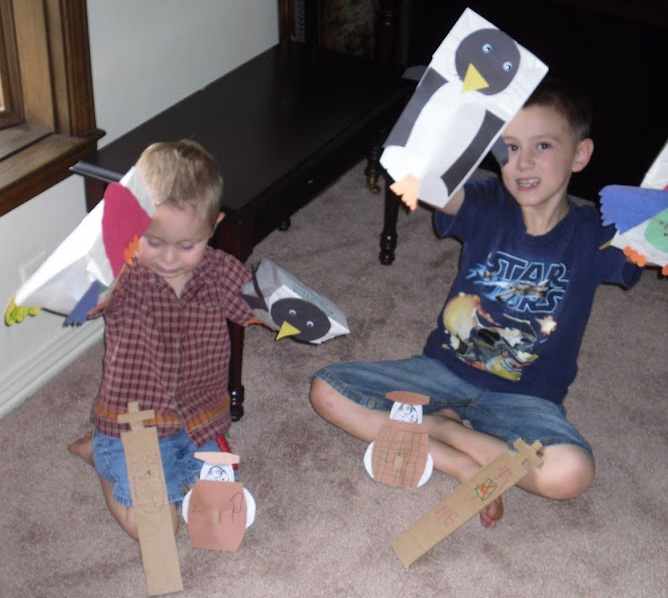
Some of the explorer crafts made during this lesson
This is part 3 of a 5 part hands-on unit study on Explorers or a stand-alone lesson if doing CC Cycle 2 Week 9 History: European Explorers. Make Da Gama Portuguese land markers, Vespucci parrot puppets, and Balboa hiding-in-a-barrel stick puppets. Search for the Pacific Ocean with Balboa (through your house). Eat “sawdust” and “leather” with Magellan and his men. And more! My lessons are geared toward elementary ages. These are lessons I created to do with a weekly 2 1/2 hour homeschool co-op group and with my family. Use these fun lessons with your classroom, family, or homeschool co-op group!
*Tip: Don’t get overwhelmed. You don’t have to do every activity we did. Select the activities that appeal to you!*
Vasco Da Gama’s Padrão
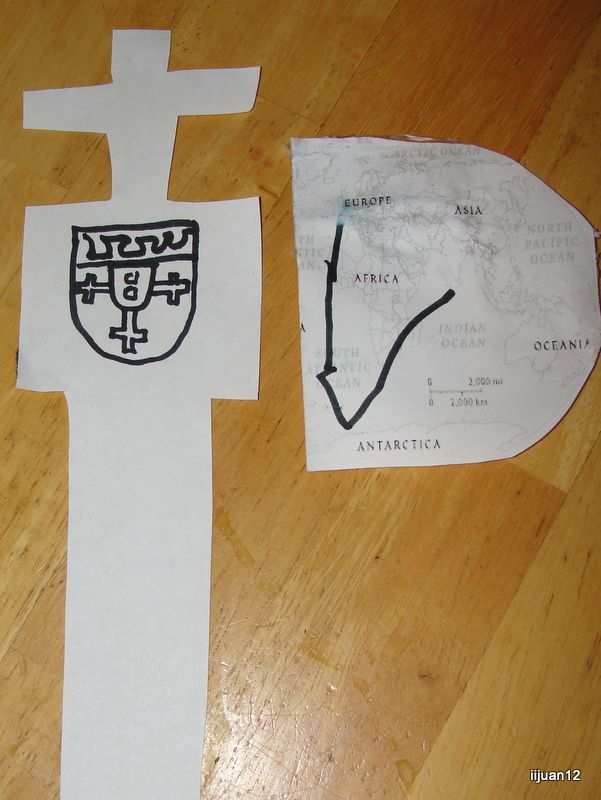
Da Gama’s padrão with map
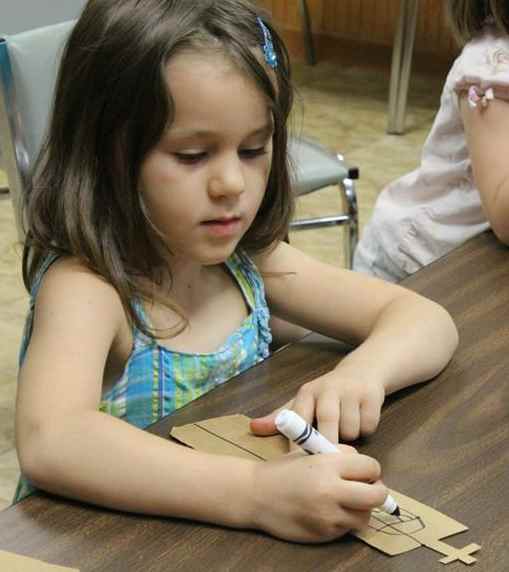
- Pray. Read & discuss Philippians 4:13.
- Review continents and oceans and sing continent song (sung to tune of “Love & Marriage” 2x). Show a world map while singing. (I used the world map from the book It’s a Big Big World by Brierly.)
North America, South America, Europe, Asia, Africa
Don’t Forget Antarctica
Or way down under in Australia
Atlantic Ocean, Pacific Ocean, Indian, Arctic, Southern Oceans
North Pole, South Pole, Equator
I know all about maps and globes
YOU WILL NEED:
- a world map
- Introduce Da Gama using pictures from books. We used A Long and Uncertain Journey: The 27,000 Mile Voyage of Vasco Da Gama by Joan Goodman for pictures to show about the journey, and we used The Great Atlas of Discovery by Neil Grant to show the route and also the padrão.
YOU WILL NEED:
- A Long and Uncertain Journey: The 27,000 Mile Voyage of Vasco Da Gama by Joan Goodman or other book showing Da Gama’s journey
- The Great Atlas of Discovery by Neil Grant or other book to show Da Gama’s route and the padrão.
- Da Gama’s Padrão: Note how Da Gama and other Portuguese explorers would mark where they had landed with large stone pillars that had the coat of arms for the prince of Portugal and maybe the coat of arms of the explorer.
- For each child cut out a 1 1/2 foot stake made out of white poster board and cut out a small cross at the top. (It should be white because the padrãoes were made of white stone.)
- First we marked Da Gama’s route on a world map. I cut the map to only show Europe, Africa, and part of Asia. We glued the map to the back of the padrão and then we wrote ” Vasco Da Gama 1497-1498″ on the back.
- On the front we drew the coat of arms symbol from what we saw in the book The Great Atlas of Discovery by Neil Grant. If you are not able to get that book, you can also see an image of a padrão at wikipedia.org.
- Mark Da Gama’s route on the map.
- If you’re not limited by time, an alternative activity would be to have the children carve a padrão out of a bar of Ivory soap as this would be closer to how they were made. After carving out the shape, they could then carve a coat of arms design at the top. If desired, they could use a black marker to trace over the coat of arms so that their carving would be more pronounced.
(NOTE: If you live near Jacksonville, Florida, you can see a version of a padrão, the Ribault Monument.)
YOU WILL NEED PER CHILD:
- an approximately 1 1/2 foot x 3 inch pieces of white posterboard or recycled cardboard with a small crosscut out at the top of each one to make it look like a bookmark with a cross at the top
- a copy of a this world map
- glue and black marker
Amerigo Vespucci’s Brazilian Parrot
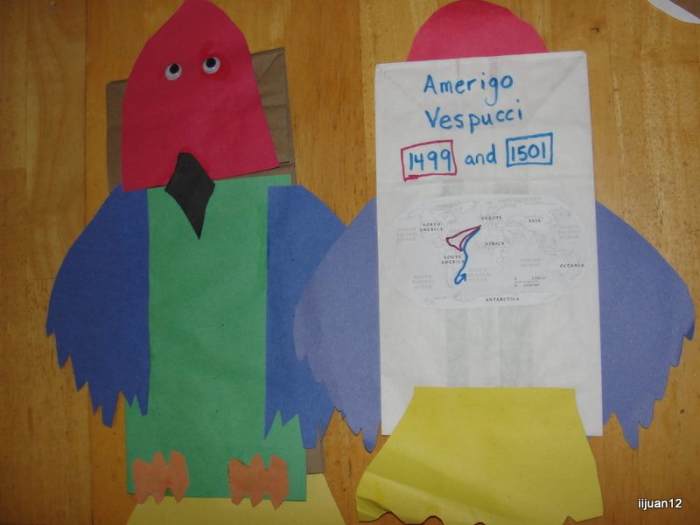
Amerigo Vespucci’s Brazilian Parrot Puppet and routes maps
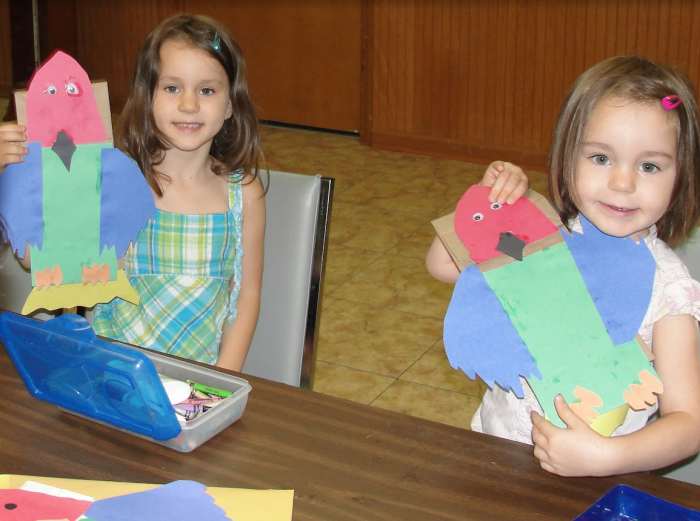
- Introduce Vespucci using pictures from books.
YOU WILL NEED:
- A book about Vespucci such as Land Ho! Fifty Glorious Years in the Age of Exploration by Nancy Winslow Parker or The Great Atlas of Discovery by Neil Grant
- Mark his routes for his first 2 voyages on a world map . Paste the map to the back of a paper lunch sack. Then write “Amerigo Vespucci and 1499 and 1501” on the back. Ask how many years after Columbus’s first voyage Vespucci went. Then paste colorful construction paper cut outs to complete the parrot puppet using the below eagle pattern. Tell the children to have the parrot tell their parent or sibling about Vespucci’s voyage.
YOU WILL NEED PER STUDENT:
- white paper sack
- sets of construction paper cut out like this eagle pattern
- sets of wiggle eyes
- glue
- copy of world map
Vasco Nunez Balboa Crossing Panama to the Pacific
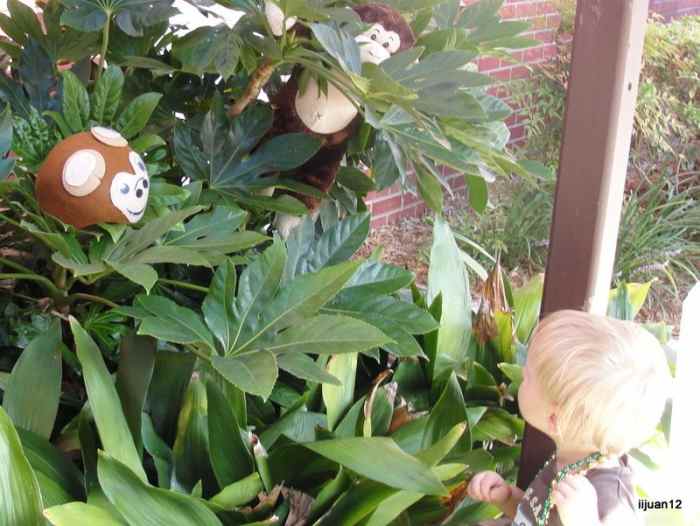
Heading through the “jungles of Panama” on the way to the Pacific with Vasco Nunez Balboa
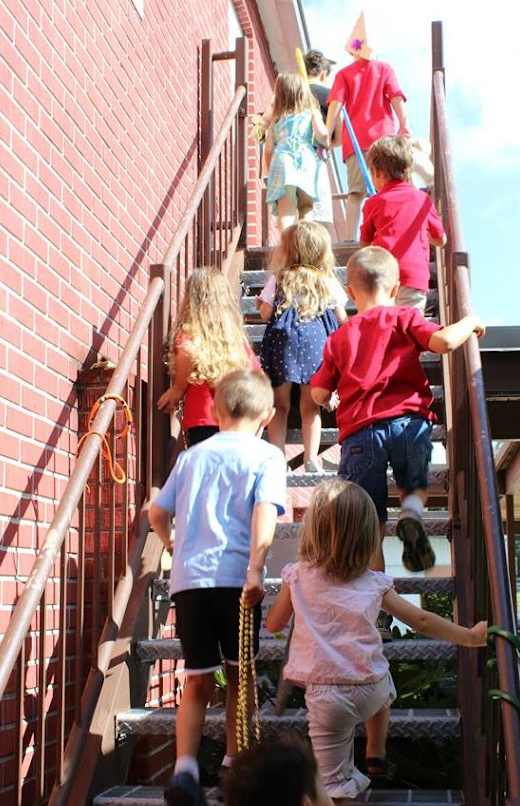
Climbing the mountains of Panama to reach the Pacific (with the gold we traded for with the Natives)
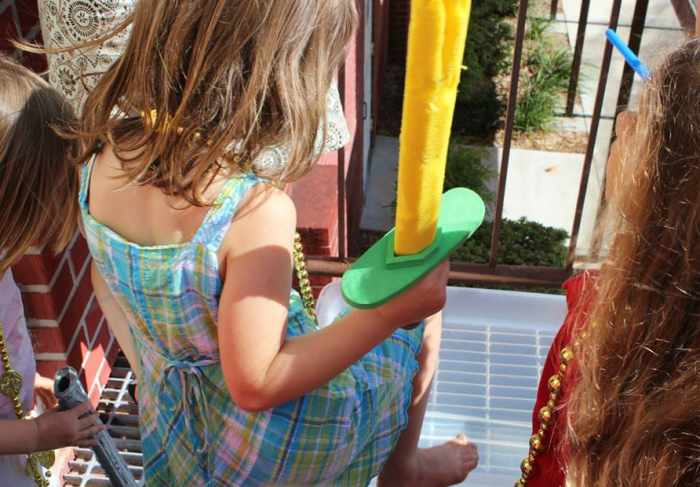
Setting foot in the “Pacific Ocean” (either a bathtub, container of water, or water fountain)
- Introduce Balboa using pictures from books.
YOU WILL NEED:
- A book about Balboa such as Land Ho! Fifty Glorious Years in the Age of Exploration by Nancy Winslow Parker or The Great Atlas of Discovery by Neil Grant
- Balboa’s journey: Take a journey around the house or classroom pretending to march through the jungles of Panama and discuss all the animals we saw (stuffed animals, pictures from books, and photos from the Internet that we set up along our path).
- If you’re not limited by time, first watch the below YouTube video on what you might encounter in the jungles of Panama.
- We used our swords (from our Viking craft) to hack through the jungle vines and we fought attacking natives (either pretend or have the parents/teachers pretend to be natives). The children asked the “natives” to be friends and then traded for gold.
- The first time I did this lesson, I handed out bowls with yellow beads to each of the children. The second time I taught this lesson, each of the parents/teachers wore gold Mardi Gras beads (necklaces). The children each had to trade something (crayons, small toys, etc.) to get a gold Mardi Gras bead necklace.
- We finally climbed a mountain (our stairs) and then spotted the Pacific Ocean (a filled bathtub or a large plastic tub with about 6 inches of water in it) and stepped in and claimed all the lands the water touched for Spain.
- Then we headed back, again hacking through the jungle vines, swatting mosquitoes, and fighting natives. If you are meeting in a location that does not have a bathtub, simply use a large, plastic storage bin and add some water OR have the kids go to the water fountain and touch the water there.
YOU WILL NEED:
- Stuffed animals you would find in the Panama jungles (or use pictures printed from online)
- bowls with yellow beads or other items that you’ll pretend are gold or pieces of toy gold jewelry (such as Mardi Gras beads)
- toy swords from Viking craft or toy swords or sticks
- plastic storage bin filled with water (optional)
Balboa’s View of Panama YouTube Video
When my children and I were reading about Balboa, we watched this great video on the jungles of Panama.
Balboa Hiding in a Barrel

Balboa and his dog in a barrel puppets
- After our return, mark Balboa’s route on a world map .
- Cut out a brown construction paper barrel and decorate it with a black marker to look like a barrel. Cut out a brown construction paper lid. (If doing this with younger children, do these steps ahead of time.)
- Paste the lid to a picture of Balboa and his dog in a barrel (link is below). It was most effective when I cut off the bottom 1/3 of the picture. Paste that to a popsicle stick.
- Cut 2 slits in the barrel and put the popsicle stick through the slits so that Balboa can pop up and down from the barrel.
- Paste the map to the back of the barrel between the two slits. Write the name “Balboa” on the back of the barrel lid.
- Alternatively, you can have the children tape the brown construction paper into a circle “barrel” and simply curl up Balboa and his dog and stuff them into the barrel. This second method would not require for you to cut slits or use a popsicle stick.
YOU WILL NEED PER CHILD:
- glue and scossors
- copy of Balboa and his dog in a barrel with ore-cut slits
- brown construction paper barrel with oval lid
- craft/popsicle stick
- copy of a world map
Magellanic Penguins and Snack & Review
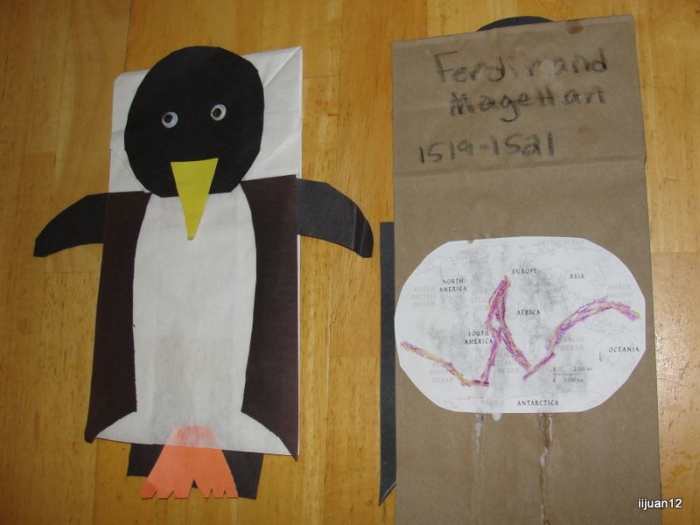
Ferdinand Magellan penguin puppet and route map
- Introduce Magellan using pictures from books. Use base ten blocks to show how many men started out and remove blocks as the men count goes down (as they die).Divide up 260 beads among 5 bowls (260 men in 5 ships). We included one special bead which represented Magellan, and we removed that bead when we read about his death. By the time we finished reading, we’d removed all but 1 bowl and all but 18 beads (18 men and 1 ship).
YOU WILL NEED:
- 260 blocks, beads, or dried beans with 1 “special” block and 5 bowls
- Create Magellanic Penguin Puppets.
- Mark Magellan’s route on a world map . Paste it to the back of a white paper lunch sack.
- Write “Ferdinand Magellan and 1519-1521.”
- On the front make a penguin puppet kind of following this penguin pattern and using googly eyes and construction paper.
- The penguin can then tell a parent or sibling about Magellan’s voyage.
- While passing by the tip of South America, Magellan and his men saw penguins, which they’d never seen before. They described them as “featherless ducks.” That breed is now named Magellanic penguins. (If you live near Jacksonville, FL, they have that breed of penguins at the zoo.)
YOU WILL NEED PER STUDENT:
- white paper sack
- construction paper cut out like eagle pattern above
- 1 set of wiggle eyes
- glue
- copy of world map
- Snack Time with Magellan: Leather and sawdust (fruit leather and graham crackers) and water. When Magellan and his man ran out of food as they sailed in the Pacific Ocean, they ate rats from the ship. When there were no more rats, they ate their leather rigging from the ship and ground up some of the wood from the ship and ate sawdust soup.
YOU WILL NEED PER STUDENT:
- fruit leather
- graham crackers
- cups for water (optional)
- 5 Minute Review of what we learned. Ask specific children questions like, “Name one explorer we learned about today. Where did he go? What was something that happened while he was exploring?” Help them if they need it. Have each child answer at least 2 questions.
Looking for more good children’s books?
Our Favorite Children’s Books on the European Explorers
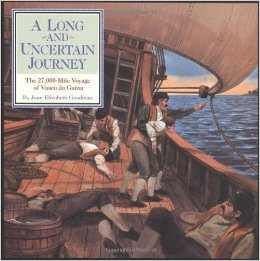


A Long and Uncertain Journey: The 27,000 Mile Voyage of Vasco Da Gama (Great Explorers) by Joan Goodman – Images are from amazon.com.
1 / 4
Vasco da Gama
- A Long and Uncertain Journey: The 27,000 Mile Voyage of Vasco Da Gama (Great Explorers) by Joan Goodman is a long picture book, but it does have some nice illustrations. We used the pictures from this book as we discussed Vasco da Gama’s journey.
- Vasco Da Gama by David C. Knight was our favorite picture book on Vasco Da Gama. It has 1 paragraph per page and black and white illustrations on every page. It includes some of Vasco Da Gama’s life before he sailed around Africa. It is quite interesting and is short enough that we could read it in one sitting.
- The Travels of Vasco Da Gama by Joanne Mattern.
- The chapter book my oldest son read was Vasco da Gama: Sailor Toward the Sunrise by Ronald Syme. After each chapter my boys either wrote 1-2 sentences or drew what the most important event was from that chapter. It is a 95 page chapter book with many black and white illustrations.
Amerigo Vespucci
- Who in the World Was The Forgotten Explorer?: The Story of Amerigo Vespucci (Who in the World) by Lorene Lambert is probably the closest to a storybook you’ll find on Vespucci.
- A World Explorer: Amerigo Vespucci by Faith Yingling Knoop was the book we read as a family. We love the “World Explorer” series! After each chapter my boys either wrote 1-2 sentences or drew what the most important event was from that chapter. Amerigo Vespucci by Nina Brown Baker would also make a good chapter book option.
Vasco Nunez Balboa
- Balboa (Explorers and Discoverers) by Marie M. Richards and Agnes M. Michnay is a simple easy reader storybook about Balboa, and is perfect for preschoolers or early elementary-aged children.
- A World Explorer: Vasco Núñez de Balboa (World explorer books) by Faith Yingling Knoop was the book we read as a family. We love the “World Explorer” series. After each chapter my boys either wrote 1-2 sentences or drew what the most important event was from that chapter.
Ferdinand Magellan
- Magellan’s World (Great Explorers) by Stuart Waldman is a longer picture book so it’s not ideal for reading aloud to a group. It does have nice illustrations, though.
- Ferdinand Magellan (Adventures in Discovery) by Ruth W. Harley was my favorite picture book. It includes more information than many of the other picture books (including descriptions of Magellan’s life before his adventure around the globe), and it typically has 1 paragraph per page along with illustrations on every page making it short enough to be a good option for a read aloud book. The illustrations are all in black-and-white, though.
- Magellan (Explorers and Discoverers) by Marie M. Richards is a simple easy reader storybook about Balboa, and is perfect for preschoolers or early elementary-aged children.
- Ferdinand Magellan (1480-1521) (What Would You Ask…?) by Anita Ganeri is a good picture book.
- Also look for Who Was Ferdinand Magellan? by S. A. Kramer.
- My oldest son read Magellan: First Around the World by Ronald Syme as his chapter book.
- Magellan: A Voyage Around the World (Expedition) by Fiona MacDonald is a longer picture book that includes quite a bit of information on Magellan’s voyage and also about life during those times.
Great YouTube Clips on These Explorers
Ready for the next lesson?
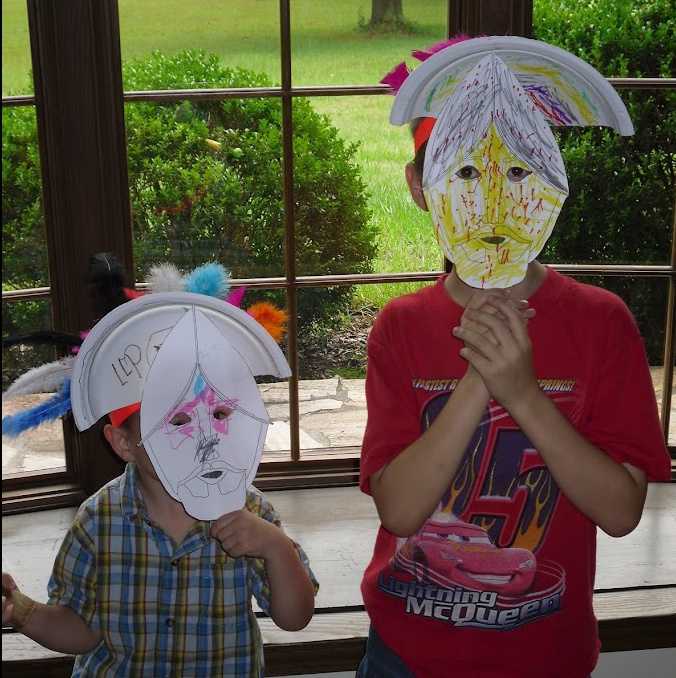
Montezuma’s Crowns and Conquistador Masks from Lesson 4: Ponce de Leon, Aztecs, Cortes, & Conquistadors Lesson
Build Viking shields and swords and “sail” to Vineland with Leif Erikson, walk the route of Marco Polo (through your house) and collect the items that he saw on his journey through China, go on a compass treasure hunt, dramatize Columbus’ journey, make Da Gama Portuguese land markers, create Montezuma’s headdress, go on a conquistador hunt for gold, bake constellation bar cookies, dress up as and present on famous explorers, and more during this unit study on Explorers!
- Marco Polo and Leif Erikson Lesson – This is part 1 of a 5 part hands-on unit on Explorers. Walk the route of Marco Polo (through the house) and collect the items he came across while in Asia. Make Viking bread, Viking helmets, shields, and swords and “sail” to Vineland (America) as a Viking, and more!
- Christopher Columbus & Prince Henry the Navigator Lesson – This is part 2 of a 5 part hands-on unit study on Explorers. Go on a compass treasure hunt, eat sailor food, jump across the parts of a caravel ship, act out Columbus’ journey, and more!
- Da Gama, Vespucci, Balboa, & Magellan Lesson – This is part 3 of a 5 part hands-on unit study on Explorers. Make Da Gama Portuguese land markers, Vespucci parrot puppets, and Balboa hiding-in-a-barrel stick puppets. Search for the Pacific Ocean with Balboa (through your house). Eat “sawdust” and “leather” with Magellan and many more activities!
- Ponce de Leon, Aztecs, Cortes, & Conquistadors Lesson This is part 4 of a 5 part hands-on unit on Explorers. Create Montezuma’s headdress, act out the meeting between Cortes & Montezuma, go on a conquistador hunt for gold, and more!
- Cabot, Cartier, Drake, Hudson, and Astronomy Lesson – This is part 5 of a 5 part hands-on unit on Explorers. Bake constellation bar cookies, create star finders, act out Cartier’s expedition, and more!
- Explorer Unit Presentations and Field Trip Ideas – For the culminating project we following the 5 part hands-on unit on explorers, the children dressed as explorers, made presentations, and shared “authentic” food from their explorer’s country of origin. They also sang the songs from the unit. Also included are the field trips we took during this unit.
- Fun, FREE Hands-on Unit Studies – Looking for all of my lessons and unit studies? Over the years I have posted over 30 science and social-studies based unit studies, compromised of more than 140 lessons. For each lesson I have included activities (with photos), our favorite books and YouTube video clips, lapbook links, and other resources. I posted links to all of my unit studies and lessons at the above link.
Konos Curriculum
Konos Volume II (Inquisitiveness)
Would you like to teach this way every day?
I use Konos Curriculum as a springboard from which to plan my lessons. It’s a wonderful curriculum and was created by moms with active boys!
If you’re new to homeschooling or in need of some fresh guidance, I highly recommend Konos’ HomeSchoolMentor.com program! Watch videos on-line of what to do each day and how to teach it in this great hands-on format!
© 2010 Shannon
Leave Me a Note or Ask Me a Question – Let me know you dropped by! Was this lens helpful? Do you have any questions, comments, or additional ideas? Please post
Shannon (author) from Florida on November 28, 2016:
I’m so happy you have been finding my lessons to be helpful!
Mary Prather on October 15, 2016:
Thanks so much for all of these ideas! I’ve been using your lesson plans for the Abecedarians from CC Connected and they are so helpful. Thank you for blessing the CC Community at large with your hard work!
anonymous on March 24, 2011:
Great ideas! I’m always looking for hands-on projects.
Leave a Reply