Colonial Christmas Party for Kids
This is the 12th lesson in a series of 27 hands-on lessons covering American History through 1865. This lesson focuses on Colonial Christmas and Epiphany. Drink wassail and munch on Twelfth Night Pound Cake while caroling and learning about the holiday traditions of the time. This was the lesson I used just before Christmas break. I used this plan while teaching a 45 minute history class for children in Kindergarten, 1st, & 2nd grades. Use these fun lessons with your classroom, homeschool, after-school program, or co-op!
Colonial Christmas Traditions & Santa Claus
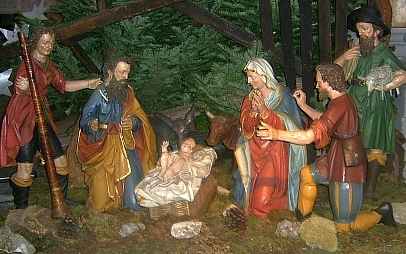
Traditional German crib (nativity scene)
- Ask the children, “What is your favorite part of Christmas?”
- Discuss some colonial (including time of American War for Independence) customs while pointing to the parts on a map of the 13 Colonies.
- New England Puritans forbade the celebration of Christmas.
- Pennsylvania Quakers didn’t celebrate Christmas because they said each day was the same as any other day.
- Anglicans, Lutherans, & Catholics, mainly in the Southern colonies, celebrated Advent (the time leading up to Christmas) with fasting & prayer. They celebrated Christmas by attending a church service, maybe holding a special meal, & maybe giving a small gift to servants (half a day of work & a coin).
- The Dutch & Germans were the ones responsible for many of our modern traditions. Dutch = St. Nicholas filling a wooden shoe left by the fire place with fruit & candy. German = Christmas tree with ornaments & giving toys as gifts. [Show a picture from the internet or book if possible.]
- Washington Irving (author of Legend of Sleepy Hollow) is kind of responsible for how our current country views a traditional American Christmas. Using Dutch legends, Irving wrote a tale of Oloffe who dreams one night that “the good St. Nicholas came riding over the tops of the trees, in that self-same wagon wherein he brings his yearly presents to children.” Irving’s Nicholas smokes a pipe and places gifts in the stockings that children have hung by the chimney. (Source)
You will need:
- a map of the 13 Colonies
- pictures of old German & Dutch Christmas celebrations & traditions (from the Internet or a book)
- Read The Story of St. Nicholas: More Than Reindeer and a Red Suit by Cheryl Odden, which is my favorite children’s book about the historic Saint Nicholas to use as a read aloud for classes. The illustrations appeal to children. It is the perfect length. It doesn’t reveal whether or not Santa Claus is real or not, leaving that discussion for parents.
You will need:
- The Story of St. Nicholas: More Than Reindeer and a Red Suit by Cheryl Odden or other book on St. Nicholas
Colonial Christmas Decorations

Christmas greens
- Ask who has a Christmas tree up & decorated at their home. During the Colonial period, there were not many Christmas decorations. They maybe added greens to their church (holly, ivy, mountain laurel, and/or mistletoe), but they did not really decorate their houses. That means they didn’t have Christmas trees.
You will need:
- Holly, ivy, mountain laurel, and/or mistletoe (real or fake) (optional)
Colonial Singing & Wassailing
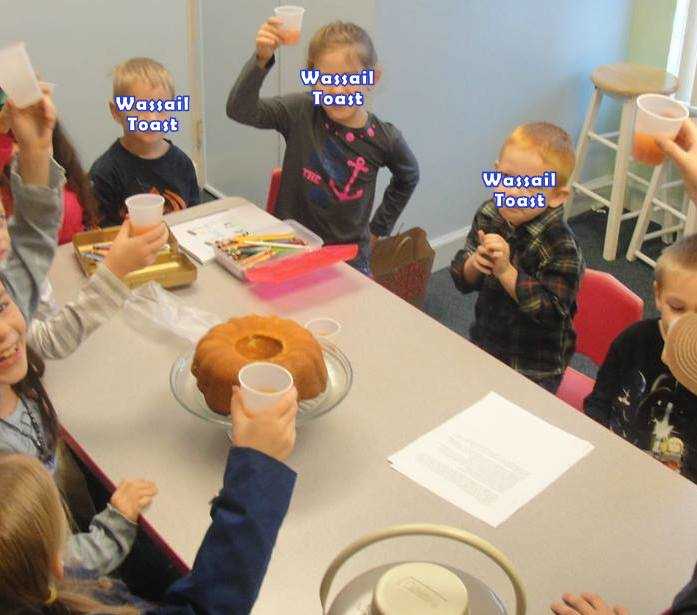
Wassail Toast
- They did have Christmas music. Since Christmas was usually spent going to church, they would sing Christmas carols like Joy to the World by Isaac Watts. Let’s sing the first verse of Joy to the World together. [Pass out the words & let the children put them in their history binders.]
JOY TO THE WORLD
Joy to the World! The Lord is Come. Let earth receive her King. Let every heart prepare Him room and heaven and nature sing, and heaven and nature sing, and heaven and heaven and nature sing.
You will need per child:
- the words to Joy to the World & The Wassailing Song punched with a 3 hole punch
- Wassailing is from old English word, “waes hael” which means “be well.” Sing the beginning of the song.
HERE WE COME A WASSAILING
Here we come a wassailing among the leaves so green,
Here we come a wand’ring so fair to be seen (refrain)
Love and joy come to you, and to you your wassail too,
And God bless you and send you a happy New Year,
And God send you a happy New Year.
- Taste wassail.
You will need:
- warm wassail (kept warm in a thermos) using this recipe or simply warm some apple juice with cinnamon sticks & whole cloves
- cups
Foods & Epiphany Parties
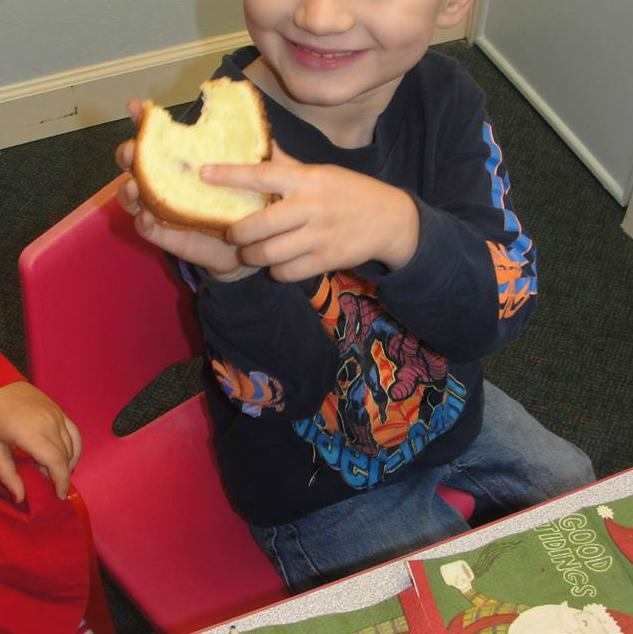
Twelfth Night Pound Cake Bean
- Ask the children what their favorite Christmas food is. During the Colonial period, there were no main traditional dishes, though they did feast on lots of meats and fish (as fresh produce wasn’t readily available during the winter months).
- In the Southern colonies, their big celebration was not on Christmas. It was 12 days later on January 6, which is when they celebrated the Wise Men finding baby Jesus & giving him gifts. They called this Epiphany or Twelfth Night.
- The time between Christmas and Epiphany was called Yuletide.
- Epiphany was the time of parties, gifts, and feasting.
- George & Mary Washington married on the Twelfth Night in 1759 because so many people were already getting together at that time. Martha’s Twelfth Night cake recipe called for 40 eggs, 4 lb. sugar, & 5 lb. dried fruit!
- One tradition was to bake a cake & with a dried bean baked into it. The bean represented baby Jesus. Whoever would get the slice of cake with the bean in it would get to be the king or queen (honored guest) of the celebration. Allow children to each try a piece of “Twelfth Night” pound cake & make sure someone gets the slice with the dried bean.
You will need:
- pound cake with a dried bean baked into the cake (Use your favorite pound cake recipe & simply drop a dried bean into the batter before baking. If you want to use a store-purchased cake, just use a knife to create a slit & slide in your dried bean.)
- a knife for cutting the cake (or pre-cut the slices)
- napkins or plates
Epiphany Gifts
Epiphany Gifts
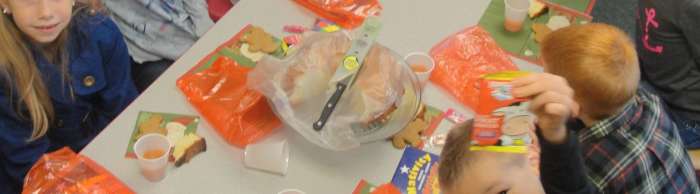
- Pass out class gifts as this was the day when gifts were sometimes passed out. Gifts might include little treats such as gingerbread men or dried fruit.
You will need:
- gifts (I handed out homemade gingerbread men (using the recipe for the Colonial Williamsburg website), “dried fruit” gummy fruit packs, & Oriental Trading Company Nativity coloring books & stickers)
Colonial Christmas Overview by Colonial Williamsburg
Joke: How many gifts can Santa Claus fit in an empty sack?
Only one – after that it’s not empty any more!
Looking for all of my American History Lessons?
(My middle school level
American History lessons can be found at https://hubpages.com/education/TeachingAmHistory .)
AMERICAN HISTORY FOR EARLY ELEMENTARY:
Native Americans & Columbus Lesson
Jamestown Lesson
Pilgrims Lesson
Thirteen Colonies Lesson
French and Indian War Lesson
Colonial Period & Revolution Rumblings Lesson
Boston Massacre & Boston Tea Party Lesson
First Shots & Declaration of Independence Lesson
American War for Independence Battles Lesson
Valley Forge & Battle of Yorktown Lesson
American Literature Lesson & American War for Independence Review
Colonial Christmas Party
Constitution Lesson
Three Branches of Government Lesson
President George Washington Lesson
Louisiana Purchase Lesson
War of 1812 Lesson
Monroe Doctrine Lesson
Trail of Tears Lesson
Oregon Trail & Battle of Alamo Lesson
California Gold Rush & Pony Express Lesson
American Industrial Revolution Lesson
Underground Railroad Lesson
Abolitionists & Women Suffragists Lesson
Civil War: The Confederate States & Abraham Lincoln Lesson
Civil War Battles Lesson
Civil War Party & End of Year Review Game
BONUS LESSONS (if you have room for a few extra classes):
Reconstruction Lesson
Wild West Lesson
Immigrants Lesson
Tycoons & Theodore Roosevelt Lesson
World War I Lesson
Roaring Twenties Lesson
Great Depression and the 1930s Lesson
World War II Lesson
ALL MY LESSONS:
Fun, Free Hands-on Unit Studies (My Lessons in All Subjects)
© 2018 Shannon
Comments
Shannon (author) from Florida on July 31, 2018:
Thank you! Yes, I really enjoyed researching for this lesson & learned quite a bit in the process.
Liz Westwood from UK on July 31, 2018:
This is a fascinating article. It’s really interesting to trace back the history of Christmas traditions.
Leave a Reply