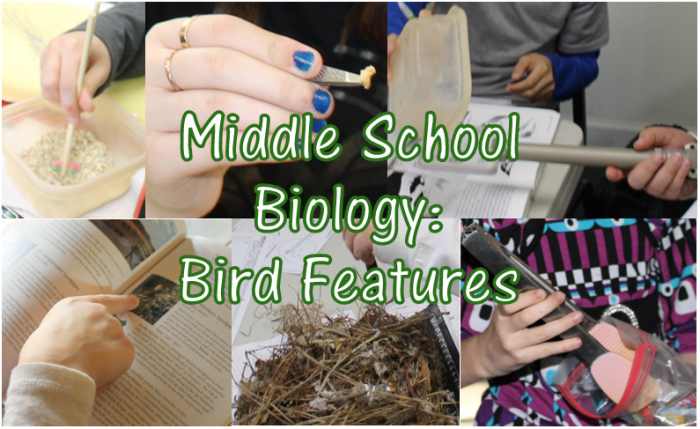
Christian Middle School Biology Lesson: Bird Features
This is the 17th lesson in a series of 32 hands-on Christian lessons covering middle school biology. This lesson focuses on bird features. Test beak types, examine nests and eggs, play Bird Field Guide 20 Questions, & more. I used this plan while teaching a 55 minute middle school biology class. Each lesson plan includes homework assignments and a variety of hands-on activities to make each lesson engaging & memorable. Use these fun lessons with your classroom, homeschool, after-school program, or co-op!
These lessons are written for a class that meets once a week. If your class meets 5 days a week, simply do this lesson one day a week and use the homework assignments (at the bottom of the page) for the work for the other days of the week.
Homework Review
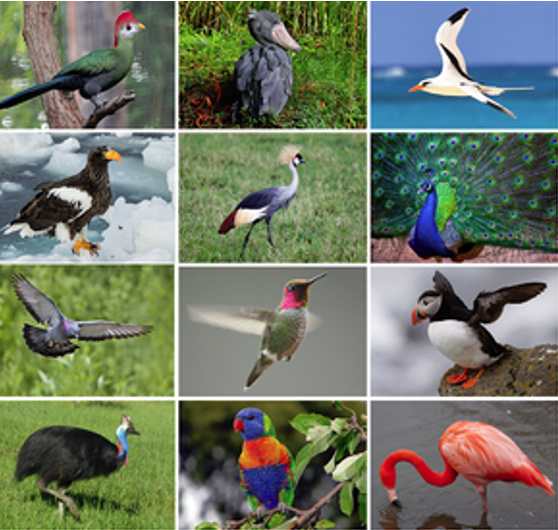
- Ask each student to share something they thought was interesting from last week’s Bird Log activity. Award tickets for students who completed extra credit. Go over the homework questions from the book. (I give out tickets for students who volunteer to answer the questions.)
- As we went through the homework, I added in bits I thought were interesting related to the homework questions such as:
- Molting: the amazing difference of the ptarmigan, which grows colorful plumage for courtship & camouflage every spring
- Types of flight: how turkey vultures sometimes glide over us when we’re exercising outside (thinking we might be dead), how we got to watch a hawk soar down & grab up a mouse in our yard, & how hummingbirds will hover outside our window to glare at us when we haven’t refilled our feeder.
- Speaking of hummingbirds, some hummingbirds can flap their wings up to 90 times in 1 second. Let’s see how many times you can flap your arms in 1 second.
- Isn’t it incredible how God gave birds instincts, built-in knowledge of where to nest, the kind of nest to build, song to sing, where & what to eat, and the type of displays to use to attract a mate? How do bowerbirds know to collect objects to decorate their bachelor pads to attract a mate (sometimes even adding a snail shell fence out front)? How do Grebes know how to perform a ballet-type dance to attract females? How do marbled murrelets, which live in the ocean, know to fly 50 miles inland to make a nest and lay their egg? How do weaver birds know how to weave their intricate nests? There are so many amazing instincts God placed in various types of birds. They’re fascinating to read about!
- Audible communication: How do we make sound? (vocal chords) What unusual organ do birds have that allow them to make sounds? (syrinx) It works more like a flute. The more muscles they have attached to their syrinx, the more sounds they can make. Some can sing in 2, 3, or 4 part harmony. Some sounds they make are at pitches we humans can’t hear & some are too fast we can’t hear all the notes. Consider that some birds can even mimic human speech! A male wren sings 100 different songs! 100! I didn’t realize that normally only male birds sing.
- Anting…What is it? (Birds rub ant, millipede, caterpillar, or other acidic substance in plumage while molting). 160 species do it. Isn’t it amazing that birds figured out how to do this?
- Migration: The Arctic tern flies around the world every single year! Also, did you notice from the book that we’re in line with the Atlantic migration? Every February Cornell University hosts the Backyard Bird Count during the weekend around Valentine’s Day to monitor which birds people are seeing. We were even contacted once to verify how sure we were when we marked we’d seen a species of bird that doesn’t usually migrate through our area. When we first moved here, one of my sons wanted us to call the zoo to let them know their sandhill cranes had escaped. Which unusual birds have you seen migrate through here?
Bird Watching & Silhouettes
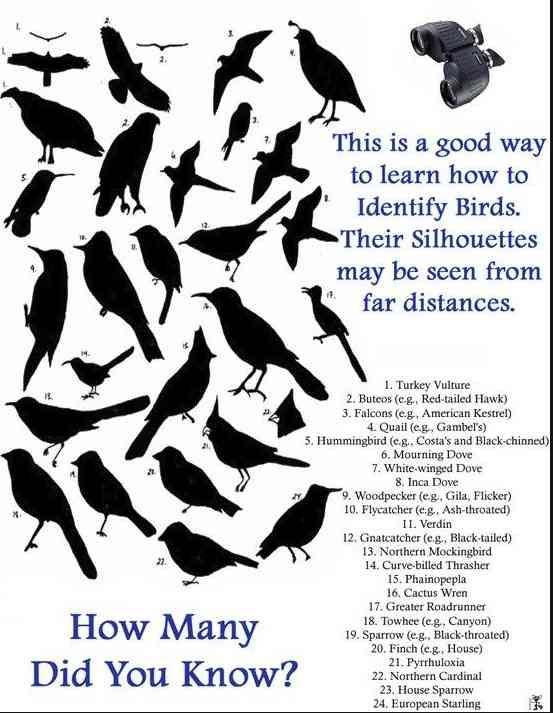
Image credit: https://i.pinimg.com/originals/0d/5a/ac/0d5aace75b6fa8c95a614843daead38d.jpg
- When you were filling out the bird log this past week, who had some difficulty identifying the birds that you saw? I sure do!
- How do you figure out which bird you’re seeing — especially if it’s passing 100 feet above you? You can probably identify more silhouettes than you know.
- Pass out the above worksheet. Have everyone cover the answers with their hand. Go through about half of them & have students call out which bird it is.
You will need per student:
- the above worksheet
Bird Field Guides
Using Bird Field Guide Books
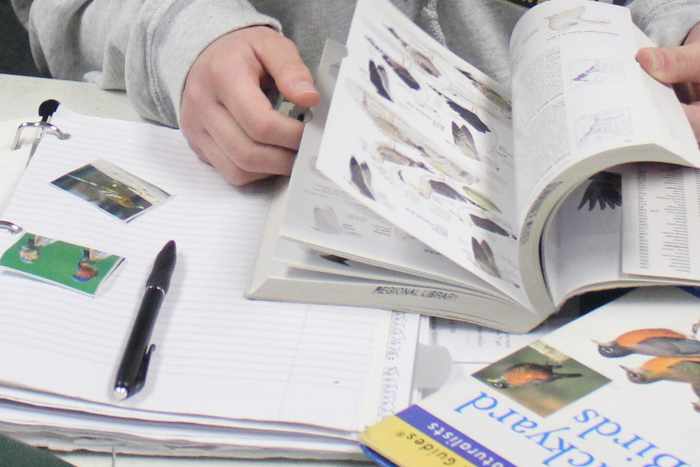
- If you can see the bird up close, you probably will have a better chance at identifying which bird it is. What can you use to help you identify the bird? (Google, bird app, or field guide) Let’s try out the field guide books since there are still a few places in the world where you won’t get a signal.
- Pass out a bird book or field guide to each student along with two color photos of birds. (I chose local birds & requested they choose another bird picture if they already knew the bird in the photo.)
- Give students about 5 minutes to try to identify both birds. If they need assistance, I did give them guidance, such as, “It’s a type of finch. Which type is it?”
- Students could switch their bird guides if they wanted to use a different one.
- After 5 minutes, I walked around and checked with each student. If they didn’t correctly identify the birds, I told them what they were and had them look them up in the bird guide to compare.
You will need:
- a bird guide for each student (I checked out every single one from our library.) If you can’t get enough for each student to have one, you can pair up students and have them play as teams.
- color photos of local birds, two per student
Beaks & Diets
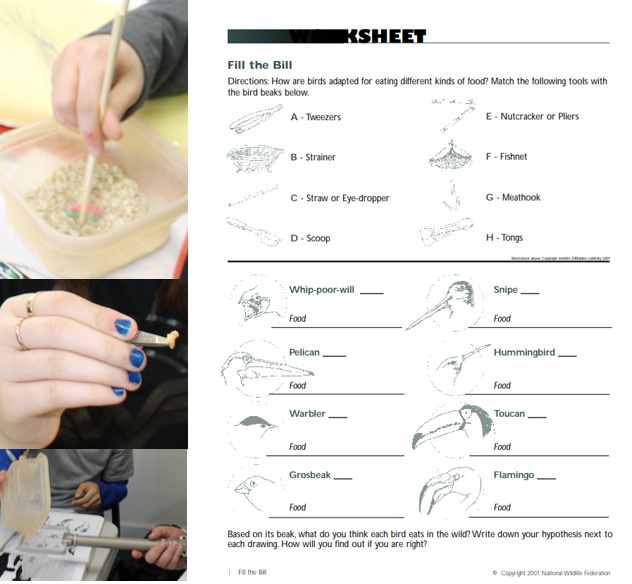
Fill the Bill Activity & Worksheet
- Discuss various types of beaks:
- God didn’t create hummingbirds to gobble up mice nor did He design hawks to slurp nectar from a flower. God gave each type of bird a special beak and tongue perfect for eating a certain type of food. A bird’s beak is frequently a good indication of its diet.
- You’re going to find out which beaks are best for scooping, cracking, and picking by going to different stations and trying to find out which tools go with which types of “food”.
- Give each student a Fit the Bill worksheet.
- At the front set out a set of beak options (straw, chopsticks, nutcracker or pliers, large scoop or slotted spoon, envelope, tweezers, strainer, & tongs) and bird foods:
- Water in a tall, thin vase or bottle (hummingbird and nectar = straw)
- Bowl filled with dry oatmeal or chocolate pudding with gummy worms on the bottom to represent worms buried in the mud (curlews and snipes = chopsticks)
- Whole walnuts or other nuts with shells to represent seeds with hard coverings (sparrows, grosbeaks and other finch-like birds = nutcracker or pliers)
- Styrofoam chunks or soap floating in a bowl filled with water to represent fish and other aquatic animals (pelicans = large scoop or slotted spoon)
- Popcorn, tiny marshmallows, or cereal tossed in the air (done by another student), which must be caught in the air to represent flying insects (nighthawks and whippoorwills = envelope or small fishnet)
- Rice or puffed rice spread on a log to represent insects (warblers = tweezers)
- Puffed rice spread in a bowl of water to represent tiny aquatic plants and animals (flamingos and some ducks = strainer)
- Fruit or fruit flavored candies in a bag to represent fruit in a tree (toucan = tongs)
- Allow 7 volunteers to come up and each match up a “beak” with a food. (If desired, set up these stations for each group of students as they really enjoyed getting to do this.)
- Have the students mark the answers on their worksheets.
You will need:
- a Fill the Bill worksheet for each student
- 1 set of “beaks” for the class or 1 set per group of students: straw, chopsticks, nutcracker or pliers, large scoop or slotted spoon, envelope, tweezers, strainer, & tongs
- 1 set of “bird food” for the class or 1 set per group of students (listed above)
Toucan Bird Trivia
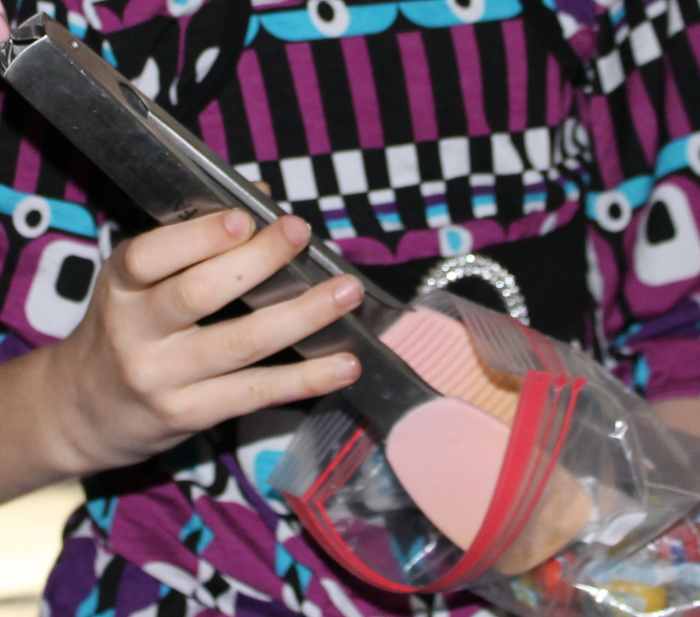
- (Optional) Ask bird trivia questions. Each student can answer only 1 question. After they answer the question correctly, they get to use the “Toucan Beak Tongs” to get the “fruit out of the tree” (fruit-flavored candy out of the bag).
You will need:
- bird trivia questions (I used the multiple choice questions from the Science Order & Design Test 7 on birds but I didn’t offer the multiple choice options until I got toward the end when the remaining students couldn’t answer a question without options.)
- tongs
- bag of fruit-flavored candy (I used ball-shaped ones so they would be more like berries. I had lemon-heads and jaw-breakers.)
Bird Nests & Eggs
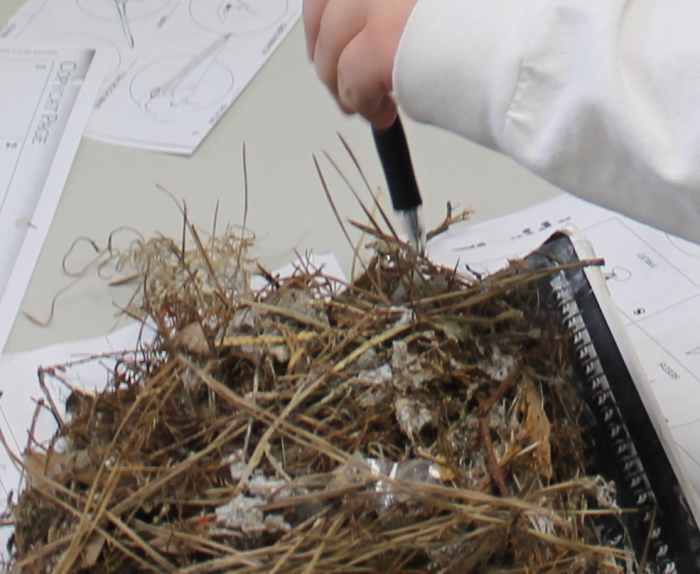
- Discuss various types of bird nests the students have seen. Pass around one. Have students note what the bird used to make the nest.
You will need:
- a bird nest (Do note that birds sometimes return to the nest every year, so an abandoned nest doesn’t mean that it will always be abandoned. The nest I had was one a wren built in our garage. After the birds and chicks left, we removed the nest.)
- What color is a bird egg? Show pictures of the variety of bird eggs. God was so creative when designing them!
- Pass around any bird egg shells you brought or other students brought.
- Common murres, which are seabirds, lay their eggs on narrow, rocky ledges on the sides of cliffs. God designed their eggs with an especially pointy end so that if it gets knocked around, it just wobbles around in a circle. Plus, each one has a distinctive pattern of spots and splotches so the parents know which is their egg.
- One of my sister’s friends raises chickens that lay various colored eggs and ships them around the country. She & her husband had high-paying careers but found out their “hobby” was making more money and was more enjoyable.
You will need:
- picture of a variety of bird eggs
- assortment of bird eggs (optional) (I have 1 mocking bird egg shell we found in our yard last spring)
- Allow students to randomly select a “Bizarre Bird” for their homework assignment. Options I included:
- Magnificent Frigatebird
- Rufous Potoo
- Kakapo
- Hoatzin
- Tawny Frogmouth
- Burrowing Owl
- Southern Cassowary
- Ribbon Tailed Astrapia
- King of Saxony Bird of Paradise
- Kea
- Shoebill Stork
- Peregrine Falcon
- Long-Wattled Umbrellabird
- Blue-Footed Booby
- Vogelkop Superb Bird of Paradise
- California Condor
- Great Bustard
- Bee Hummingbird
- Scarlet ‘I’iwi
- Indian Scops Owl
You will need:
- the above birds written on individual slips of paper
A Beka’s Science: Order & Design science textbook
Homework
Page numbers refer to the pages in A Beka’s Science: Order & Design.
- Friday: Complete your Bizarre Bird report. Use color when drawing the bird and the egg. Next to the drawing of the bird include 1 reason why this bird might be considered amazing/bizarre/weird.
- Monday: Read pp. 259-267 (skipping Science Investigation on pp. 260-263) & answer 4 questions of your choice on p. 267. ALSO, identify 1 new bird outside. Sketch it on your homework sheet and write its name.
- Tuesday: Read pp. 268-276 & answer 5 questions of your choice on p. 276. ALSO, identify 1 new bird outside. Sketch it on your homework sheet and write its name.
- Wednesday: Complete 10 questions of your choice from Identify from Ch. 7 Review on p. 276. ALSO, identify 1 new bird outside. Sketch it on your homework sheet and write its name.
- *Extra Credit (Option 1: if having a guest speaker next week): Create a bird feeder and place it in your yard. Notice what types of bird(s) visit it.
- Extra Credit (Option 2: if you’re not having a guest speaker next week): Bird Show & Tell: Bring a live bird in a container and/or part of a bird (feathers, wild bird eggs, taxidermied birds, wattles, bird feet, etc). You are welcome to bring in a variety of items (like lots of feathers) but will only get 1 ticket per type of item. Be prepared to tell us about what you bring.
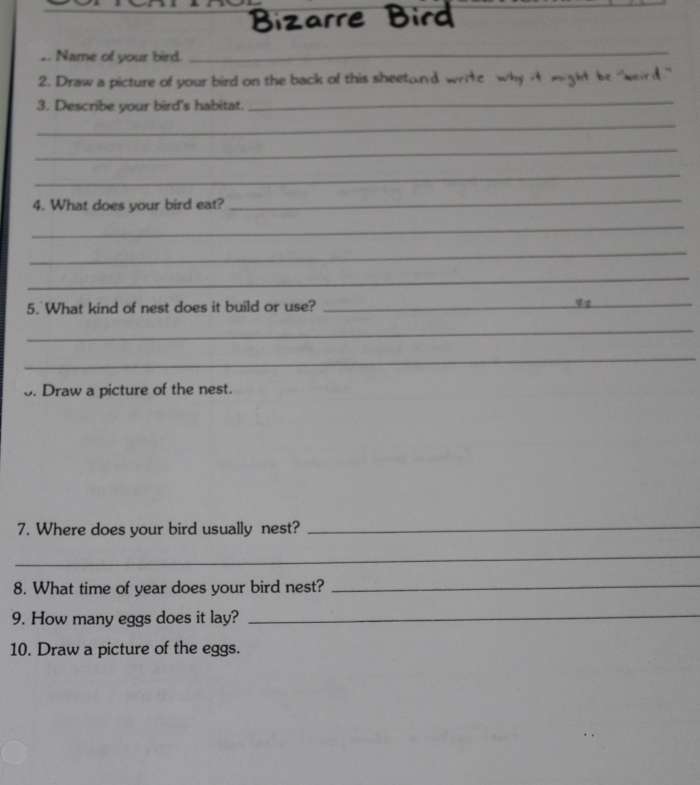
Bizarre Bird Report Sheet (originally from Ranger Rick Naturescope: Birds)
Looking for all my lessons?
- First Day of Class & Plant Identifications
- Parts of a Flower
- Amazing Plants (Horticulturist Guest Speaker)
- Seeds and Flower Families
- Photosynthesis and Plant Parts
- Cardiovascular, Respiratory, & Digestive Systems
- Skeletal, Muscular, & Integumentary Systems
- Endocrine & Nervous Systems and Healthy Living
- Human Baby Fetal Development (Pregnancy Care Center Guest Speaker)
- Creation and Science
- Creation, Evolution, & the Eyes of Faith
- Classifying Plants & Animals
- Amazing Mammals
- Mammal Dissection
- Semester Review & Winter Party
- Bird Anatomy
- Bird Features
- Bird Watching (Birding Guide Guest Speaker)
- Fish Anatomy and Dissection
- Invertebrates Anatomy and Dissections
- Frog Dissection
- Reptiles Show and Tell
- Insect Anatomy
- Singing & Social Insects
- Beneficial Insects (Entomology Guest Speaker)
- Arthropods (Crayfish & Grasshopper) Anatomy and Dissections
- Crustaceans & Arachnids
- Cells, Algae, and Fungi
- Protozoa and Bacteria
- Trees
- Ecology
- Semester Review & End of Year Party
- My Middle School American History Lessons
- All of My Hands-on Lessons & Unit Studies
© 2019 Shannon
Leave a Reply