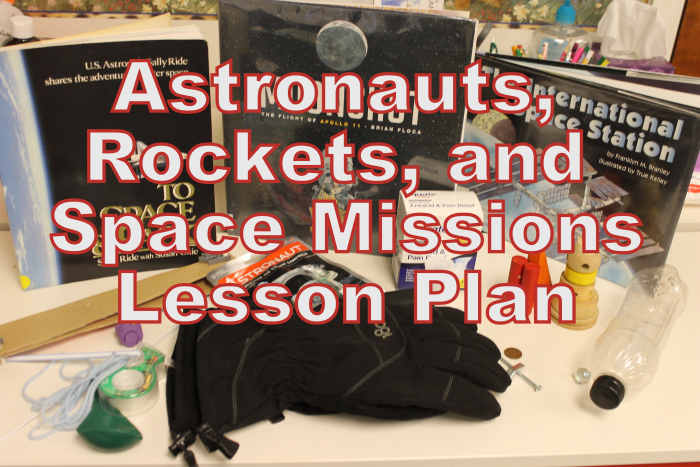
This is part 4 of a 4 part hands-on unit on Astronomy or is a stand-alone lesson if studying CC Cycle 2 Week 13 Science: U.S. Space Missions. Make rockets, try out astronaut tasks, make and eat a spacecraft, and more in this fun lesson on space exploration! My lessons are geared toward 3rd – 4th grade level children and their siblings. These are lessons I created to do with a weekly homeschool co-op. We meet each week for 2 1/2 hours and have 14 children between the ages of 1-13. Use these fun lessons with your classroom, family, after school program, or co-op!
*Tip: You don’t have to do all the activities. Select a few that appeal to you! *
Introduction and Edible Cassini Spacecraft
Edible Cassini Spacecraft
Introduction
- Read & discuss Hebrews 11:3 and Psalm 19:1.
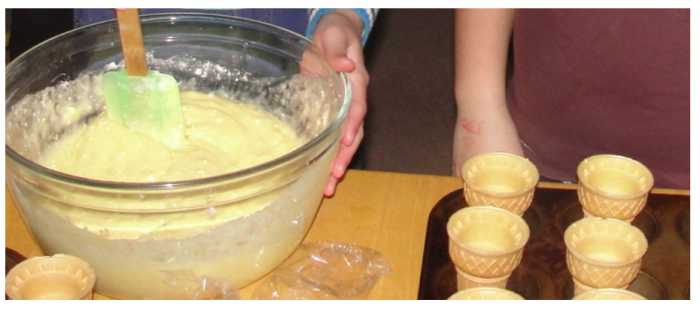
- Begin making Edible Cassini Spacecraft: Prepare cake mix according to package directions. Place ice cream cones individually in muffin tins. Fill the ice cream cones 2/3 full of cake mix. (We had enough extra batter to make 6 regular cupcakes as well.) Bake according to the cake mix instructions, just as for a cupcake.
(Cassini-Huygens is robotic spacecraft mission currently studying the planet Saturn and its many natural satellites until 2017. Cassini is the fourth space probe to visit Saturn and the first to enter orbit. This was the first landing ever accomplished in the outer solar system.)
YOU WILL NEED: 24 ice cream cones with a flat bottom and a cup-like top, 1 box cake mix, eggs & oil for cake mix, mixing bowl & spoon, muffin tins
Astronauts in Outer Space
Astronaut ice cream
Astronaut Gloves
Astronaut gloves
3) Review planets, moon phases, comets, stars & constellations, & the sun.
4) Show pictures from To Space and Back by Sally Ride or other book talking about astronauts in outer space.
YOU WILL NEED: To Space and Back by Sally Ride or other book talking about astronauts in outer space.
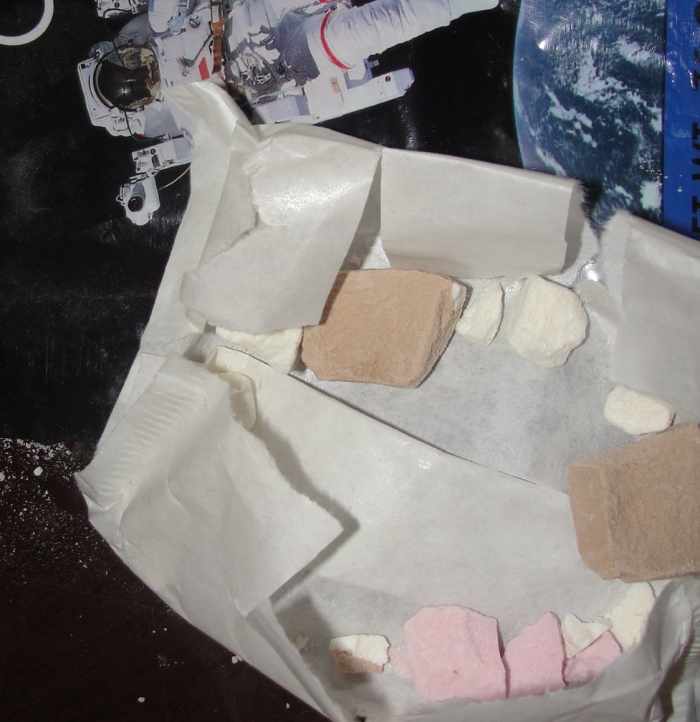
5) (Optional) Taste astronaut ice cream, which was the way astronauts ate ice cream and other foods originally: dehydrated. Thankfully, they’re able to now eat foods that appear closer to how we enjoy them here on Earth.
YOU WILL NEED: 1 package of astronaut ice cream, broken into pieces
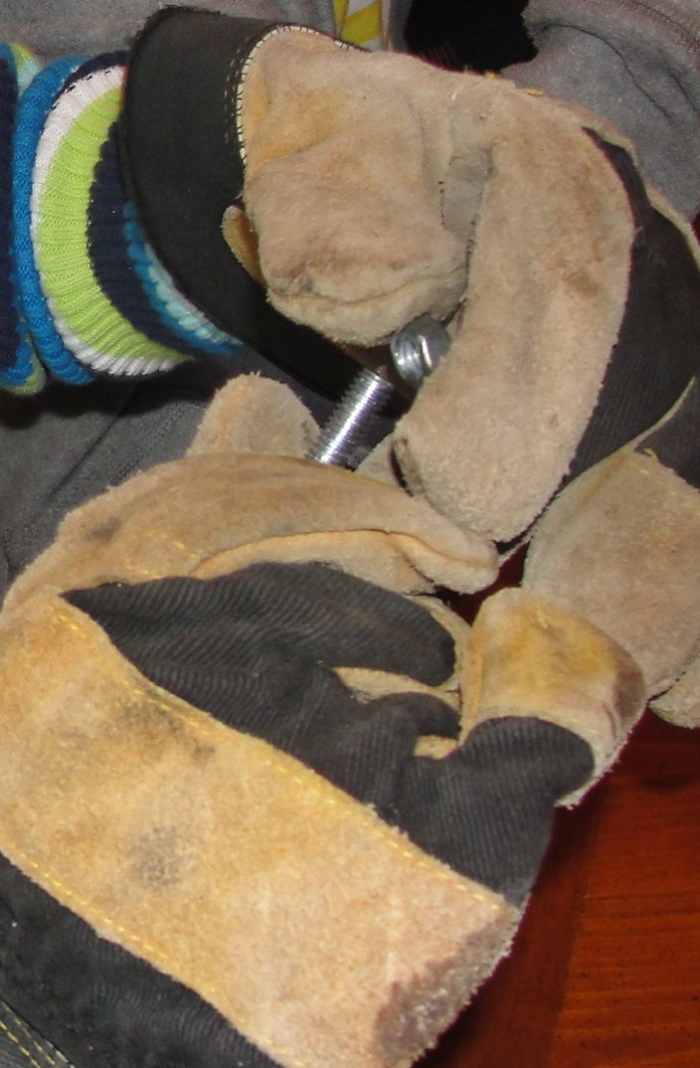
- Try some astronaut gloves: Let each child wear large, leather work gloves & try to pick up a penny and place it in a cup and then put together a nut & bolt. To make it more realistic, you can plug up a sink and have them do this underwater. (We divided the group up into 4 groups and let each group take turns with the gloves.) This activity idea came from Cosmic Science by Jim Wiese.
YOU WILL NEED: 3 pairs leather work gloves ($3 each at Wal-Mart), 2 packages of 3 sets of nuts and bolts ($.97 each at Wal-Mart), 12 pennies, and 12 small cups or other containers
Robot Arms
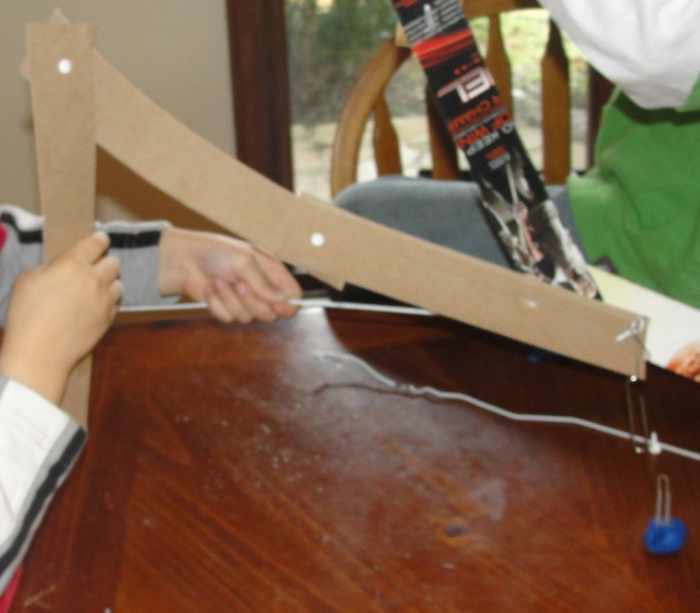
Robot arm model
- Read some of International Space Station by Franklyn M. Branley. As of the last time I taught this lesson, the ISS is being decommissioned and will be replaced Gateway, which will be like the ISS but will go around the Moon.
YOU WILL NEED: International Space Station by Franklyn M. Branley or other book on the ISS or on Gateway
- Make robot arm (Canandarm): Ahead of time punch a hole at both ends of the cardboard strips about 1 inch in at each side. I did this using a nail. Also, loop one end of the hanger closed. I used pliers. I used wire clippers to cut the wire hangers in half.
Give each child 3 strips of cardboard. Have them us the two brads to connect the 3 pieces together. Have them push the straight end of the hanger through a hole at one of the ends. On the looped part of the hanger, attach a paperclip that has been bent to look like a hook. This is a simple machine called a lever. Place another paperclip into the play-dough and have children try to use their robot arm to pick up the paperclip/dough item. Have them use their robot arm while wearing their astronaut/work gloves. This activity came from Cosmic Science by Jim Wiese.
YOU WILL NEED PER CHILD: 3 strips of cardboard (I used cereal boxes) approximately 11″x1.25″, 2 brads, 1/2 wire coat hanger, 2 paperclips, and 1 small ball of play-doh or clay
Edible Cassini Spacecraft
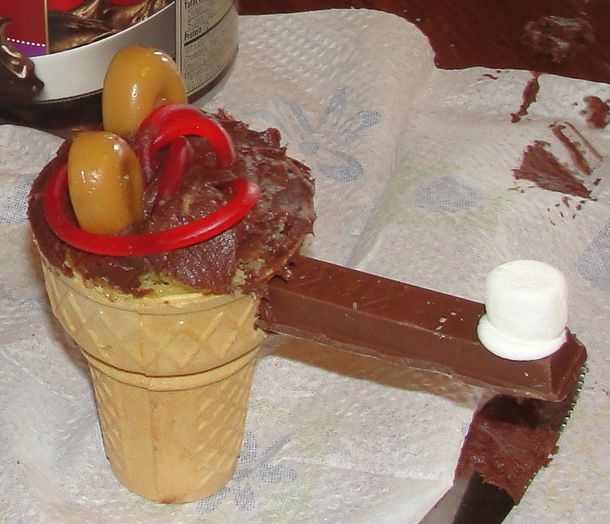
Edible Cassini Spacecraft
- Decorate your edible Cassini Spacecraft:
- Place a layer of frosting on top of the “cake.”
- Fold the licorice in half and poke the ends into the cake. The licorice should make an inverted V sticking out of the cake. This represents the support structure on the interior of Cassini’s high-gain antenna dish.
- Using frosting as glue, place two disk candies around the inside of the top of the ice cream cone. If you’d like, you can leave the metallic wrapping on the candy to make it look more realistic, but we didn’t. We used unwrapped Werther’s Originals. These represent the Sun sensors that tell the spacecraft where the Sun is.
- Using a plastic knife, stab a hole in the ice cream cone right under the cake “antenna.” Insert the Kit Kat into the cone. Using frosting as glue, place a marshmallow on the end of the Kit Kat. This represents the magnetometer boom.
- Holding the cone with the chocolate wafer pointing to the right, take the candy disk (we used a wrapped Hershey’s kiss) and attach it to the side of the cone that is facing you. Use frosting as glue. This represents the Huygens probe.
YOU WILL NEED: 12 napkins, cake frosting, 12 Kit Kat sticks, 36 candy disks (like butterscotch disks or Werther’s Originals), 24 M&M’s, 12 small pieces of licorice, 12 small marshmallows, & 12 plastic knives
Apollo 11 & Centrifugal Force

Centrifugal Force
- Read Moonshot by Brian Floca or other book on landing on the moon.
YOU WILL NEED: Moonshot by Brian Floca or other book on landing on the moon.
- Quickly discuss Newton’s 3 Laws. Newton’s 1st Law vs. Centrifugal force: Give each child an empty bottle without a lid and a marble and ask them to turn the bottle over without allowing the marble to drop out and not placing anything at the open end of the bottle. Let them experiment. If no one figures out, show them how to do it. Turn the bottle upside down and quickly twirl it around. Centrifugal force will push the marble outward and circling around. Why this is important: when a space shuttle or satellite is shot into space, according to Newton’s first law, it should just keep going. It doesn’t, though, because the earth is spinning like the bottle and gravity pulls the satellite or shuttle to spin around the Earth like the marble. (An alternate way to show this is to swing a ball or an eraser that’s been tied to a string around and around in a circle.)
YOU WILL NEED: 12 plastic bottles (like empty water bottles) & 12 marbles
Launch a Rocket from a Spinning Planet
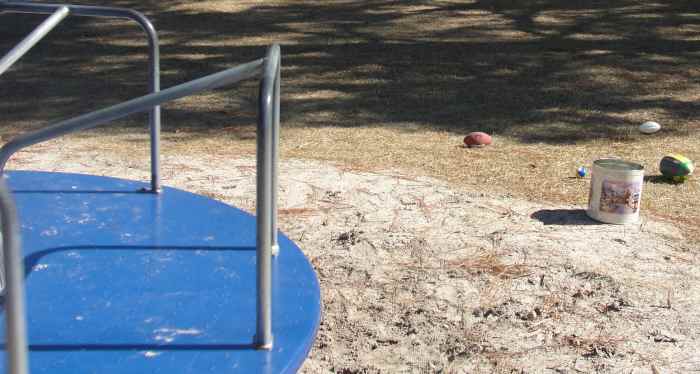
Launch a “Rocket” from a Spinning “Planet”
- If you are not limited by time, launch a “Rocket” from a Spinning “Planet” by letting children get on a merry-go-round playground toy OR a spinning chair, spinning them around, and trying to aim balls for a bucket. Check out this link lesson idea at this link.
YOU WILL NEED: a bucket & assorted balls and something the spins
Rockets
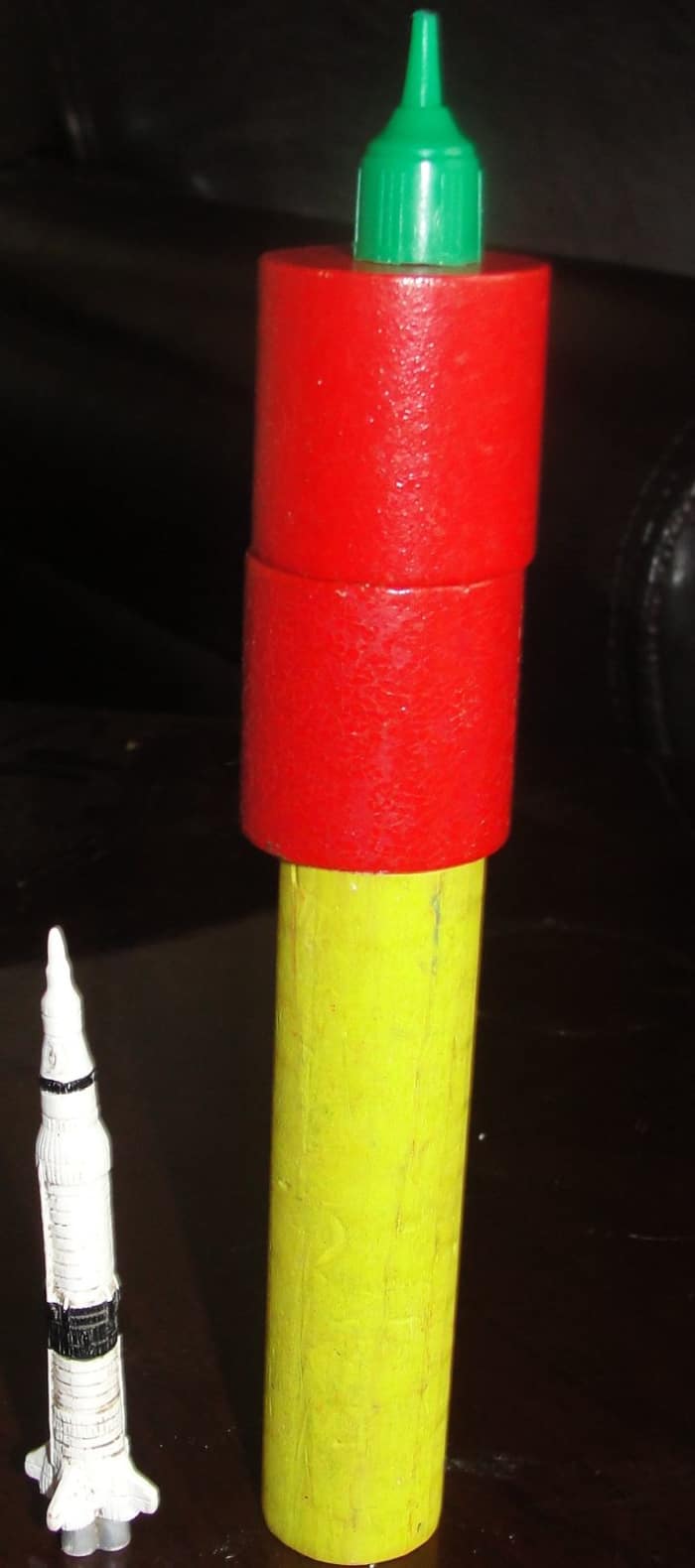
Rockets
- Quickly talk about the development of rockets being the step needed to get astronauts into outer space. (Optional) I used blocks to demonstrate how the Saturn V rockets worked by dropping one after the other. Then I used 3 cylinder blocks next to a paper model of a space shuttle to show how these work. You can find lots of free paper models including one of the Columbia space shuttle at this link. I used the Space Ship Glider.
YOU WILL NEED: cylinder-shaped blocks and toy or paper model space shuttle and rocket
Balloon Rockets
Balloon Rockets
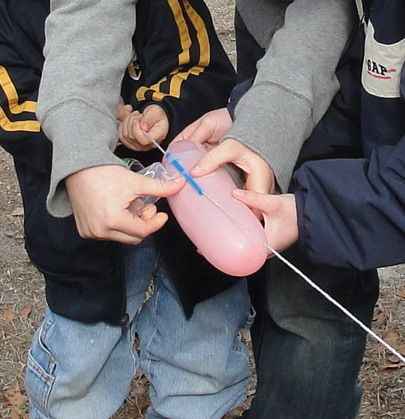
- Demonstrate Newton’s 3rd Law: make & shoot off balloon rockets. Divide children into 3 groups. Give each group a sting (5 feet), tape, a long balloon, and a straw. 2 children will hold the string. Place the straw on the string at one end. Blow up but do not tie the balloon. Pinch the end to keep it from losing its air. Tape it to the straw and then release the air. Let them each take a turn releasing the balloon. Let all 3 groups release their balloon at the same time to have a race. As the air rushes out of the balloon, it creates a forward motion called thrust. Thrust is a pushing force created by energy. Thrust comes from the energy of the balloon forcing the air out. In a real rocket, thrust is created by the force of burning rocket fuel as it blasts from the rockets engine – as the engines blast down, the rocket goes up breaking away from Earth’s gravity.
YOU WILL NEED: 3 pieces of string (5 feet each), 12 long balloons (which are easier to tape – or you can use any type of balloon), and 3 straws
Bubble-Powered Rockets
Bubble-Powered Rockets
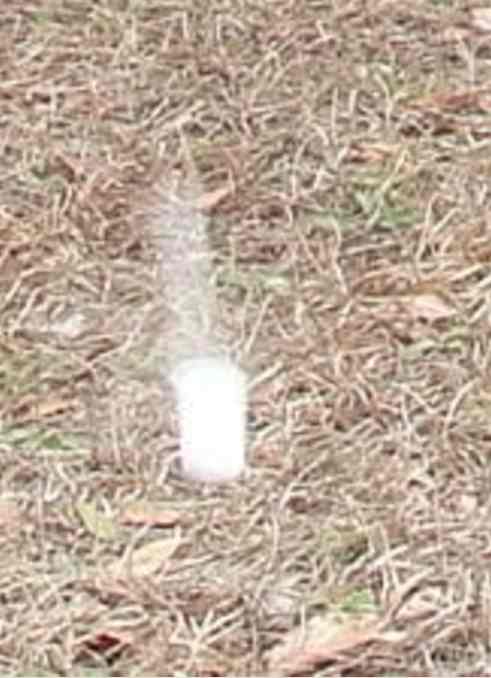
- Make & shoot off Bubble-Powered Rockets. (Do this outside!)
- Just like with real rockets, the less your rocket weighs and the less air resistance (drag) it has, the higher it will go. Your rockets will shoot off more rapidly if you put an entire Alka-Seltzer tablet in it. It won’t shoot up as high though.
- Turn the rocket upside down and remove the canister’s lid. Fill the canister one-third full of water. Now work quickly on the next steps! Drop one-half of an effervescing antacid tablet into the canister. Snap the lid on tight. Stand back and wait. Your rocket will blast off. Let them shoot off their rockets a few times.
- Explanation: When the fizzy tablet is placed in water, many little bubbles of gas escape. The bubbles go up, instead of down, because they weigh less than water. When the bubbles get to the surface of the water, they break open. All that gas that has escaped from the bubbles pushes on the sides of the canister. Now when you blow up a balloon, the air makes the balloon stretch bigger and bigger. But the little film canister doesn’t stretch and all this gas has to go somewhere! Eventually, something has to give! So the canister pops its top (which is really its bottom, since it’s upside down). All the water and gas rush down and out, pushing the canister up and up, along with the rocket attached to it. Real rockets work kind of the same way. But instead of using tablets that fizz in water, they use rocket fuel.
YOU WILL NEED: 24 Effervescing (fizzing) antacid tablets (like Alka-Seltzer) & 12 plastic 35-mm film canisters
Review, Songs, & Snack

Edible Cassini Spacecraft
- Five minute review of what we learned.
- Review songs in preparation for Presentation Night: The Planets Go Spinning, Day, Night, & Year, and C-O-M-E-T.
- (Optional) Eat edible Cassini Spacecrafts
YOU WILL NEED: 12 cups for water & 12 sandwich baggies for taking these home
More of Our Favorite Children’s Books on Space Missions and Astronauts
- Look to the Stars by Buzz Aldrin
- One Giant Leap by Robert Burleigh
- Grandpa takes me to the moon by Gaffney, Timothy R.
- One giant leap : the story of Neil Armstrong by Brown, Don. (Good)
- Reaching for the moon by Aldrin, Buzz
- You wouldn’t want to live without satellites! by Graham, Ian
- You wouldn’t want to be on Apollo 13! : a mission you’d rather not go on by Graham, Ian
- Hidden Figures by Margot Lee Shetterly
- Space heroes by Dolan, Hannah
- Mae Jemison by Calkhoven, Laurie
- Super Rover’s space adventure Author: Rabe, Tish
- The amazing story of space travel : Max Axiom STEM adventures by Biskup, Agnieszka
- Laika: The 1st Dog in Space (Famous Firsts: Animals Making History (Graphic Planet)) by Joeming Dunn
- Laika by Nick Abadzis
- First In Space by James Vining
- Ham: The Astrochimp
- Pupniks: The Story of Two Space Dogs
- When sparks fly : the true story of Robert Goddard, father of US rocketry by Fulton, Kristen
- The stellar story of space travel by Lakin, Patricia
- If you decide to go to the moon by Faith McNulty
- Exploring space : from Galileo to the Mars Rover and beyond by Jenkins, Martin
- Floating in Space by Franklyn M. Branley
- Sally Ride: Astronaut, Scientist, Teacher (Biographies) by Pamela Hill Nettleton
- Sally Ride by Anderson, AnnMarie
- Counting on Katherine: How Katherine Johnson Saved Apollo 13 Helaine Becker
- The First Moon Landing (Graphic History) by Thomas K. Adamson
- Astronaut handbook by McCarthy, Meghan
- Go for lift off! : how to train like an astronaut by Williams, Dave
- My journey to the stars : astronaut Scott Kelly by Kelly, Scott
- The true story of Alan Bean : The astronaut who painted the moon by Robbins, Dean
- Mighty mission machines : from rockets to rovers by Williams, Dave
- The astronauts : space survival by Jefferis, David
- I am Neil Armstrong by Meltzer, Brad
- Mae among the stars by Ahmed, Roda
- To the stars! : the first American woman to walk in space by Van Vleet, Carmella
- Space Crusaders. Wernher von Braun : revolutionary rocket engineer by Thomas, Rachael L.
Ready for the other lessons?
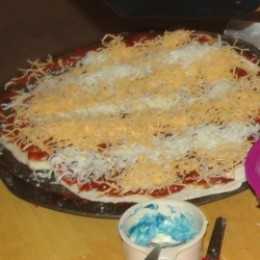
Making planet pizzas in Part 1: Solar System Lesson
Make planet pizzas as you study planets, form the lunar phases using Oreo cookies as you study the moon, study and paint Van Gogh’s “Starry Night ” as you study stars, build and blast off rockets as you study space exploration, make presentations on individual planets, and more during this 4 part hands-on unit study on the solar system.
- Solar System Lesson – This is part 1 of a 4 part hands-on unit on Astronomy. Make planet pizzas, take a planet walk, and more in this exciting lesson on our fascinating solar system!
- The Sun and the Moon Lesson – This is part 2 of a 4 part hands-on unit study on Astronomy. Form the lunar phases using Oreo cookies, drop balls in flour to make a crater-filled lunar surface, recreate Galileo’s famous gravity experiment, and more!
- Comets, Asteroids, Meteors, Stars, & Constellations – This is part 3 of a 4 part hands-on unit study on Astronomy. Make a comet, study and paint Van Gogh’s “Starry Night,” decorate a cookie to learn the parts of the sun, form asteroids out of mashed potatoes, assemble constellations using marshmallows, and more!
- Astronauts, Rockets, and Space Ships Lesson – This is part 4 of a 4 part hands-on unit on Astronomy. Make rockets, try out astronaut tasks, make and eat a spacecraft, and more in this fun lesson on space exploration!
- Astronomy Presentations and Field Trip Ideas – This is the culminating activity we did after a 4 part hands-on unit on astronomy. We held a star-gazing party and dinner. The children each presented on an assigned planet and they sang the astronomy songs we’ve been learning during our unit. Also included are the field trips we took during this unit.
Good Video Clip: Life of an Astronaut – Jerry Carr – *Also look for Bill Nye The Science Guy & Space Exploration!*
Would you like to be an astronaut?
Konos Curriculum
Konos Volume I
Would you like to teach this way every day?
I use Konos Curriculum as a springboard from which to plan my lessons. It’s a wonderful curriculum and was created by moms with active boys!
If you’re new to homeschooling or in need of some fresh guidance, I highly recommend Konos’ HomeSchoolMentor.com program! Watch videos on-line of what to do each day and how to teach it in this great hands-on format!
© 2011 Shannon
Which Rocket or Shuttle Mission Would You Have Liked to Have Joined? – Or just leave me a note. I love getting feedback from you!
Shannon (author) from Florida on September 20, 2012:
@KimGiancaterino: Oh, that would be so neat to watch! I loved getting to see all my friends’ photos of it going over Austin.
KimGiancaterino on September 20, 2012:
I’m so excited to see the Endeavour fly over Los Angeles tomorrow!
lasertek lm on May 16, 2011:
great looking lens. love your projects!
Leave a Reply