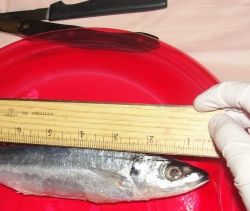
Measuring the fish before we dissect it
This is part 3 of a 5 part hands-on unit study on Animals and Zoology. Peel your “skin” like a reptile, dissect a fish, make origami jumping frogs, compare amphibian and reptile eggs by feeling tapioca and grapes, and more as you study Amphibians, Reptiles, and Fish! My lessons are geared toward 3rd-4th grade level children and their siblings. These are lessons I created to do with a weekly homeschool co-op. We meet each week for 2 1/2 hours and have 11 children between the ages of 0-13. Use these fun lessons with your classroom, family, after school program, camp, or co-op!
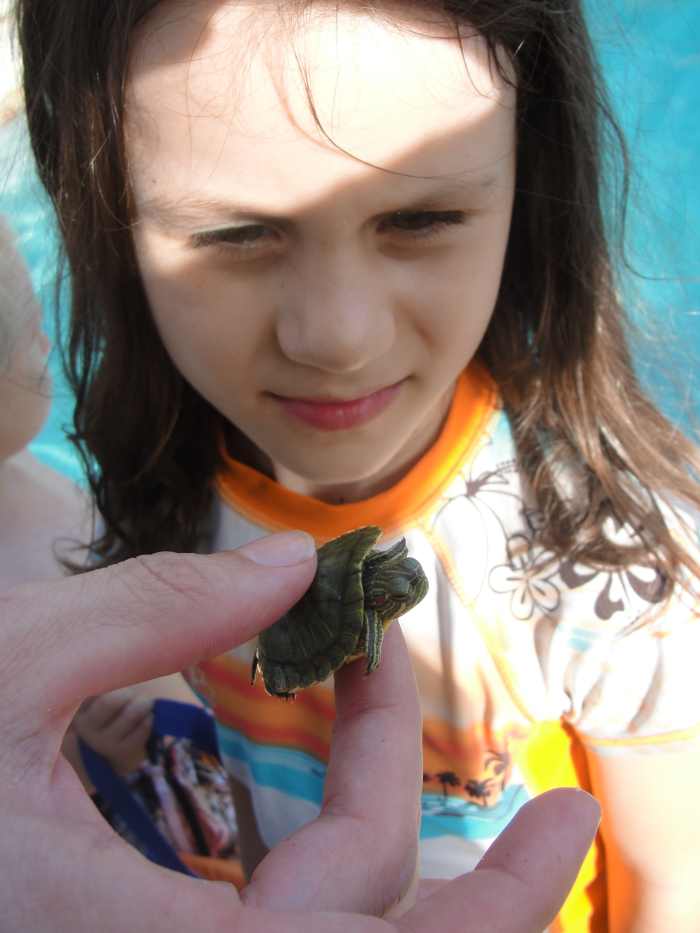
Inspecting a turtle, which is a coldblooded vertebrate
Introduction, Review, and Animals in Exodus
- Stretch. Pray.
- Review classification. If desired, sing first verse of “Six Kingdoms” & “Invertebrates” songs from previous lessons. (Find the links to the previous lessons by going to the section toward the bottom of this page titled “Ready for the next lesson?”.)
- Read about 10 plagues using some of Exodus from Egypt by Mary Auld. (Alternatively, you could read the passage from the Bible.)
- Ask the children to name all the cold-blooded vertebrates or invertebrates mentioned during the plagues. (The staff changes into a reptile [snake]. Fish die from the blood in the Nile River because of the blood. Amphibians [frogs] fill the land.)
YOU WILL NEED: Exodus from Egypt by Mary Auld or other book on the 10 plagues
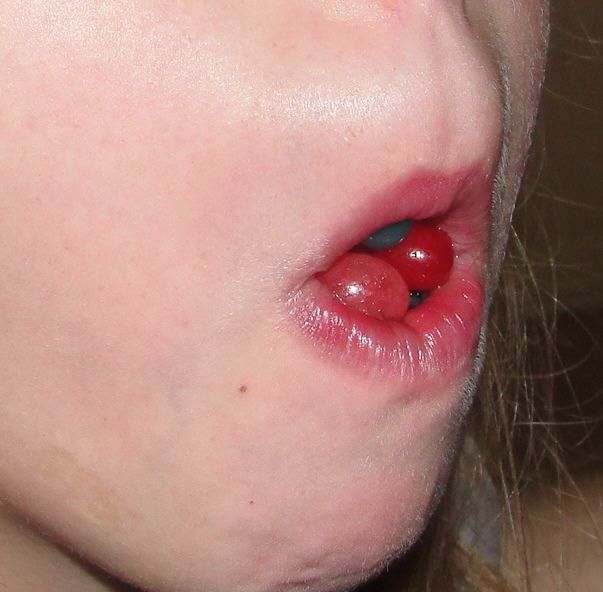
Imitating mouth brooder fish using jellybean “eggs”
Fish Overview
- Quickly discuss the differences between endothermic & ectothermic (warm-blooded & cold-blooded) animals.
- Read most of Fish: Finned and Gilled Animals by Suzanne Slade.
- While reading, have children open and close their mouths repeatedly to get air, just like the fish do.
- Briefly mention mouth brooders and have children each hold a small handful of “eggs” (jellybeans) in their mouths without biting or swallowing them just like mouth brooders carry eggs in their mouths. Don’t swallow your fish eggs!
- Most fish leave, but not all. The male jawfish is a mouth brooder, holding the eggs in his mouth until they hatch…and sometimes even after that if they sense danger. Let’s try that.
- Pass out about 10 jelly beans to each child to hold in their mouths while you continue reading. Don’t eat your babies!
- A female seahorse lays her eggs in a pouch in the male’s abdomen.
- A small fish is a fry.
- Some fish give birth to live younger, so they’re called livebearers.
- You can now stop pretending to be that jawfish. You can chew up and swallow your baby fish eggs.
YOU WILL NEED:
- a bag of jellybeans (at least 100 jellybeans)
- Fish: Finned and Gilled Animals by Suzanne Slade or other book giving an overview of fish
Book to read for activity 5: Fish
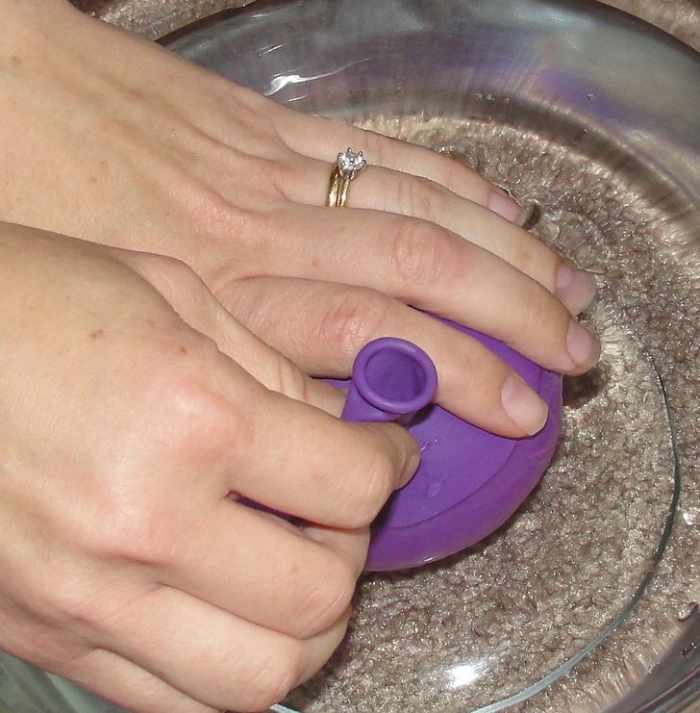
Using a balloon and water to demonstrate how fish bladders work
Fish Bladders
- Fish have 2 special organs.
- Some also have electric organs near their tail with specialized muscle or nerve cells with cells called electrocyles that can be used for communication, stun prey, or deter predators. Who can name a fish with electric organs? (electric eel, torpedo, electric catfish)
- Most fish have a swim bladder that lets them stay suspended in any depth of water? It is kind of like this balloon?
- Demonstrate how fish bladders work. God designed fish to have a swim bladder that fills with air when they want to rise in the water, and it lets all the air out when they want to sink in the water. Demonstrate using a balloon and a large bowl of water. Blow up the balloon, and show how the filled “swim bladder” lifts the “fish” up near the surface of the water. Let the air out to show how that allows the fish to sink lower. The air is lighter than water, so it helps the fish to rise when the swim bladder is full.
- People have used a similar design in submarines.
- Which fish doesn’t have a swim bladder (bottom dwellers like flounder)
YOU WILL NEED:
- a balloon (not inflated)
- a bowl of water
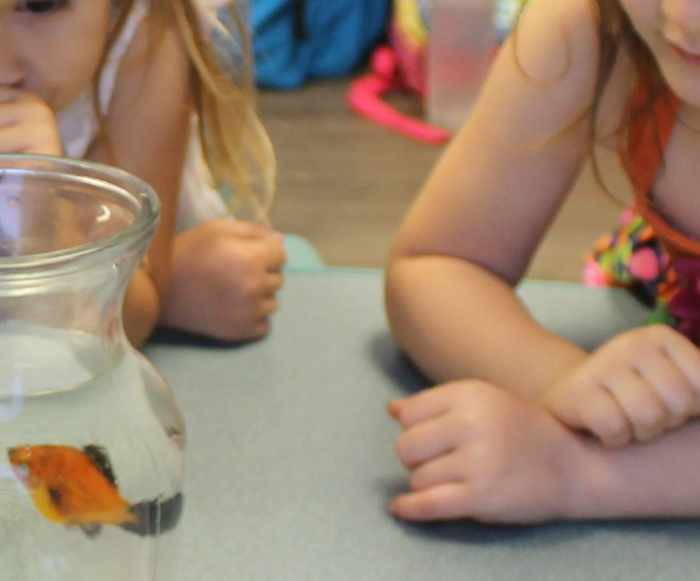
Observing a live fish
Fish Observation
- (Optional) Spend a few moments observing a fish swim.
- What do you notice about it?
- How many fins does it have? Which ones does it move the most? What do you think each of the fins does?
- How frequently does it open its mouth? Why do you think it’s doing that?
YOU WILL NEED: a live fish in water
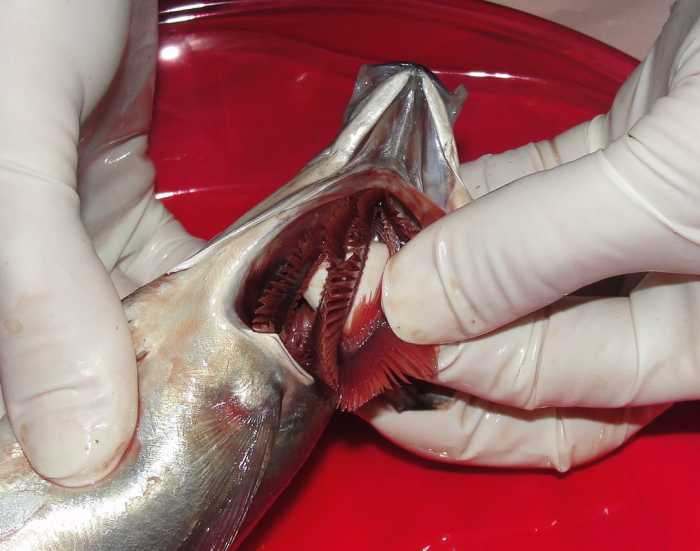
Inspecting the gills of our fish
Fish Anatomy and Dissection
- Dissect fish & review main character traits of a fish. Refer to this fish dissection lesson plan and/or this fish dissection lesson plan to provide you with procedures and questions to ask as you dissect the fish.
YOU WILL NEED for each group of 3-5 children:
- dead fish – I’ve dissected fish with groups of students at least half a dozen times. We’re purchased whole fish at Asian markets and used perch caught from a local pond. Twice we’ve used preserved one, but I wouldn’t recommend that. They are so tough and rubbery. Get fresh fish if you can.
- disposable gloves
- a sharp pairing knife and a hard, disposable plastic plate
- disinfectant wipes & Lysol or other air freshener (optional)
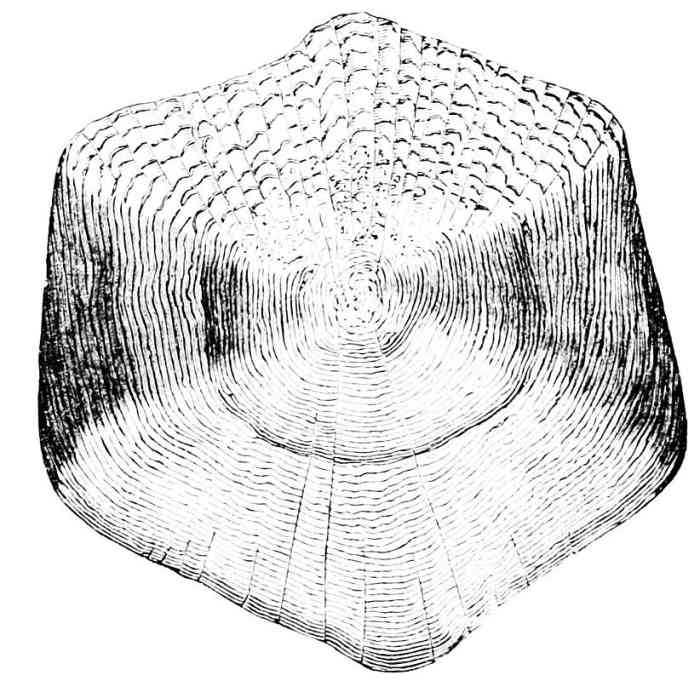
A fish scale magnified so that you can see the layers of growth. Year one’s growth is in the middle and then the rings grow outward — just like tree rings. You can also tell the difference between summer growth and winter growth.
Fish Scales
- (Optional) As children finish washing their hands, let them look at fish scale under a microscope and count how old the fish is. Just like trees, fish scales grow a circle for each year a fish is alive. Honestly, we couldn’t see any circles on the scales we looked at. I guess we needed a more powerful microscope or a larger fish. It was still neat to see the scale under the microscope anyway, though.
YOU WILL NEED: a microscope and microscope slide
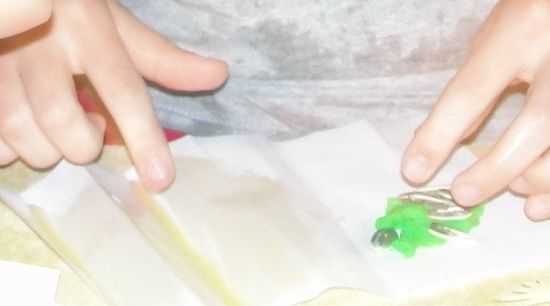
Scales vs. Slime
1 / 2
Scales vs. Slime
- Introduce herpetology: the study of reptiles and amphibians. It comes from the Greek word herpeton which refers to “creeping, crawling creatures that move about on their bellies.” Amphibians & reptiles are called herps.
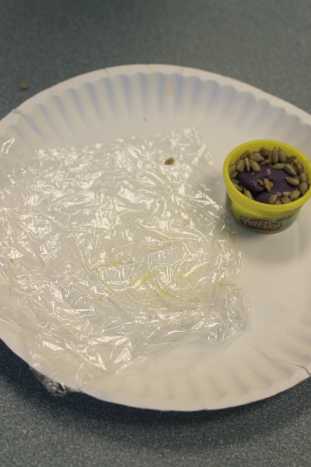
- Scales vs. Slime: Let children touch a piece of clay with rows of shelled sunflower seeds stuck in it and a piece of plastic wrap sprayed with thin layer of non-stick cooking spray.
- Have children describe how each feels.
- Which do you they think represents the reptile skin? The amphibian skin?
- Do let them know this is a generalization because some toads have dry, rough skin & some geckos have smooth skin with inconspicuous scales.
YOU WILL NEED:
- a small plate with a piece of clay with rows of shelled sunflower seeds stuck in it
- a small plate with a piece of plastic wrap sprayed with thin layer of non-stick cooking spray
Amphibian vs. Reptile Eggs
1 / 2
Amphibian vs. Reptile Eggs
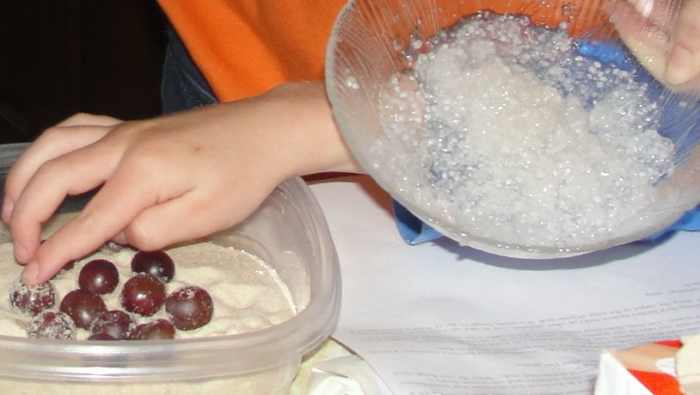
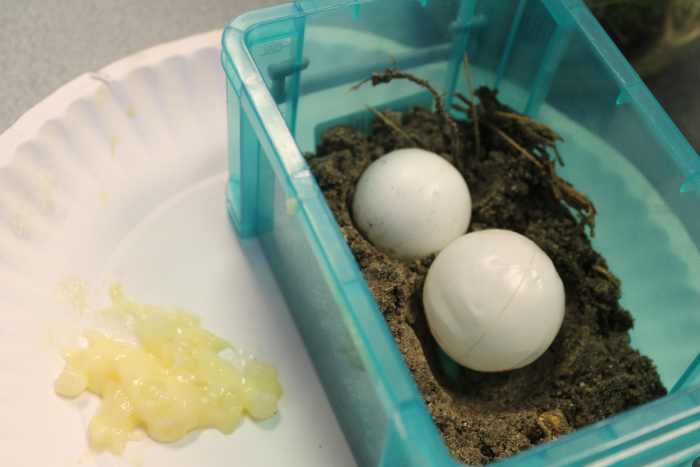
- Let children touch some tapioca that’s been sprinkled in a small bowl filled with boiling water and touch a few grapes and/or ping pong balls laid on sand or dirt in a bowl.
- Have the children describe some of the differences between them.
- Which do you think represents reptile eggs? Amphibian eggs?
- Amphibian eggs don’t have shells, so they do not have much protection from drying out.
- Reptile eggs stay moist because they are laid in water or near moist areas on land. They’re firm but not brittle (like bird eggs). Reptile eggs can vary. Turtle eggs are round with a smooth shell. Snake eggs are oval & leathery. Most amphibians and reptiles lay eggs, but some do bear live young.
YOU WILL NEED:
- a small bowl with some tapioca pearls that’s been sprinkled in a container filled with water (or some prepared tapioca pudding if you can’t find tapioca)
- a container with a few grapes and/or ping pong balls laid on sand or dirt
Comparing our tongues to amphibian tongues
Amphibians
- Read most of Amphibians: Water-to-Land Animals by Laura Purdie Salas.
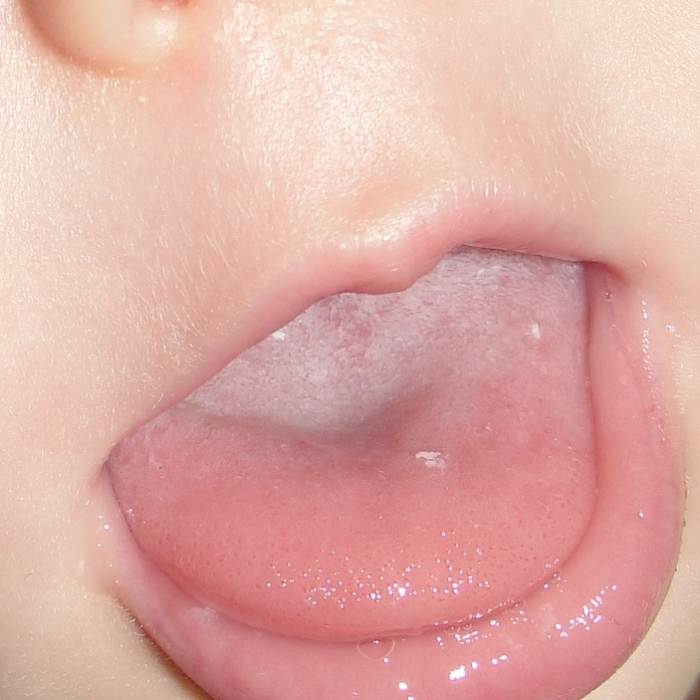
- When it talks about amphibians’ tongues being connected at the front of their mouths, have the children stick out their tongues and see where theirs is connected. Observe the person’s tongue next to you to see where their tongue is connected.
- Ask, “Why do you think God created amphibians’ tongues to be connected at the front instead of the back?”
YOU WILL NEED: Amphibians: Water-to-Land Animals by Laura Purdie Salas or other book giving an overview of amphibians
- Quickly look at pictures in Amphibian by Barry Clarke (or look at pictures from a laptop). It includes pictures of fossilized amphibians. The next page shows modern skeletons of amphibians. They look the same as the fossilized ones, don’t they? The book says they’re millions of years old, but they’re really just great evidence of the flood during the time of Noah.
YOU WILL NEED: Amphibian by Barry Clarke or pictures from a laptop showing fossilized amphibians & modern amphibian skeletons
Book we used for activity 13: Amphibians
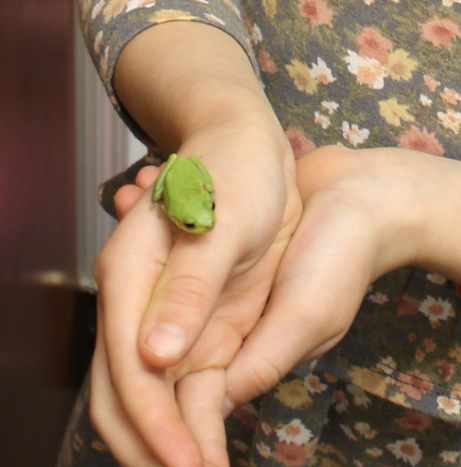
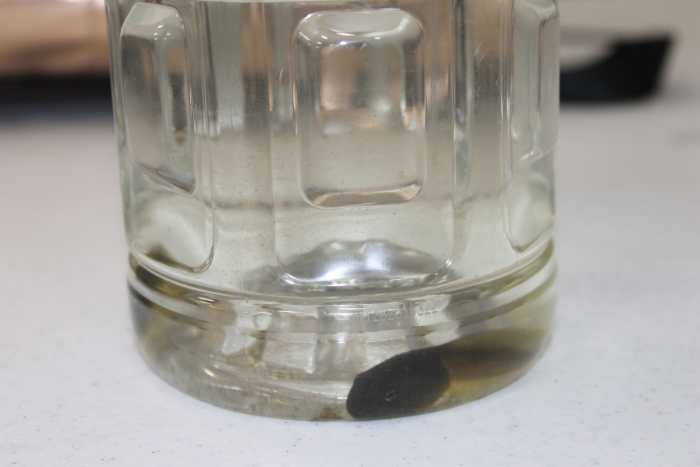


Observing a live frog
1 / 5
Observing a live or preserved amphibians
- (Optional) If you have them, let children pet or look at a live amphibian (frog, toad, salamander, or newt), tadpoles, and/or preserved frogs or toads.
- *If children do handle a live frog or toad, make sure they wash their hands afterward.
YOU WILL NEED: a live amphibian (frog, toad, salamander, or newt), tadpoles, and/or preserved frogs or toads
- Read Growing Frogs by Vivian French.
YOU WILL NEED: Growing Frogs by Vivian French or other book on the lifecycle of frogs
Book to read for activity 16: Frogs
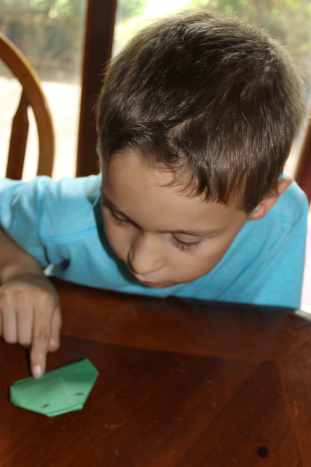
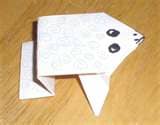
You can also make the origami frog using green copy paper (what can be used in printers). We learned the hard way that using construction paper makes a “lethargic” frog that does not jump as well.
1 / 2
Origami Jumping Frog
- Make an origami jumping frog. Use these directions or any other you prefer. (If doing this with younger children, pre-fold the paper and then unfold it again. Let the young children re-fold the paper using the creased lines as their guide.)
YOU WILL NEED: pieces of paper & 1 pre-made model
Joke: What type of amphibian loves to tell jokes?
The silly-mander!
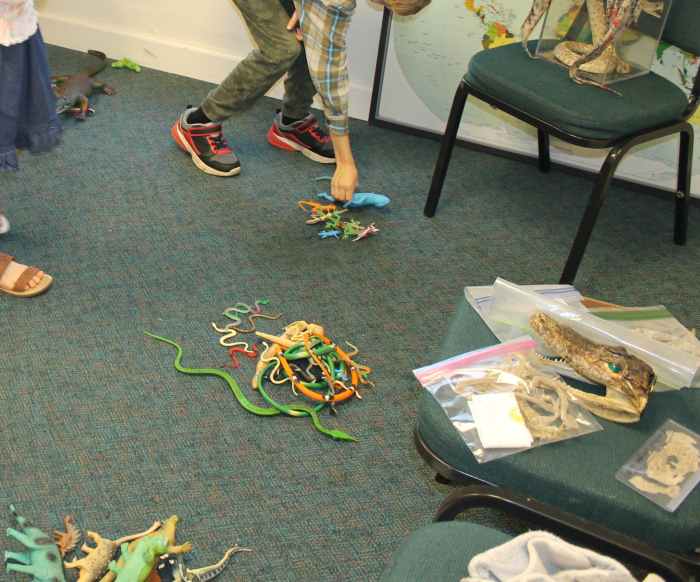
Dividing reptiles into orders
Reptile Overview & Orders
- Read some of Reptiles: Scaly-skinned Animals by Laura Purdie Salas or Miles and Miles of Reptiles: All About Reptiles by Tish Rabe.
YOU WILL NEED:
- Reptiles: Scaly-skinned Animals by Laura Purdie Salas or Miles and Miles of Reptiles: All About Reptiles by Tish Rabe or other book giving an overview of reptiles
- Discuss the main traits of a reptile: vertebrate, ectothermic/cold-blooded (why they like to bask in the sun), scaly skin that sheds/molts, breathes oxygen with lungs, & leathery eggs usually laid on land
- Review: What are the 3 types of ectothermic vertebrates? (fish, amphibians, reptiles) Which type does not have scales? (amphibians) Which 2 have scales? (fish & reptiles) What do fish breathe oxygen with? (gills) What do reptiles breath oxygen with? (lungs)
- Discuss the orders of reptiles: 1) Squamata — lizards, snakes and amphisbaenids (“worm-lizards”) with about 7,900 species 2) Testudines — turtles and tortoises with about 300 species, 3) Crocodilia — crocodiles, gharials, caimans and alligators with about 23 species, and 4) Sphenodontia — tuataras with 2 species (and I added dinosaurs to this group)
- If you’re teaching younger children, lay out toy reptiles or printed pictures from on-line. Have the children divide them into the orders. (I had the children divide the lizards and snakes into their suborders, so they were separate piles.)
YOU WILL NEED:
- Either a variety of toy reptiles or printed pictures (from online) of a variety of different reptiles
- Quickly look through some of the pictures in Eyewitness: Reptile by Colin McCarthy (or just look at photos from a laptop). Again, fossilized reptiles are not millions of years old. They’re really just great evidence of the flood during the time of Noah.
YOU WILL NEED:
- Eyewitness: Reptile by Colin McCarthy or photos from a laptop showing reptile fossils and modern reptile skeletons
Book option to read for activity 18: Reptiles
Book option to read if you have younger children (preschool and kindergarten aged)
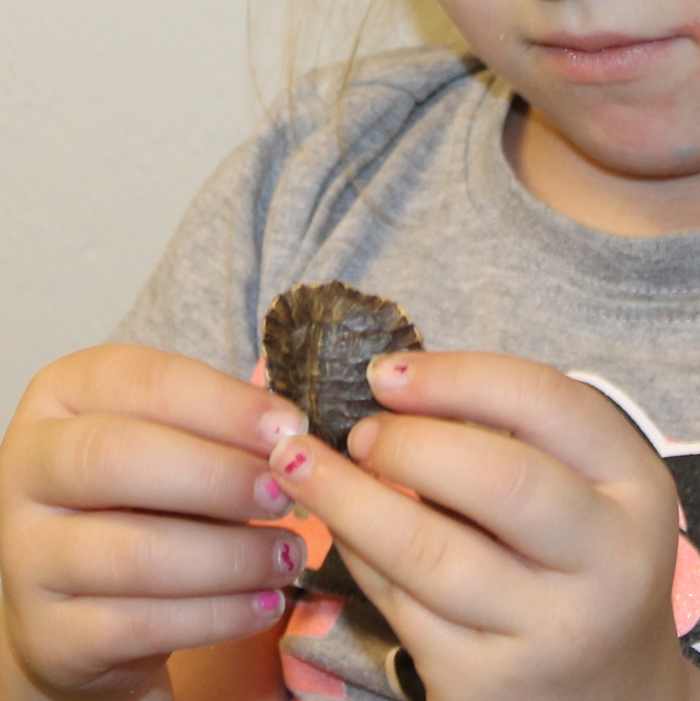
Examining a turtle shell
Turtles, Tortoises, & Terrapins (Testudines order)
- Quickly discuss traits and fun tidbits about turtles, tortoises, & terrapins while children either look at a live turtle or tortoise, a turtle shell, and/or pictures of them from a book. Some options of what to say include:
- How are they different? Shells!
- A shell’s upper dome = carapace &lower = plastron. Both are covered with plates=scutes made from keratin (like your fingernails) but the shell itself is made of bone & is part of the turtle’s skeleton
- You can’t remove a turtle from its shell because its ribs & backbone are actually attached to upper part of the shell. (You can observe this if you have an empty shell.)
- Not all turtles can pull themselves inside shells. Sea turtles & snapping turtles can’t.
- They don’t have teeth, just specially designed beaks for eating what they like (plants, jellyfish, fish, etc.)
- Turtles = spends most of its life in water & has webbed feet; Tortoise = lives mostly on dry land & doesn’t have webbed feet; Terrapin = between the 2
- Snapping turtles: common (20-30 lbs) or alligator (200+ pounds), which has a tongue like worm to attract curious fish which then become its dinner
- Soft-shells: Instead of shell being covered with scutes, they’re covered with leathery-looking thick skin
YOU WILL NEED:
- a live turtle or tortoise, a turtle shell, and/or pictures of them from a book (I used Little Kids First Big Book of Reptiles and Amphibians by Catherine Hughes.)
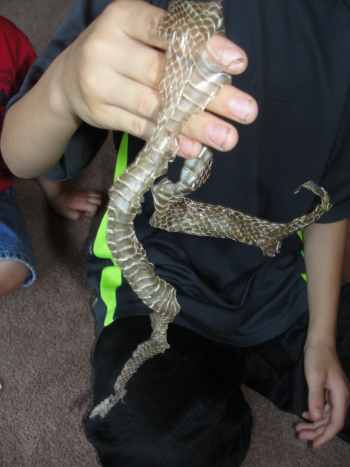
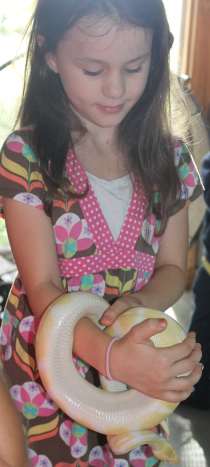

Examining a snake skin
1 / 3
Snakes (Squamata order / Serpentes suborder)
- Quickly discuss traits and fun tidbits about snakes while children either look at a live snake, dead snake, snake skin, and/or pictures of them from a book. Some options of what to say include:
- While looking at a snake or at snake skin, notice the difference between the scales on the top and bottom. Ask why they think God designed them that way. (The scutes on their bellies to give them traction to grip & slither across the ground, though sea snakes don’t have them so they’re helpless on land. The upper scales are like armor to protect it from predators.)
- Snakes don’t blink. Instead of eyelids they have transparent layer of skin over eyes, which sheds when they molt. Before molting, their eyes cloud over, impairing its sight.
- All snakes have teeth & they are thin & point backward. Why? (It holds prey in the mouth.) When a rattlesnake plans to strike, it extends its fangs. It folds them back when it doesn’t feel threatened. They also have about 6 pairs of reserve fangs to replace ones that break.
- Rattlesnakes grow a new rattle each time they molt, so you can guage their age by how long their rattle is.
- Venomous snakes in US: Rattlesnakes, copperheads, cottonmouths/water moccasins, & coral snakes (all found in our area). All but the coral snake have a triangular head. Most nonvenomous snakes in the US have a round head. – Show pictures if you have them.
- Coral snake: Discuss the rhyme: “Red touches yellow, kill a fellow. Red touches black, friend of jack.” – Show pictures of a coral snake, scarlet snake, & king snake.
- Venom is either a neurotoxin, interfering with muscles including the ones that control breathing – so you stop breathing, or hemotoxin, interfering with blood flow
- Sea snakes have paddle-shaped tails & tremendously poisonous venom, working instantly to paralyze prey. Of the 50 varieties, the beaked sea snake is most feared. One drop of its venom can kill 5 adults. Thankfully, no sea snakes live off the coasts of America. They live off the coasts of Australia, India & other parts of Asia
- Snakes can’t hear because they have no ear openings. They feel vibrations on the ground.
- They’re helpful in keeping populations of insects & rodents under control
- They flick their tongues to “taste” the air, moving air particles to its Jacobson’s organ on roof of its mouth
- Pit vipers can sense heat, so they can hunt in pitch darkness
- Constrictors: After striking, they loop their body around prey & tighten each time the prey inhales. Eventually, the prey can no longer breathe. Constrictors monitor the heart beating in its prey. Once the heart stops beating, it releases in order to eat its prey.
- Lower jaw is loosely attached to skull with ligament (connective tissue like a rubber band) so snakes can eat animals much larger than their mouths. They can go months without eating. — Show a picture of this.
YOU WILL NEED:
- pet snake, dead snake, snake skin, and/or a book showing snakes (I used Little Kids First Big Book of Reptiles and Amphibians by Catherine Hughes and Eyewitness: Reptile by Colin McCarthy.)
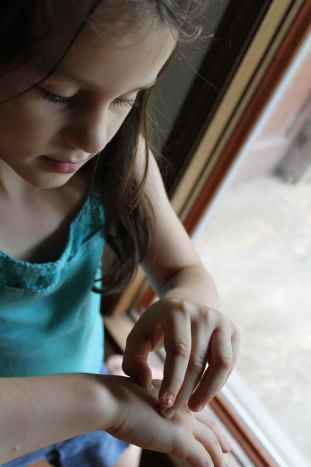
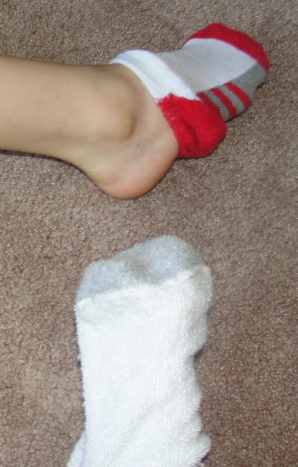


Shedding “skin” (dried Elmer’s glue) like a reptile
1 / 4
Molting
- Learn about molting.
- Squirt a small amount of liquid Elmer’s glue on the back of each child’s hand and tell them to smooth it out so that it is in a thin layer. Tell them to leave it there to dry.
- Almost all reptiles molt, or shed their skin, but we think about it most in regards to snakes because we sometimes find snake skins. Do you know why that is? (Many reptiles eat their shed skin but snakes do not.)
- Snakes don’t have fingers to peel their skin. How do you think they get off the old skin? (They shed their skin by rubbing their bodies against rocks or other surfaces.)
- Have children try to take off their sock without using their hands. They can rub their foot along the carpet.
- If you can no longer see your glue, it should be dry. Now it’s time to molt. Peel off the glue.
YOU WILL NEED:
- Elmer’s liquid glue
- extra children’s socks (just in case some children aren’t wearing socks)
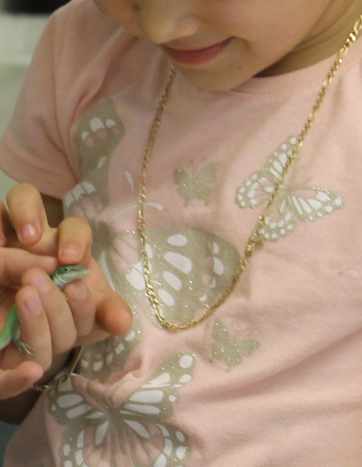
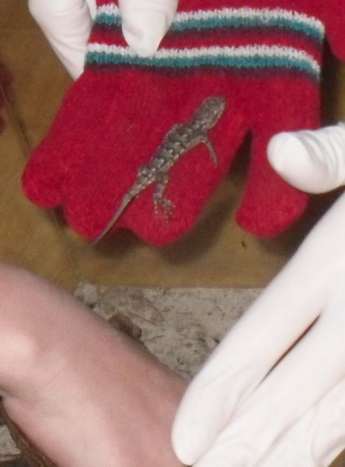
Petting and holding an anole lizard
1 / 2
Lizards (Squamata order / Lacertilia suborder)
- Quickly discuss traits and fun tidbits about lizards while children either look at a live lizard, toy lizard, and/or pictures of lizards from a book. Some options of what to say include:
- Unlike snakes, most lizards have ear holes, 4 legs with 5 digits, eyelids, & a tail that can break off & wiggle around to distract hungry predators (The tail does grow back.)
- Some are venomous: Gila monster, Mexican beaded lizard, bearded dragon, Komodo dragon, & monitor lizard
- Basilisk lizard/”Jesus lizard” can run across water
- Iguanas, anoles, chameleons, & agamas change color based on amount of light, time of day, desire to mate, or specific mood (& helps it camouflage itself)
- Many chameleons have one or more horns growing out of their heads
- Frill-necked lizards flare out the ruff on skin, hiss, & lunge as if to bite to scare off predators
- Anole lizards – most males have brightly colored flap of skin under throat called a dewlap used to attract a mate. Many are also sociable and can be kept as pets.
- Geckos can make a lot of noise, unlike most other lizards. Not all can climb but some can climb on any surface due to the amazing design of millions of hair-like projections called setae. Humans have tried to imitate that ability but haven’t yet been successful. Some geckos can clean their eyeballs with their tongues. Ask the children what they can reach with their tongues.
- Komodo dragons are the largest lizards, growing up to 10 feet long.
YOU WILL NEED:
- live lizard, toy lizard, and/or pictures of lizards from a book (I used Little Kids First Big Book of Reptiles and Amphibians by Catherine Hughes.)
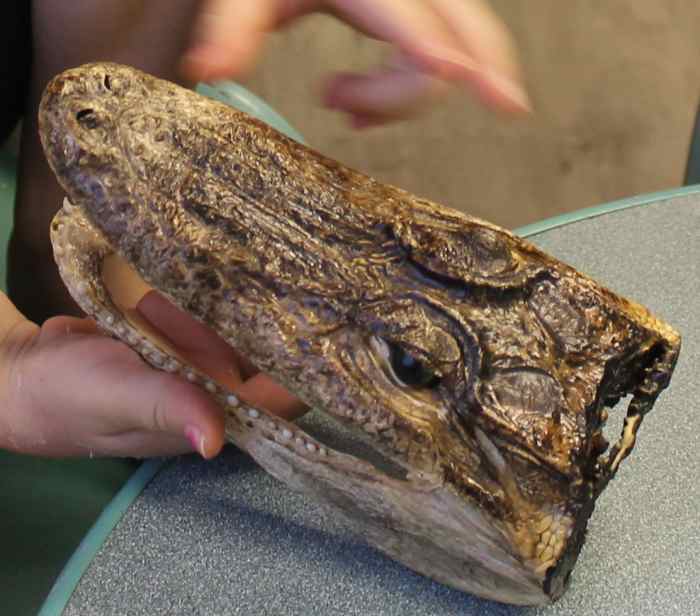
Examining a small alligator head
Alligators, Crocodiles, Gavials, & Caimans (Crocodilia order)
- Quickly discuss traits and fun tidbits about crocs while children either look at an alligator head or tooth, toy alligator, and/or pictures of crocs from a book. Some options of what to say include:
- Crocodiles (top & bottom teeth show, slender snout), alligators, (only top teeth show; rounder snout), caimans (very similar to alligators), & gavials (very long snout with bump at end)
- God designed with special underwater gear: Can open its mouth underwater to capture prey without getting a throat full of water because it has a special valve in the back of its throat that closes when underwater; they also have “swimming googles”, transparent lenses that slide over their eyes keeping them protected under water.
- They swallow stones (gastroliths) to grind up food & to add weight so they can stay submerged.
- The outside temperature determines the gender of the eggs. If it’s warm (above 95F), all the eggs will be males. If it’s a little cool (below 85F), all the eggs will be females. If the temperature is between 85F-95F, the eggs will have both males and females.
- After hatching from eggs, moms will carry the babies in her mouth to water. Most reptiles lay their eggs & then leave their babies to hatch and take care of themselves immediately. American alligators are unusual as they watch over their babies for about 2 years.
- The largest crocodile found recently was 28+ feet, though a fossilized crocodile was 40+ feet. – Show that distance on the ground.
YOU WILL NEED:
- alligator head or tooth, toy alligator, and/or pictures of crocs from a book (I used Little Kids First Big Book of Reptiles and Amphibians by Catherine Hughes and Eyewitness: Reptile by Colin McCarthy.)
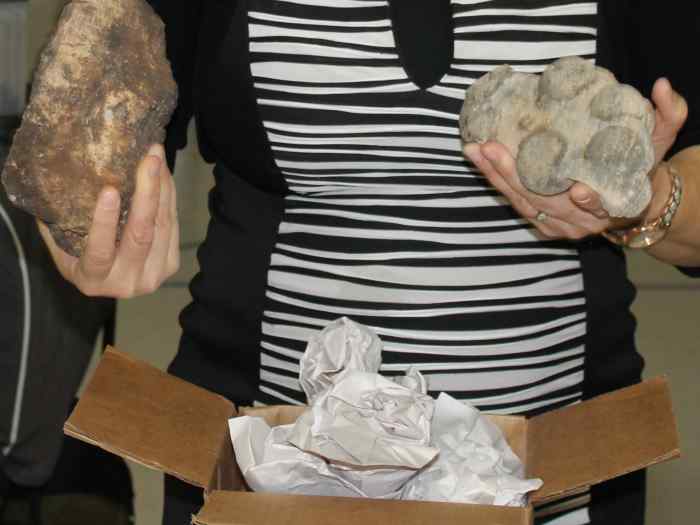
Fossilized dinosaur poop & eggs
Tuataras (Sphenodontia order), Dinosaurs, & Review
- Quickly discuss traits and fun tidbits about tuataras and about dinosaurs while children either look at fossilized dinosaur pieces (real or fake), toy dinosaurs, and/or pictures of a tuatara from a book. Some options of what to say include:
- Tuatara fossils have been found alongside dinosaur fossils. Paleontologists thought they were extinct, but in the late 1800s, they discovered tuataras are still alive and roaming New Zealand.
- Even though they look a lot like iguanas, scientists do not classify them as lizards because have they no ear holes & live in cooler weather. Many people make a big deal about them having a “third eye” that can detect light and heat, but some iguanas also have the same type of “third eye.”
- For a few thousand years people have found dinosaur fossils. In 1841 a British scientist decided to call them “dinosaurs” which means “terrible lizard”. They might be the same animals referred to as a behemoth in the Bible.
- They were created on the 6th day of creation along with all the other land animals. They existed the same time as people. Many were killed during the flood. We don’t know why most were killed off after the flood. Many current reptiles look like fossilized ones.
- A petroglyph in Utah from 1500 years ago shows a sauropod dinosaur. A petroglyph in Arizona is of a theropod. A tomb of Bishop Bell, built 500 years ago in England, has brass artwork of a sauropod. A T-rex fossil in Montana still had flexible tissue including blood vessels & blood cells, neither of which can survive for “millions of years.”
- Dinosaurs are not classified as lizards because of their leg structures. The legs of most lizards go out to sides but many dinosaur fossils show their legs were under their bodies rather than out to the sides.
YOU WILL NEED:
- fossilized dinosaur pieces (real or fake), toy dinosaurs, and/or pictures of a tuatara from a book
(Many of my “fun tidbits” of information came from Exploring Creation with Zoology 3: Land Animals of the Sixth Day (Young Explorer Series) by Jeannie K. Fulbright.)
- Five minute review of what we learned today.
Joke: Why couldn’t the reptile talk?
He had a frog in his throat!
Looking for More Books to Compliment This Lesson?
These are the additional books that we read and enjoyed while studying cold-blooded vertebrates.
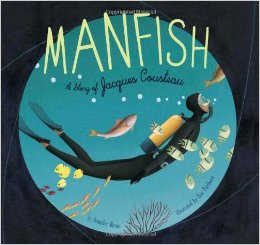
Manfish: A Story of Jacques Cousteau by Jennifer Berne – All images are from amazon.com.
More Great Books We Read & Used
Fish:
- “Manfish: A Story of Jacques Cousteau: by Jennifer Berne is a beautifully written and illustrated book about him. It has rhyming text. Even my 2 year old enjoyed this book. Also look for “The Fantastic Undersea Life of Jacques Cousteau” by Dan Yaccarino, which was our second favorite picture book biography on Cousteau.
- “The Magic School Bus Goes Upstream” by Joanna Cole
- “Salmon Stream” Carol Reed-Jones
- “The Underwater Alphabet Book” by Jerry Pallotta
- “Wish for a Fish” by Bonnie Worth
Amphibians:
- “Red-Eyed Tree Frog” by Joy Cowley
- “Starting Life Frog” by Claire Llewellyn
- “Tree Frog Hears a Sound” by Rebecca Johnson
- “Wanda and the Frogs by Barbara Azore
- “The Frog Alphabet Book” by Jerry Pallotta
Reptiles:
- “About Reptiles” by Cathryn P. Sill
- “How to Hide a Crocodile and Other Reptiles” by Ruth Heller
- “Who Lives in an Alligator Hole?” by Anne Rockwell
- “Snakes Are Hunters” by Patricia Lauber
- “Look Out for Turtles!” by Melvin Berger
- “The Yucky Reptile Alphabet Book” by Jerry Pallotta
- “Colorful Chameleons!” by Michelle Knudsen

The Voyage Beyond (Jonathan Park Radio Drama) Audio CD by Pat Roy and Douglas W. Phillips – Image credit: amazon.com
Audio Story We Used For This Lesson to Learn More About Fish
The Voyage Beyond (Jonathan Park Radio Drama) Audio CD by Pat Roy and Douglas W. Phillips – My entire family loves this extremely well-done Christian audio drama. We own the entire series and have listened to them numerous times. In this volume Jonathan Park and his family explore the depths of the ocean and see the marvelous designs of our Creator in the fish of the ocean and many other unique sea creatures…amidst the many exciting twists and turns in the face-paced plot. This mentions quite a bit about the classification of fish.
Joke: Why was the newt named Tiny?
Because he was my newt! (“minute”)
Our Favorite Video Clips: Tadpoles to Frogs *Also look for the BBC video clips on Reptiles & Amphibians
Life Cycle of a Frog
Bille Nye The Science Guy on Reptiles — Do note that this does have evolutionary ideas, but it also has fun and informational footage.
Metamorphosis: Amphibian Nature Documentary
Steve Irwin feeding Agro
Caecilians
Ready for the next lesson?
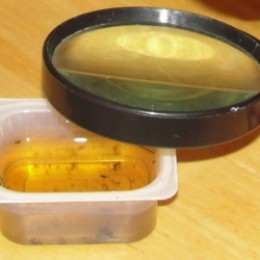
Examining life in pond water during Lesson 1: Taxonomy, Animal Classification, and Invertebrates Lesson
Examine pond water and yeast cells under a microscope, test out various insect mouths, dissect a fish, create an egg model, perform a play about mammals, present on a specific animal phylum or genius, and more during this fun 5 part hands-on unit study on animal classification!
- Taxonomy, Animal Classification, and Invertebrates Lesson – This is part 1 of a 5 part hands-on unit study on zoology. Examine pond water and yeast cells under a microscope, dissect an oyster, sing “The Six Kingdom Song,” eat 5 of the kingdoms on a supreme pizza, and more!
- Insects and Spiders Lesson – This is part 2 of a 5 part hands-on unit on zoology. Test out various insect mouth types, examine insect parts under a microscope, make and eat edible ants, test out spider webs for vibration, and more!
- Birds Lesson – This is part 4 of a 5 part hands-on unit on zoology. Create an egg model, make edible nests, test out various types of beaks, compare bird bones with mammal bones, examine various feathers, dissect a gizzard, sing a song about bird traits, and more!
- Mammals Lesson – This is part 5 of a 5 part hands-on unit on zoology. Perform a play about mammals, experience how blubber keeps marine mammals warm, sniff out your “baby,” examine animal skulls, dissect an owl pellet and piece together a rodent skeleton, and more!
- Zoology Presentations and Field Trip Ideas This describes the culminating activity for the 5 part hands-on unit on zoology. The children each presented on an assigned phylum, class, or order of animals. They also sang some of the animal classification songs and enjoyed an animal-themed meal. (Recipes are included.) Also included are the field trips we attended during this unit.
© 2011 Shannon
Which Is Your Favorite Reptile or Amphibian? – Or just leave me a note. I love getting feedback from you!
anonymous on November 14, 2011:
enjoyed your lens tonight, thank you for sharing, blessed and liked.
JoyfulPamela2 from Pennsylvania, USA on March 31, 2011:
Very cool ideas! Adding this to our reptile / amphibian lens for our future studies. Thanks! =D
anonymous on March 15, 2011:
Great job, Shannon!
Leave a Reply